
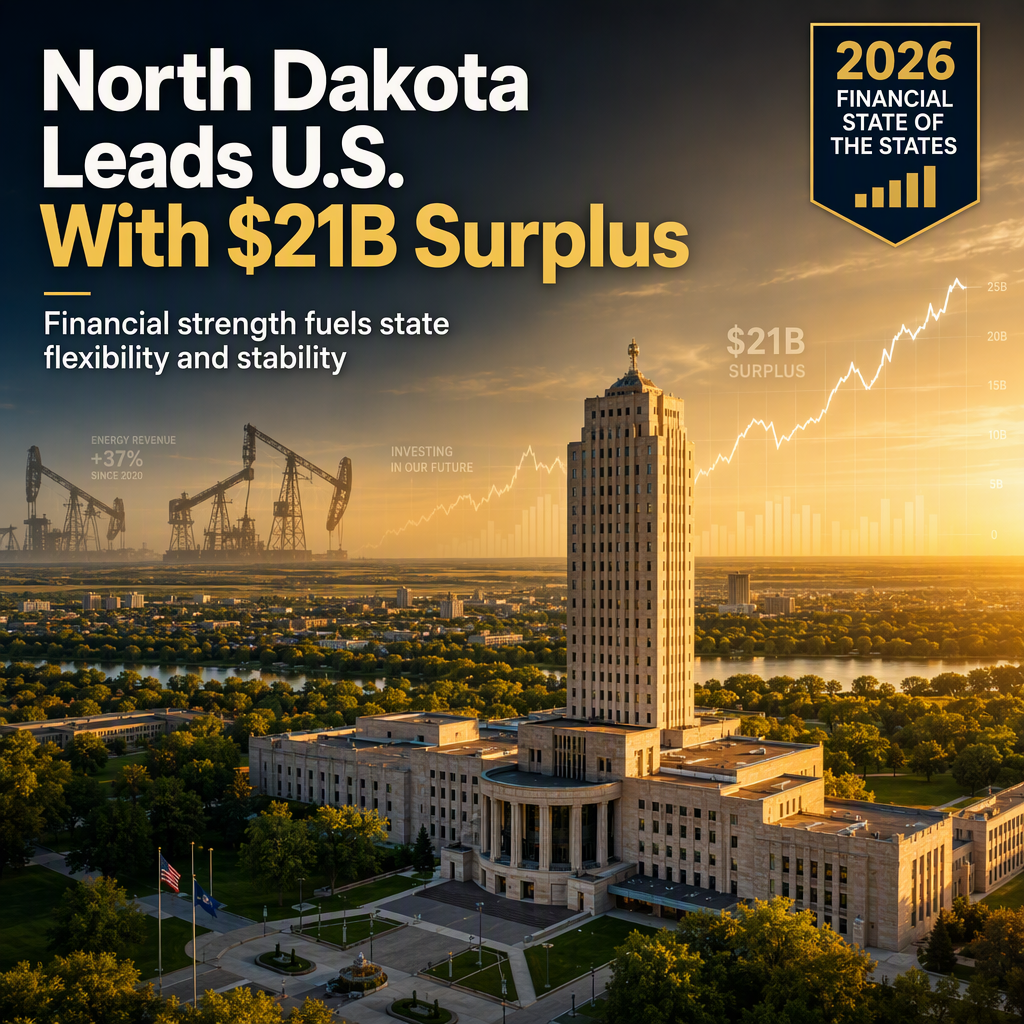
North Dakota has emerged as the leading U.S. state in financial health, according to Truth in Accounting's 2026 Financial State of the States report, ending fiscal year 2025 with a $21 billion surplus—more than enough to cover its financial obligations [1]. This surplus translates to a 'Taxpayer Surplus' of $72,300, the highest in the nation, though this figure represents each taxpayer's share of the state's surplus rather than a direct payout [1]. North Dakota's strong financial position is attributed to its oil boom, which has generated billions in tax revenue, and the state's Legacy Fund, an investment fund built from oil tax proceeds [1]. Despite declines in oil, gas, and coal tax revenues due to lower energy prices, robust investment earnings and federal grant revenue helped offset these drops [1].
The report highlights a stark divide among states: 24 out of 50 states do not have enough assets to cover their bills, with New Jersey ranking last with a $162.3 billion shortfall and a 'Taxpayer Burden' of $45,800—the highest in the country [1]. Other states with strong surpluses include Alaska, Wyoming, Utah, and Tennessee, with taxpayer surpluses ranging from $11,400 in Tennessee to $72,300 in North Dakota [1]. In contrast, the bottom five states—New Jersey, Connecticut, Illinois, Massachusetts, and California—face taxpayer burdens ranging from $16,000 to $45,800 [1].
Long-term retirement obligations remain a significant pressure on state finances nationwide. The report notes that states collectively held $775 billion in unfunded pension liabilities and $490 billion in unfunded retiree health care obligations in fiscal 2025 [1]. However, most states saw financial improvement in 2025, as strong investment returns boosted pension assets and helped reduce unfunded pension obligations. Truth in Accounting cautioned that these gains could reverse if markets decline [1].
The financial strength of states like North Dakota provides them with greater flexibility to weather economic downturns, maintain public services, and meet retirement obligations, while states with large unfunded debts may face difficult decisions regarding taxes, spending, and borrowing during periods of revenue shortfall [1].
CONCLUSION
North Dakota's robust surplus and top financial ranking underscore the benefits of strong investment returns and prudent fiscal management, especially amid fluctuating energy revenues. While most states improved their financial positions in 2025, significant disparities remain, with nearly half unable to cover their obligations. The report highlights the importance of sound fiscal policy and investment performance for long-term state financial health.