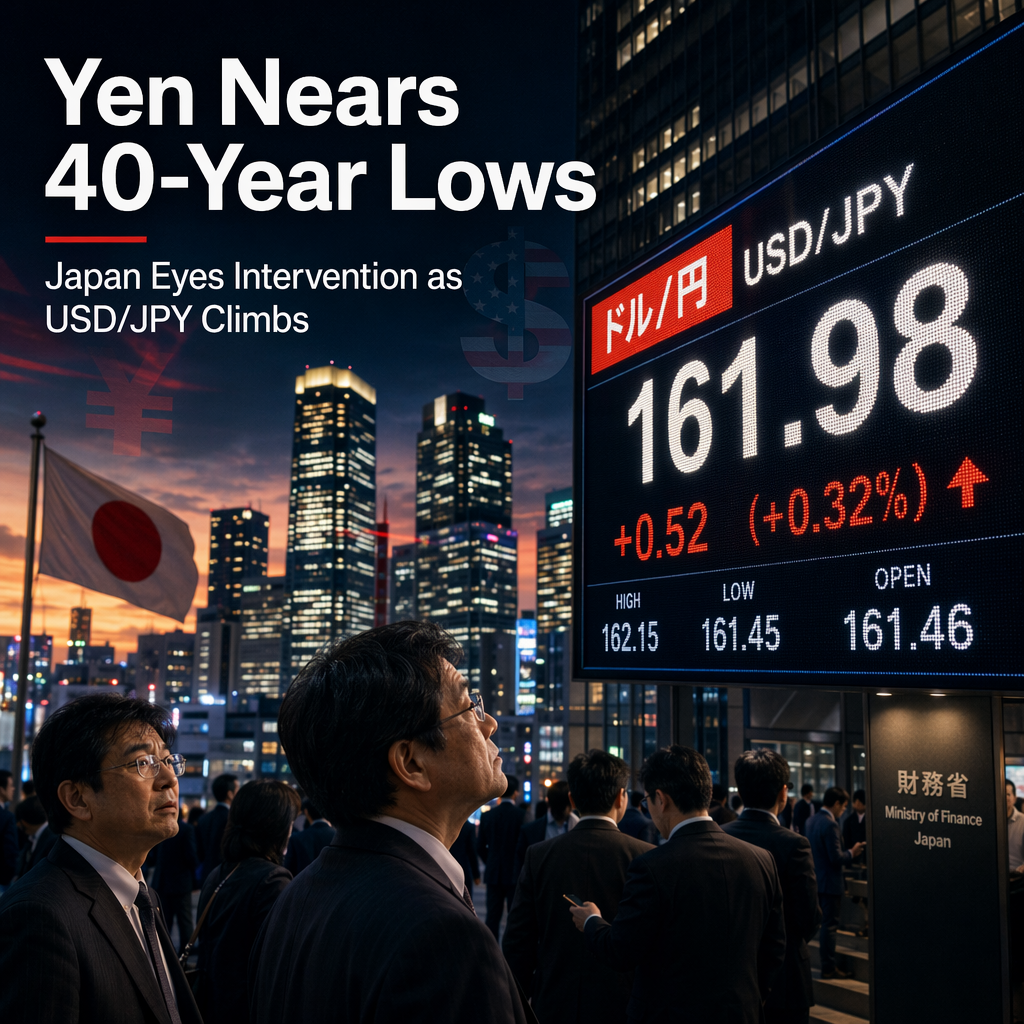
The Japanese Yen weakened against the US Dollar on Monday, with the USD/JPY pair dropping to a low of 161.07 after previously trading near 161.90, close to its highest level in approximately 40 years [1]. This movement comes amid heightened vigilance from Japanese officials, who have repeatedly stated they are closely monitoring currency markets due to the Yen's depreciation and the risk of intervention if the pair approaches the 162.00 level [1]. The recent price action follows USD/JPY's highest weekly close in about four decades, underscoring the significance of the current exchange rate levels [1].
The Greenback's yield advantage continues to support the USD/JPY pair, but the proximity to 162.00 increases the likelihood of either verbal or direct intervention from Japanese authorities, which could trigger sharp pullbacks even if the overall trend remains upward [1]. Market participants are also focused on the upcoming US Personal Consumption Expenditures Price Index (PCE), scheduled for Thursday. A stronger-than-expected PCE reading could reinforce expectations that the Federal Reserve will maintain restrictive monetary policy for a longer period, potentially supporting further gains in USD/JPY. Conversely, a softer PCE print may prompt traders to take profits after the pair's recent rally [1].
From a technical perspective, USD/JPY is trading at 161.35, maintaining a bullish bias as it remains above the 20-period Simple Moving Average (SMA) at 161.12 and the 100-period SMA at 160.27. The pair is also above horizontal support at 161.16, while the Relative Strength Index (RSI) has eased to around 59, indicating that bullish momentum is moderating but not reversing after recent overbought conditions [1]. Key resistance levels are identified at 161.58, 161.77, and the recent cap near 161.92, while a break below 161.16 could expose the 20-period SMA at 161.12 and the 100-period SMA at 160.27 as support levels [1].
CONCLUSION
The Japanese Yen's retreat and the USD/JPY's approach to a four-decade high have heightened market sensitivity to potential intervention by Japanese authorities. With the upcoming US PCE data in focus, traders are closely watching for signals that could influence both monetary policy expectations and currency volatility.