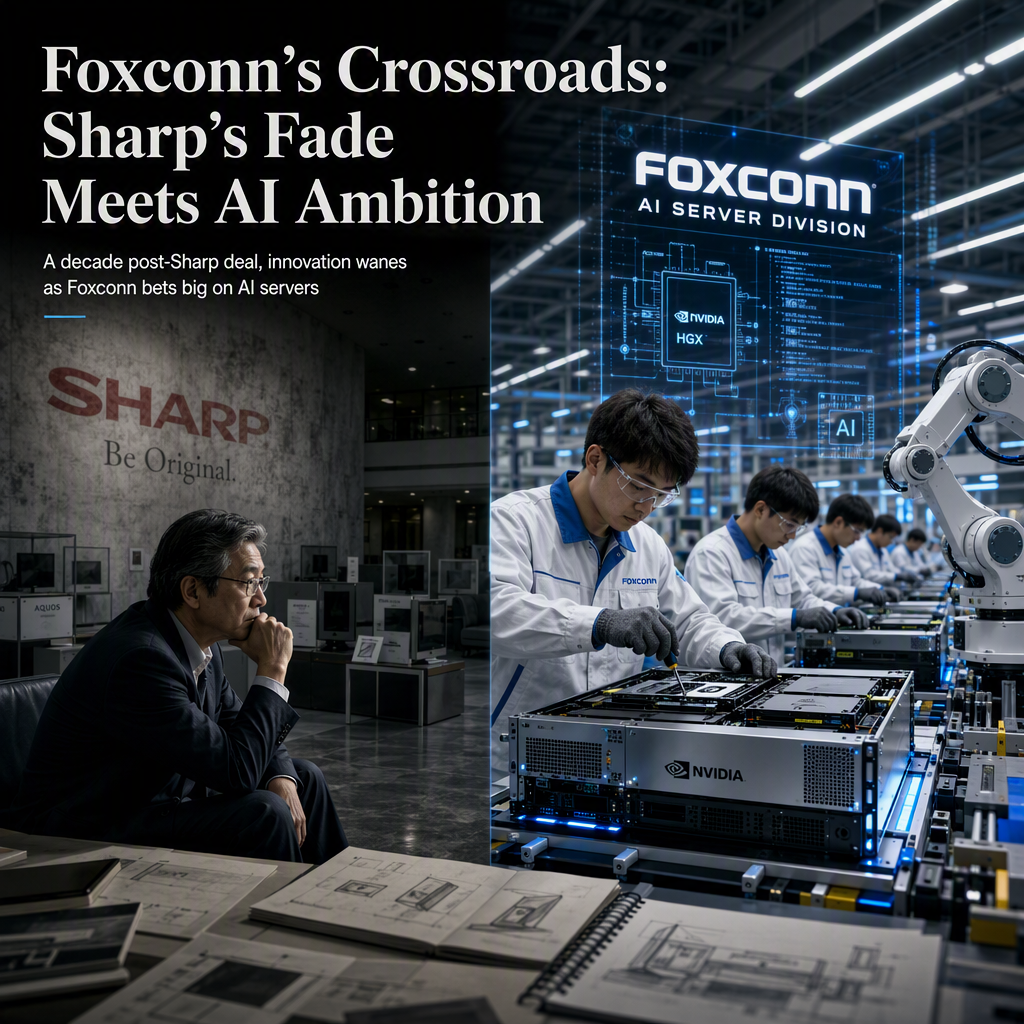
Foxconn, also known as Hon Hai Precision Industry, is at the center of two contrasting narratives as it marks a decade since acquiring Japanese electronics maker Sharp and simultaneously asserts its confidence in the competitive AI server market. Former Sharp President and Chairman Katsuhiko Machida reflected on the 2016 acquisition, describing the past ten years under Foxconn's ownership as 'negative' for Sharp. Machida criticized the shift away from Sharp's historical focus on unique product innovation, stating, 'The mindset of a contract manufacturer was different from that of a company that attached importance to design and new products.' He noted that Sharp's sales and profits have not returned to pre-acquisition levels, and investment in research and development has declined. Machida also highlighted Sharp's diminished leadership in home appliances and display technologies, expressing concern over the company's reduced presence in the global electronics market and its transition from trendsetter to follower [1].
In contrast, Foxconn's leadership projects optimism regarding its position in the rapidly growing AI server sector. Michael Chiang, Foxconn's newly appointed rotating CEO, told investors that the company's large manufacturing scale and integrated supply chain are key advantages that will help it increase market share, particularly with the introduction of Nvidia's new modular AI server platform. Chiang emphasized Foxconn's close collaboration with Nvidia and its ability to quickly adapt to new technologies as factors that will help the company maintain and expand its market share despite rising competition. While no specific financial figures or market share percentages were disclosed, Foxconn reiterated its commitment to investing in advanced manufacturing processes and maintaining its leadership in the AI server segment [2].
The two perspectives underscore a strategic divergence within Foxconn's portfolio. While the Sharp acquisition is viewed critically by former leadership due to perceived declines in innovation and market position, Foxconn's management remains bullish on its prospects in the AI server market, citing operational strengths and industry partnerships as drivers of future growth [1][2].
CONCLUSION
Foxconn's decade-long stewardship of Sharp is viewed negatively by former Sharp leadership, citing lost innovation and market standing. Meanwhile, Foxconn expresses strong confidence in its AI server business, highlighting manufacturing scale and partnerships as competitive advantages. The contrasting outlooks reflect both the challenges and opportunities facing Foxconn as it navigates different segments of the electronics industry.