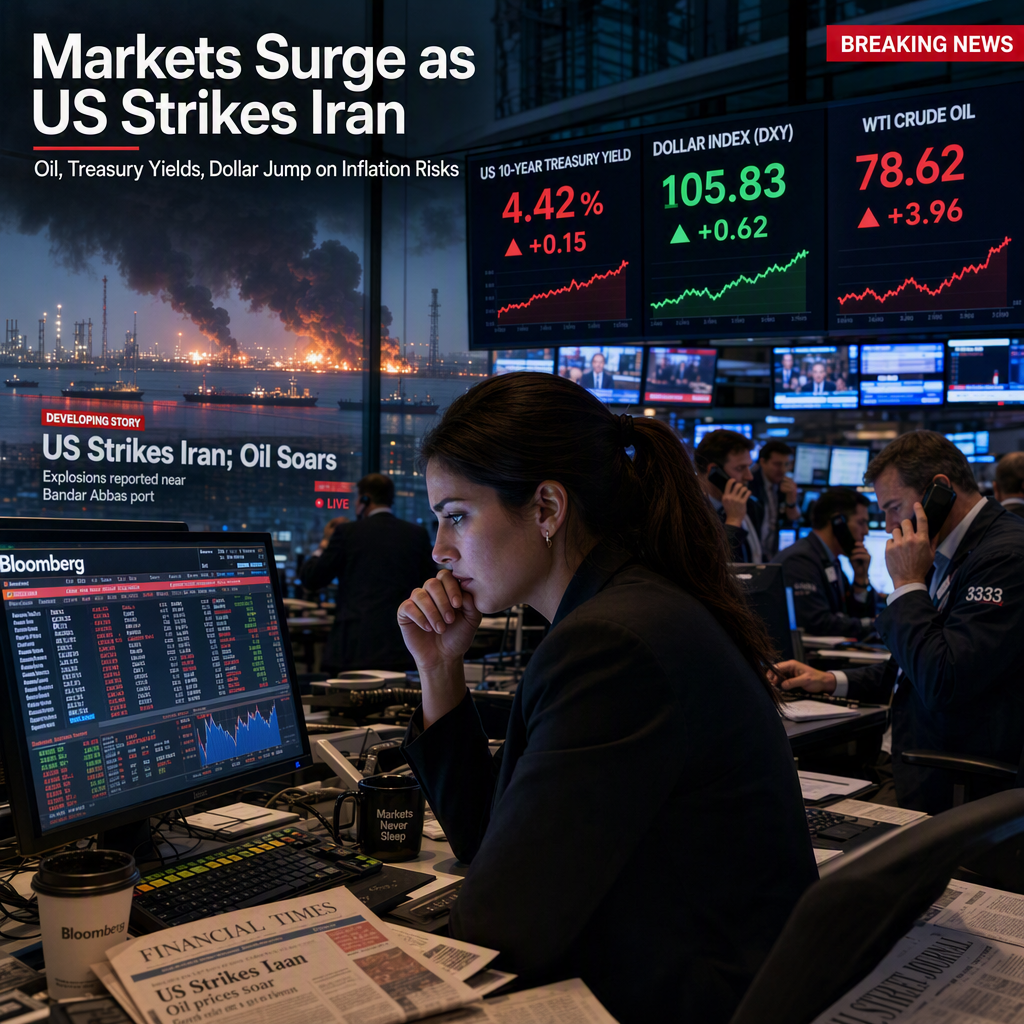
Global financial markets reacted sharply to escalating tensions between the United States and Iran, as American forces began striking Islamic Revolutionary Guard Corps (IRGC) targets inside Iran, with explosions reported on Qeshm Island and in the southern cities of Bandar Abbas and Chabahar [3]. US President Donald Trump confirmed the operation, warning of further retaliation if Iran responds [3]. The conflict, now six months old, has contributed to depleted oil inventories and heightened supply-chain pressures, raising concerns about energy price risks and their impact on inflation [1][3].
Oil prices surged, with West Texas Intermediate (WTI) reaching $88.70 per barrel, its highest level since July 24, as the market responded to the military escalation and the risk of further disruptions in the Strait of Hormuz [3]. NBC strategists highlighted that the fragile advance in global equities, including the MSCI ACWI, is vulnerable to renewed inflation shocks, particularly given generational-high government bond yields and persistent fiscal deficits across major economies [1].
US Treasury yields rose significantly, with the 10-year yield trading near 4.79%-4.80%, its highest since January 2025, and the two-year yield climbing to 4.39% [2][3]. The 30-year yield returned to 5.28%, reversing the effects of the Treasury Department's expanded buyback operation [2]. The yield curve movement was led by the front end, reflecting market expectations for higher rates rather than a typical war-risk premium, with futures pricing a 68% probability of a rate hike at the September 15-16 Federal Reserve meeting and a 95% probability for the October 28 meeting [2][3].
The US Dollar Index (DXY) gained 0.30% to 99.71, supported by safe-haven flows and hawkish Fed expectations, despite softer US economic data such as the ISM Manufacturing PMI falling to 54.6 in August and JOLTS Job Openings rising to 7.271 million but missing forecasts [3]. Fed Chair Kevin Warsh’s tough rhetoric at the Jackson Hole Symposium and persistent inflation concerns have revived expectations of imminent rate hikes [3]. NBC strategists warn that higher energy prices could slow inflation normalization, prompting markets to scale back expectations for monetary easing and keeping long-term yields elevated [1].
Attention now turns to upcoming US employment data, including the ADP Employment Change report and Nonfarm Payrolls, which could further influence rate hike expectations and the Dollar’s trajectory [3].
CONCLUSION
Escalating US-Iran tensions have triggered a surge in oil prices, US Treasury yields, and the Dollar, as markets price in heightened inflation risks and a more hawkish Federal Reserve stance. The fragile outlook for equities and persistent fiscal concerns underscore the vulnerability of global markets to renewed shocks. Upcoming US employment data will be crucial in shaping further market expectations for monetary policy and risk sentiment.