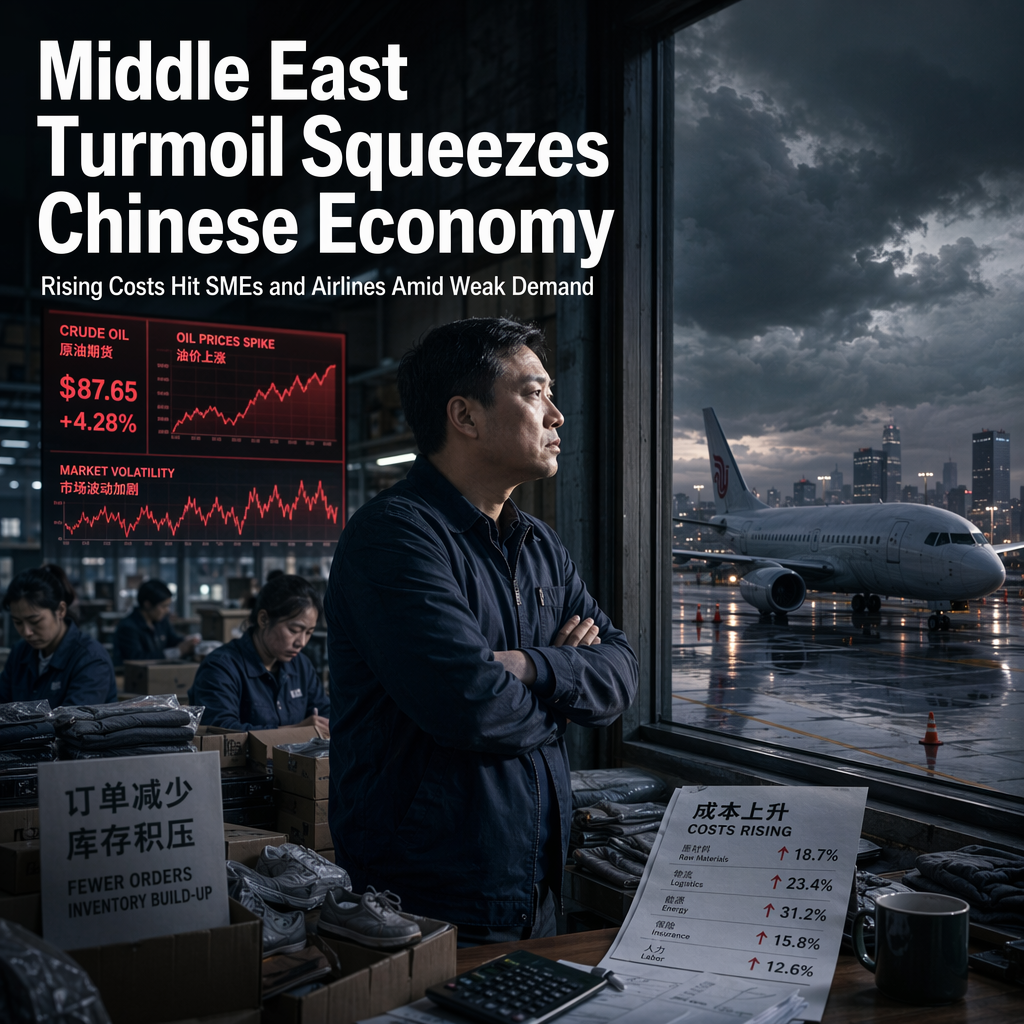
China's economy is facing mounting pressure as both small and medium-sized enterprises (SMEs) and the country's largest airlines struggle with rising costs and weak demand, largely due to the ongoing war in the Middle East. SMEs are finding it increasingly difficult to raise prices, as competition for limited consumer demand remains fierce and inventory levels continue to rise. The Iran war has intensified supply chain disruptions, pushing up input costs for many sectors. However, these businesses are unable to pass on higher costs to consumers, resulting in thinner profit margins and growing concerns about potential closures and layoffs, which could further dampen domestic demand and consumer sentiment [1].
Meanwhile, China's three major state-owned airlines—China Southern, Air China, and China Eastern—are bracing for deeper first-half net losses compared to last year, attributing their financial woes primarily to surging fuel prices caused by the Middle East conflict. China Southern Airlines expects to report the largest loss, with net losses reaching up to $1.33 billion for the first half of the year. The volatility in oil prices has eroded gains from increased passenger traffic, and all three carriers are reviewing operational costs and capacity management in response to the challenging environment [2].
Market analysts highlight that the war in the Middle East has disrupted global energy supplies, leading to a spike in jet fuel prices and directly impacting the profitability of major Chinese airlines. The sector's outlook remains cautious, with analysts warning that continued instability in fuel prices could result in further losses in the second half of the year. Technical analysis indicates that airline stocks are likely to face ongoing resistance until geopolitical tensions subside [2].
For SMEs, analysts warn that the ongoing pressure could lead to more business closures and layoffs, exacerbating the supply-demand imbalance and making price recovery difficult in the near term. The persistent inventory buildup and inability to raise prices underscore the challenges facing China's domestic economy [1].
CONCLUSION
Both China's SMEs and major airlines are under significant financial strain due to rising costs linked to the Middle East conflict and weak domestic demand. Market sentiment is subdued, with analysts warning of continued losses and a challenging outlook unless geopolitical and energy market conditions improve. The situation signals high market impact and ongoing uncertainty for key sectors of the Chinese economy.