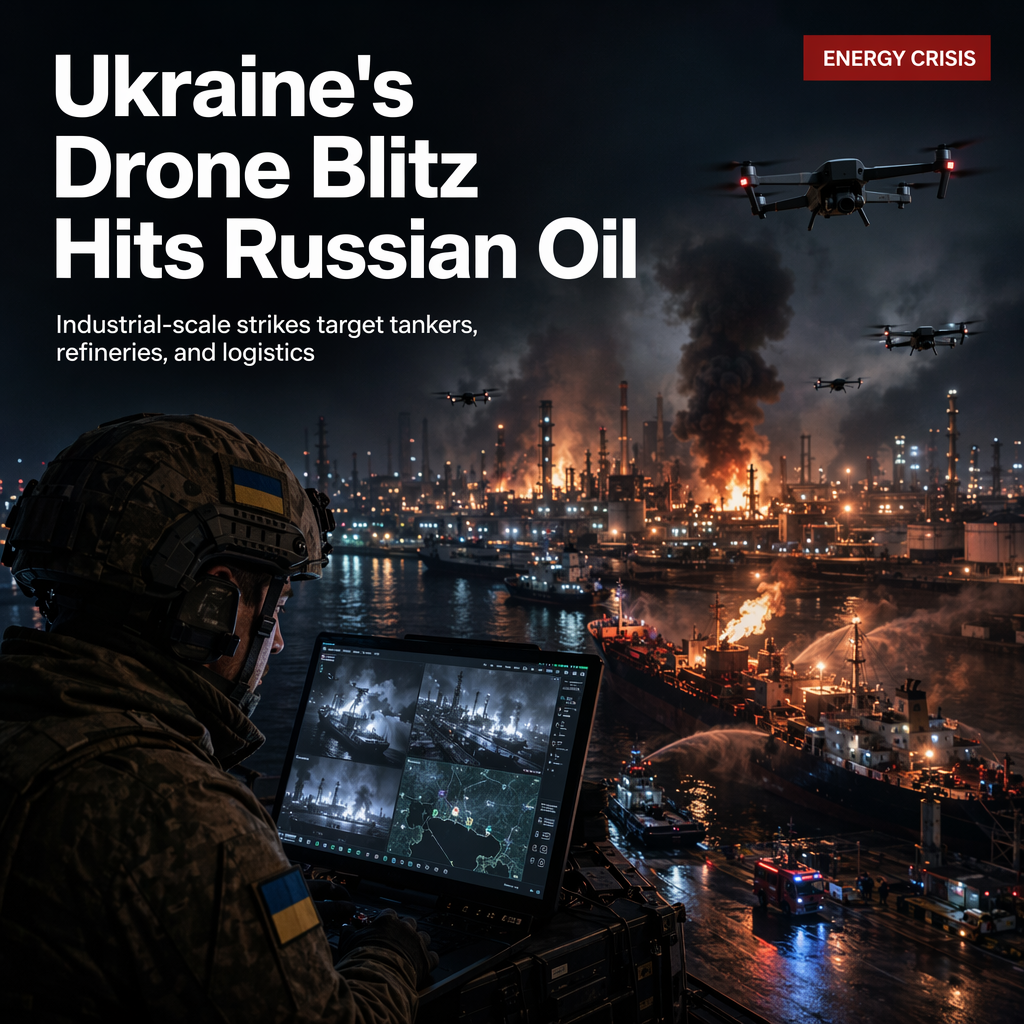
Ukraine executed one of its largest recent drone offensives against Russia’s maritime and energy infrastructure this week, targeting 21 vessels over three days and intensifying attacks on major refineries deep inside Russian territory [1]. The Ukrainian Unmanned Systems Forces reported that nine Russian-linked vessels were struck in the Sea of Azov on Wednesday, bringing the total number of targeted vessels to 21 within a 72-hour period [1]. Commander Robert 'Magyar' Brovdi specified that the targets included 19 oil tankers, a cargo ship, and a ferry operating near Russian-occupied Crimea, describing the campaign as reaching an 'industrial scale' [1].
Both Ukrainian and Russian officials confirmed that the overnight offensive targeted tankers, refineries, pipeline facilities, and a military airfield across several Russian regions [1]. Ukraine claims that many of the vessels were part of Russia’s so-called shadow fleet, used to transport fuel to Crimea, which was annexed by Moscow in 2014 [1]. The strikes were accompanied by attacks on the Saratov refinery and energy facilities in the Russian regions of Tatarstan, further disrupting fuel production and maritime logistics in areas previously considered insulated from the conflict [1].
The timing of the offensive coincided with President Volodymyr Zelenskyy’s meeting with President Donald Trump at the NATO summit in Ankara, where discussions focused on air defense and a potential drone agreement between the United States and Ukraine [1]. Zelenskyy emphasized air defense as his top priority and described the emerging drone deal as 'a very good beginning,' expressing hope for further discussions [1]. Trump praised Zelenskyy’s leadership and credited Ukrainian forces with effectively using American-supplied equipment against Russia’s larger military [1].
While Ukraine has not achieved a comparable breakthrough on the ground, these repeated long-range strikes are beginning to disrupt Russian fuel production and maritime logistics, imposing costs on infrastructure previously shielded from the war [1].
CONCLUSION
Ukraine’s large-scale drone offensive marks a significant escalation in its ability to target Russian energy and maritime assets, with confirmed strikes on oil tankers, refineries, and other infrastructure. The attacks coincide with high-level talks on enhanced air defense cooperation with the United States, signaling both immediate and potential future impacts on Russia’s fuel supply chain and broader market stability.