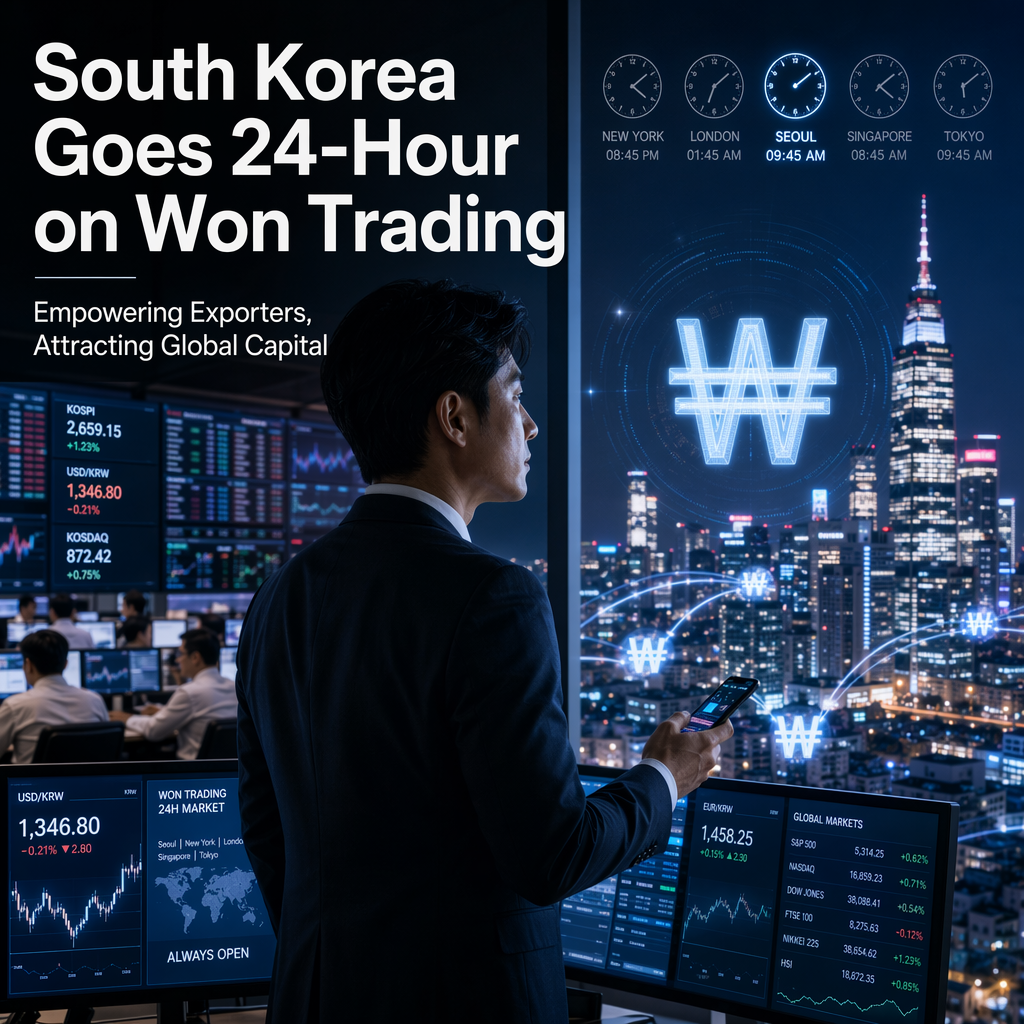
South Korea has initiated near 24-hour trading of its currency, the won, starting Monday, marking a significant shift in its foreign exchange policy and aiming to reduce the country's historical vulnerability to global currency shocks [1]. This reform is expected to benefit major exporters, particularly chipmakers and technology companies, by providing greater flexibility in hedging exchange rate risks and improving pricing strategies [1]. Previously, the won was only traded during limited hours, which exposed Korean firms to sharp overnight moves in global currencies; the new policy aligns South Korea with other major economies and is intended to mitigate the 'currency trauma' experienced since the Asian financial crisis [1].
Market participants have welcomed the change, highlighting improved responsiveness to global market developments and enhanced competitiveness for Korean firms [1]. An executive at a major South Korean exporter described the reform as 'long-awaited' and beneficial for leveling the playing field in global markets [1]. Financial analysts anticipate that increased liquidity and price transparency in the won market could attract more foreign investors and contribute to greater currency stability [1]. Technical analysts are monitoring the market for increased short-term volatility but expect a more stable environment over time [1].
Exporters, especially in the semiconductor sector, are projected to gain from enhanced risk management capabilities and the ability to secure favorable exchange rates at any time [1]. The Bank of Korea and the Ministry of Economy and Finance have committed to closely monitoring the market and intervening if excessive volatility threatens financial stability [1]. This policy shift is part of broader efforts to internationalize the won and reflects South Korea's growing economic influence and integration with global markets [1].
CONCLUSION
South Korea's move to 24-hour won trading is a major reform aimed at supporting exporters, attracting foreign investment, and stabilizing the currency. Market participants and analysts expect short-term volatility but anticipate long-term benefits in liquidity, transparency, and competitiveness. The government has pledged to monitor the market closely to ensure financial stability.