
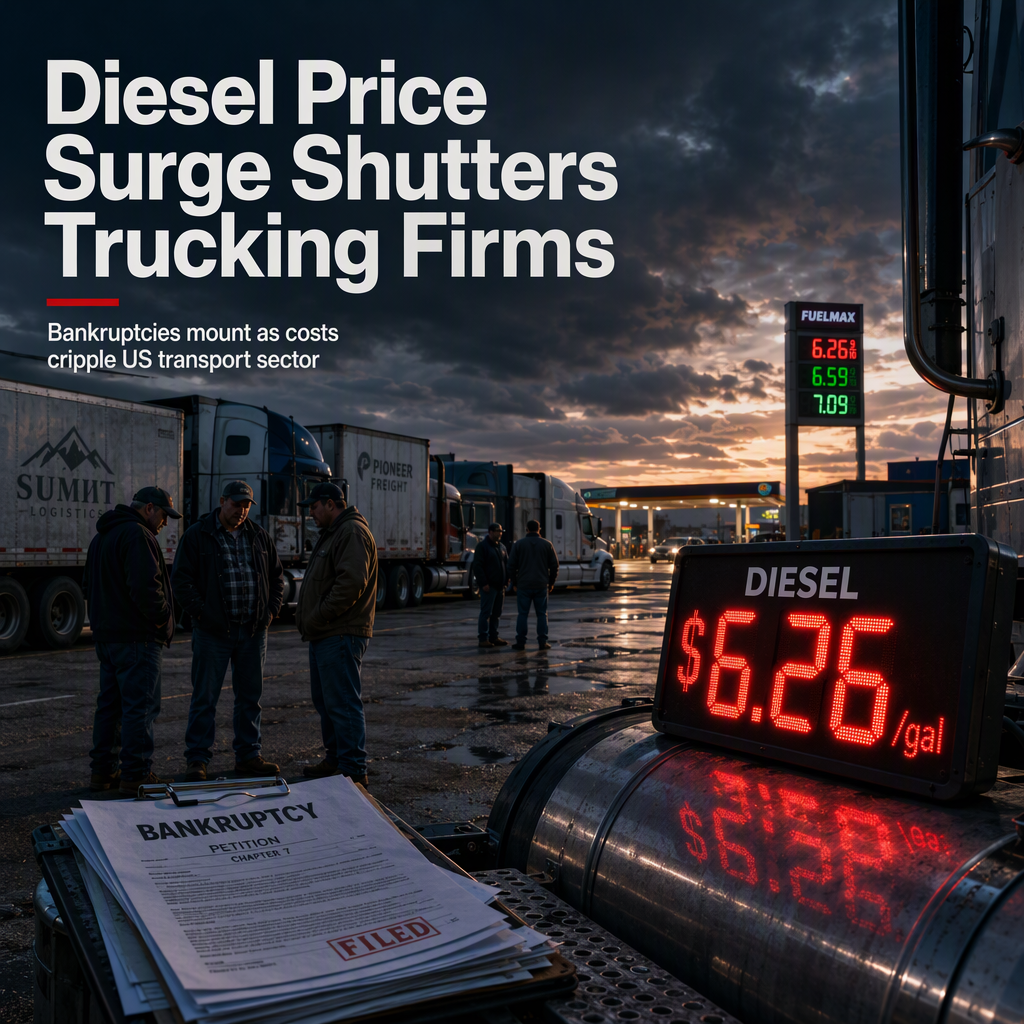
In September, at least eight trucking and freight companies filed for Chapter 11 bankruptcy protection, highlighting significant distress within the U.S. transportation sector as operating costs surge [1]. Notable filings include Globemaster Incorporated, which reported approximately $1.1 million in assets against $3.26 million in liabilities, and CLJ Transporting Inc., with $483,205 in assets and $823,161 in liabilities, both filing under Subchapter V for small business reorganization on September 15 [1]. Pacer Transport Inc. filed on September 4, estimating less than $50,000 in assets and between $1 million and $10 million in liabilities, while Jett Transport & Materials LLC and Mill Creek Logistics–Illinois Inc. also filed mid-month, reporting significant asset-liability gaps [1].
The filings are attributed to mounting operational costs, particularly higher diesel and insurance expenses. Marcus Overcast, owner of Truckload LLC, cited diesel and insurance costs as key factors in his company's bankruptcy, with insurance being the most significant pressure [1]. Diesel prices were reported at approximately $6.26 per gallon at a Flying J truck stop in Orange, Texas, underscoring the financial strain on trucking companies [1].
In response to the crisis, President Donald Trump signed an executive order this week permitting the temporary use of red-dyed diesel, typically reserved for off-road use, on highways to provide relief to truckers facing high fuel costs [1]. The administration attributed the spike in diesel prices to tight global supplies and limited refining capacity, referencing the Russia-Ukraine war and refinery closures in Democrat-led states as contributing factors [1].
No analyst opinions or forward-looking statements were provided in the article. However, the wave of bankruptcies and government intervention signal significant market disruption and ongoing challenges for the trucking industry [1].
CONCLUSION
A surge in diesel and insurance costs has led to a string of trucking company bankruptcies in September, prompting emergency government action to ease fuel expenses. The market impact is high, with the industry facing ongoing financial pressures and uncertainty. No analyst outlooks were provided, but the situation underscores acute vulnerability in the sector.