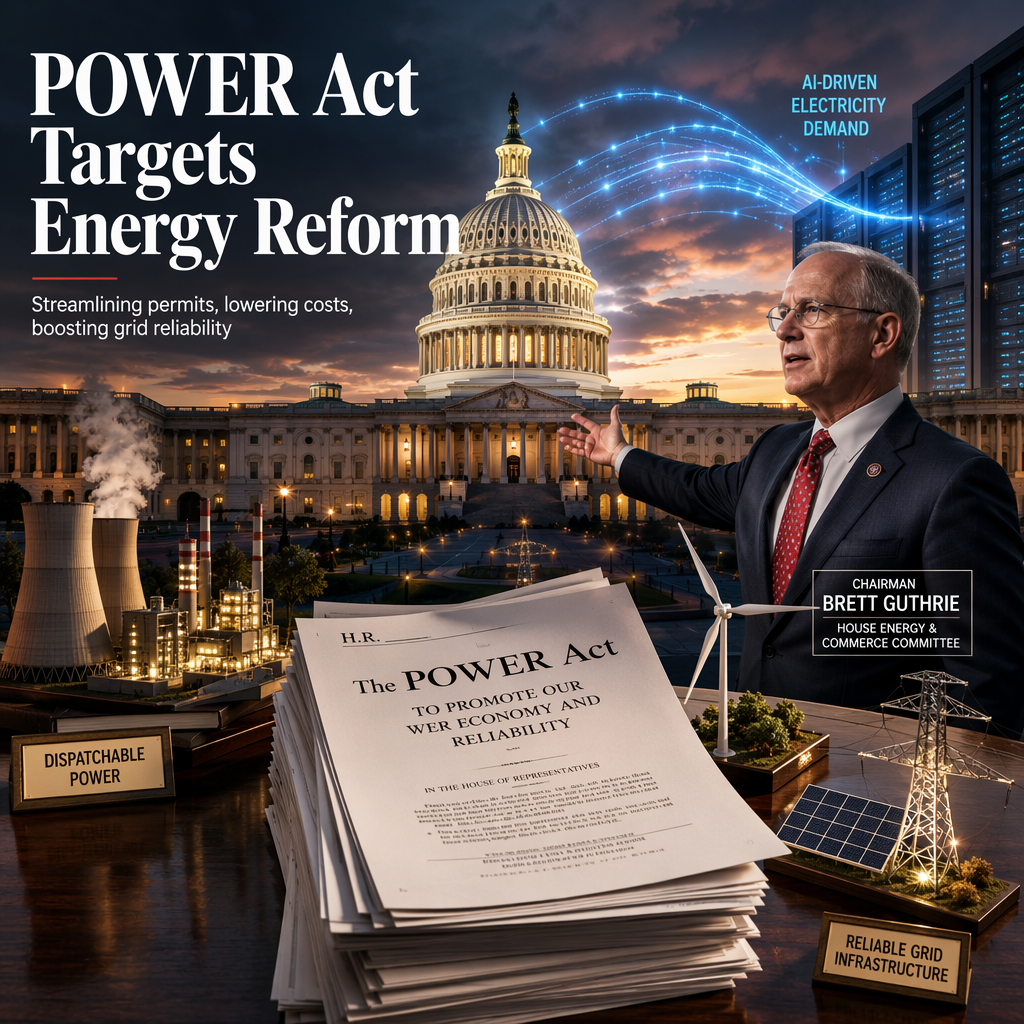
House Republicans have introduced the 'Permitting Our Way to an Energy Resurgence (POWER) Act,' a comprehensive 96-page legislative package designed to lower energy costs, strengthen grid reliability, and accelerate the construction of new energy projects [1]. The bill, introduced by House Energy and Commerce Committee Chairman Brett Guthrie, R-Ky., is described as a 'discussion draft' and combines nearly 20 Republican proposals aimed at streamlining approvals for pipelines, transmission lines, power plants, and manufacturing projects [1].
A key focus of the legislation is addressing the rapidly growing electricity demand driven by artificial intelligence data centers. The bill seeks to protect ratepayers from price hikes by requiring data centers to cover the costs of grid upgrades [1]. Additionally, the POWER Act would prioritize dispatchable power plants over intermittent sources like wind and solar in interconnection queues, expand federal regulators' authority to keep power plants online, and overhaul portions of the Clean Air Act [1].
One of the most significant provisions comes from Rep. Troy Balderson, R-Ohio, whose Reliable Power Act would require federal agencies to submit major actions affecting electricity generation to the Federal Energy Regulatory Commission for review, ensuring such actions do not negatively impact grid reliability [1]. Guthrie emphasized that the package is the result of months of collaboration among GOP committee members and aims to cut regulatory 'red tape,' protect families from higher electricity costs, and support American innovation and growth [1].
The introduction of the POWER Act occurs amid ongoing bipartisan negotiations over permitting reform, which have yet to yield consensus despite widespread recognition of the need for changes to the federal permitting process. It remains unclear whether House GOP leaders will bring the package to a floor vote before the midterm elections, with fewer than two dozen legislative days remaining before November [1].
CONCLUSION
The POWER Act represents a significant Republican effort to reform energy permitting, lower costs, and address grid reliability concerns, particularly in light of rising electricity demand from AI data centers. While the bill consolidates multiple GOP proposals and seeks to streamline regulatory processes, its legislative future remains uncertain amid ongoing bipartisan negotiations and a limited congressional calendar.