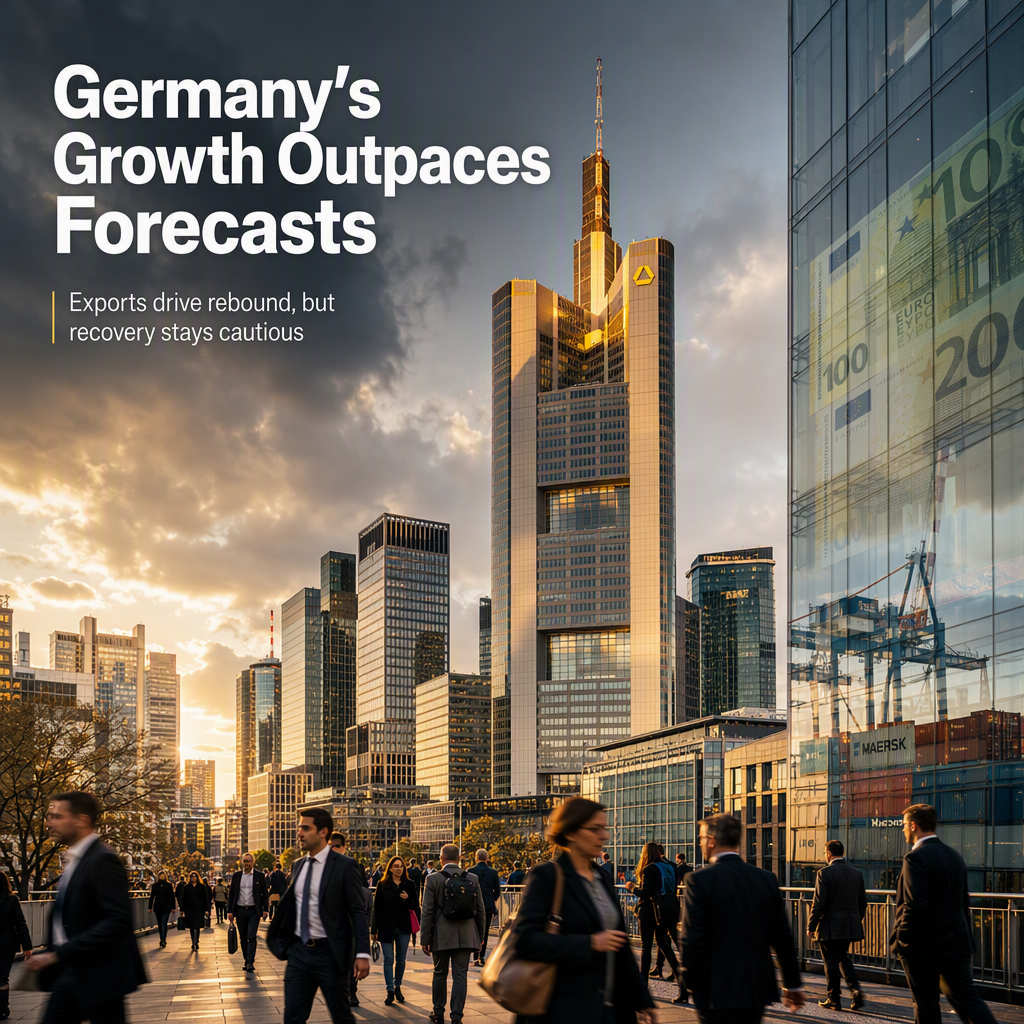
According to Commerzbank’s Dr. Ralph Solveen and colleagues, the German economy has shown stronger-than-expected growth, with GDP expanding by approximately 0.35% per quarter over the last three quarters, primarily driven by increased exports to EU partners [1]. The latest GDP figures, released last Tuesday, indicate that economic output in the second quarter was even higher than previously assumed, contributing to this positive trend [1].
Despite these encouraging results, the report highlights that private investment remains weak, having declined again in the second quarter, and government investment has not yet shown a sustainable increase despite the availability of special funds [1]. Commerzbank’s Early Bird leading indicator and improved business sentiment suggest that the recovery is likely to continue, with businesses expressing somewhat more positive expectations recently [1].
There are slight upside risks to Commerzbank's current growth forecast of 1% for the year, given the upward revision to second-quarter figures and expectations for a less weak third quarter [1]. However, uncertainty persists regarding the impact of the conflict in the Middle East on energy prices, which could influence future growth prospects [1].
Overall, while recent developments have generally exceeded expectations, Commerzbank notes that there is still no sign of a self-sustaining recovery, as a significant increase in private investment is necessary for more robust growth. As a result, German economic growth is expected to remain moderate in the coming quarters [1].
CONCLUSION
Germany’s GDP growth has outperformed expectations, mainly due to stronger exports, but weak private investment continues to limit the pace of recovery. Commerzbank anticipates that growth will remain moderate, with some upside risk to forecasts but ongoing uncertainty from external factors such as energy prices.