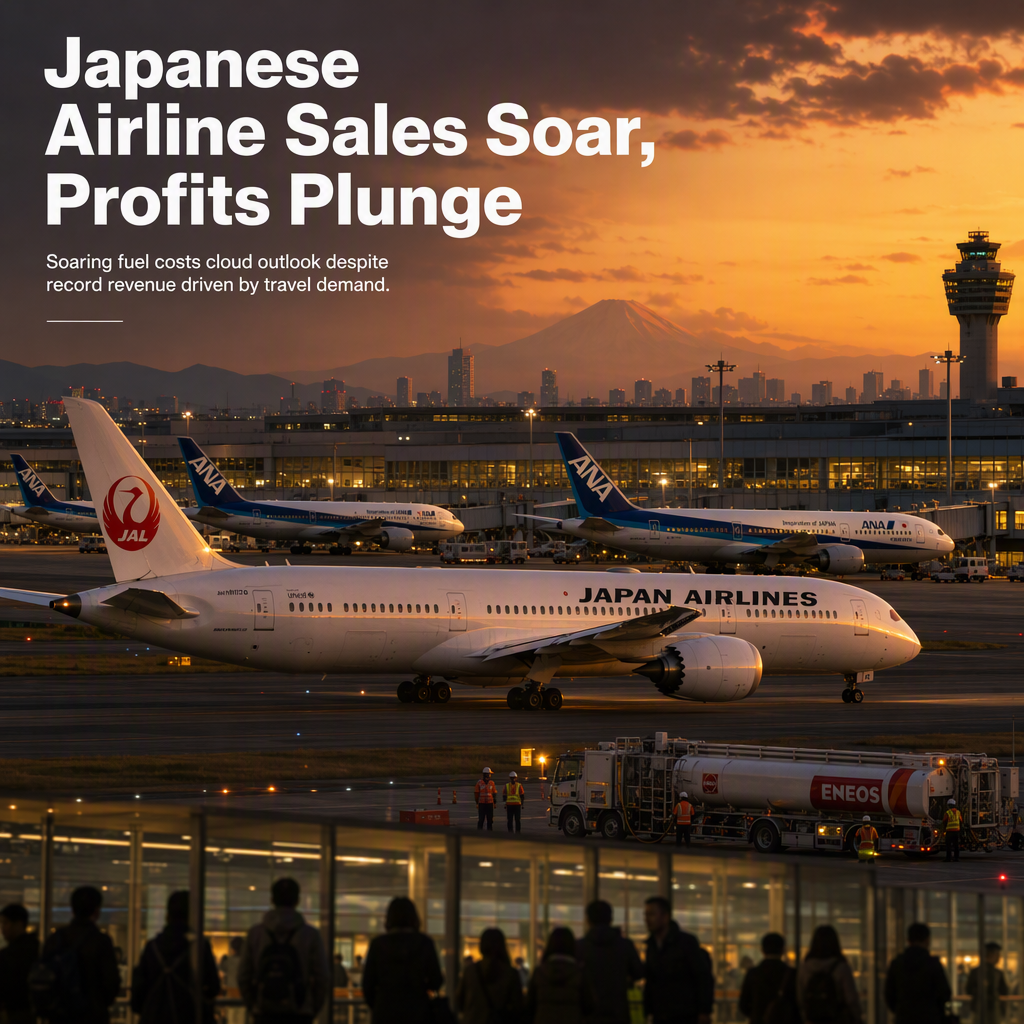
Japan Airlines (JAL) and All Nippon Airways (ANA), the two largest commercial passenger airlines in Japan, reported record revenues for the latest quarter, driven by increased fare surcharges since April in response to the Iran war [1]. Despite the surge in sales, both airlines experienced significant profit declines due to elevated jet fuel prices. JAL announced an 80% fall in quarterly profit, while ANA Holdings reported a 15% drop in net profit for the first quarter, both attributing the declines to soaring fuel costs [1].
The airlines have implemented record fuel surcharges for the July-August Japan travel season, impacting both domestic and international ticket prices [1]. The increased surcharges have also affected frequent flyer miles programs, reducing their value for customers [1]. JAL is considering upgrades to its miles program to boost non-aviation businesses, while ANA has revamped its domestic fares to align more closely with budget airline models [1].
Market implications are significant, as the profit declines highlight the vulnerability of airline earnings to geopolitical events and commodity price fluctuations. The surge in Golden Week bookings provided a temporary boost, but the persistent high fuel prices continue to weigh on profitability [1].
No forward-looking analyst opinions are explicitly stated in the article, but the companies' responses—such as fare revamps and miles program upgrades—suggest ongoing efforts to adapt to the challenging environment [1].
CONCLUSION
Japanese airlines JAL and ANA have achieved record sales but suffered sharp profit declines due to high fuel prices linked to the Iran war. The market impact is high, with both carriers implementing fare surcharges and considering strategic adjustments to offset rising costs. The situation underscores the sensitivity of airline profitability to external shocks and commodity price volatility.