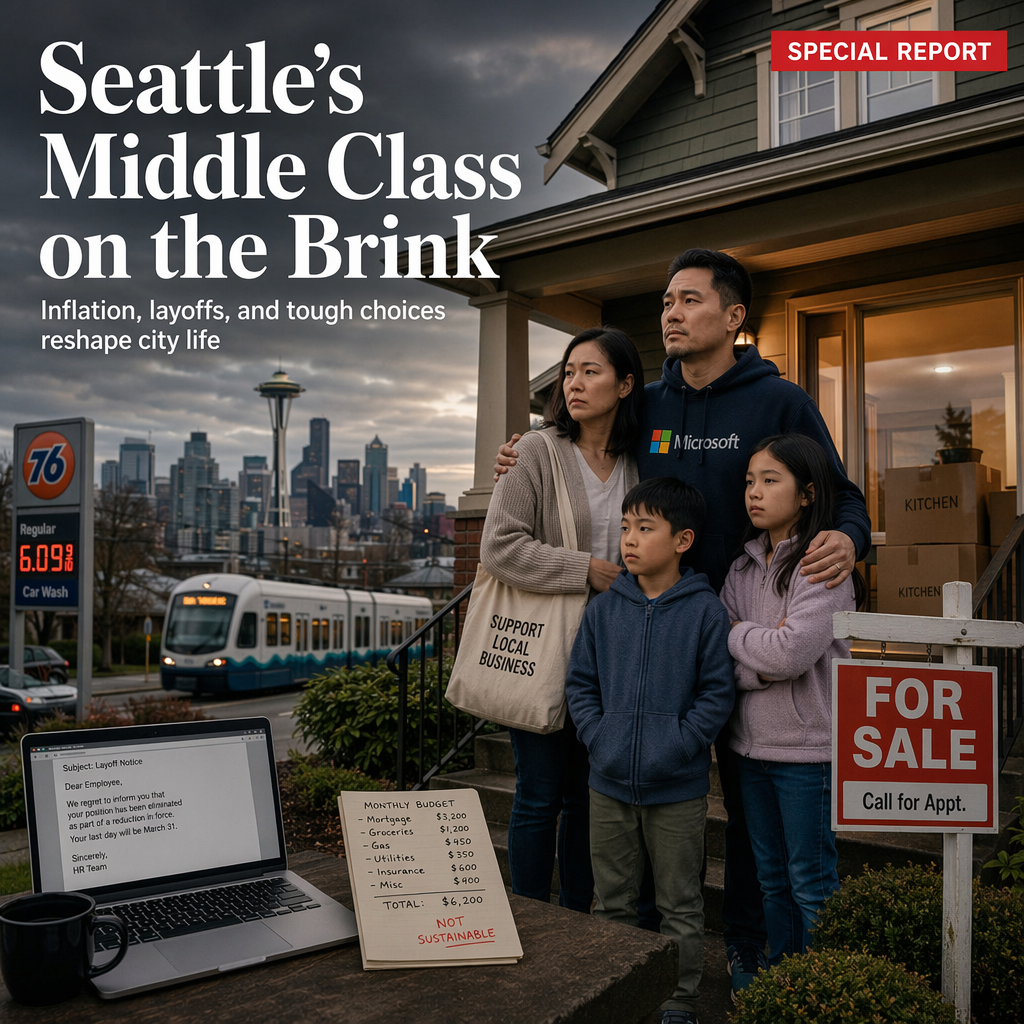
Seattle residents are experiencing significant financial pressure as inflation in the Seattle-Tacoma-Bellevue region remains elevated, with consumer prices rising 4.5% over the past year—higher than the U.S. inflation rate of 3.5% [1]. This has led middle-class families, including those with ties to major tech companies like Microsoft, to sell their homes and downsize in response to rising costs for essentials such as groceries, gas, insurance, and housing [1]. Liesl Gatcheco, a self-employed esthetician whose husband works at Microsoft, described the situation as 'very stressful' and said her family is in 'survival mode' as they prepare to sell their home in Seattle's Crown Hill neighborhood to regain financial control [1].
The tech sector, once seen as a source of stability, is now a source of anxiety for some. Microsoft recently cut 4,800 workers in its Xbox division and sales teams, and in 2025, it laid off 15,000 employees. Additionally, the company offered voluntary buyouts to 7% of its U.S.-based employees this year [1]. This has contributed to uncertainty among tech workers, with Gatcheco noting that 'working in tech used to be a sure thing, and it’s absolutely not anymore' [1].
Rising costs are affecting daily life for many. Dusty Wilson, a math teacher, reported that he and his wife have reduced their driving and now rely more on light rail due to gas prices reaching $6 per gallon [1]. Restaurant food costs have also increased by 6.2% over the year ending in June, making dining out feel like an indulgence even for those who are not struggling financially [1]. Veronica Brown, a tech worker, expressed concern about her ability to make larger purchases, such as buying a house, as her money 'doesn’t go as far' [1].
A spokesperson for Seattle Mayor Katie Wilson emphasized that these stories highlight why affordability and inequality are among the city's most urgent challenges and remain a priority for local leadership [1].
CONCLUSION
Seattle's middle class is under pressure as inflation outpaces the national average, leading to lifestyle changes and home sales even among tech workers. Rising costs and tech sector layoffs are fueling uncertainty, making affordability and inequality top priorities for city officials.