
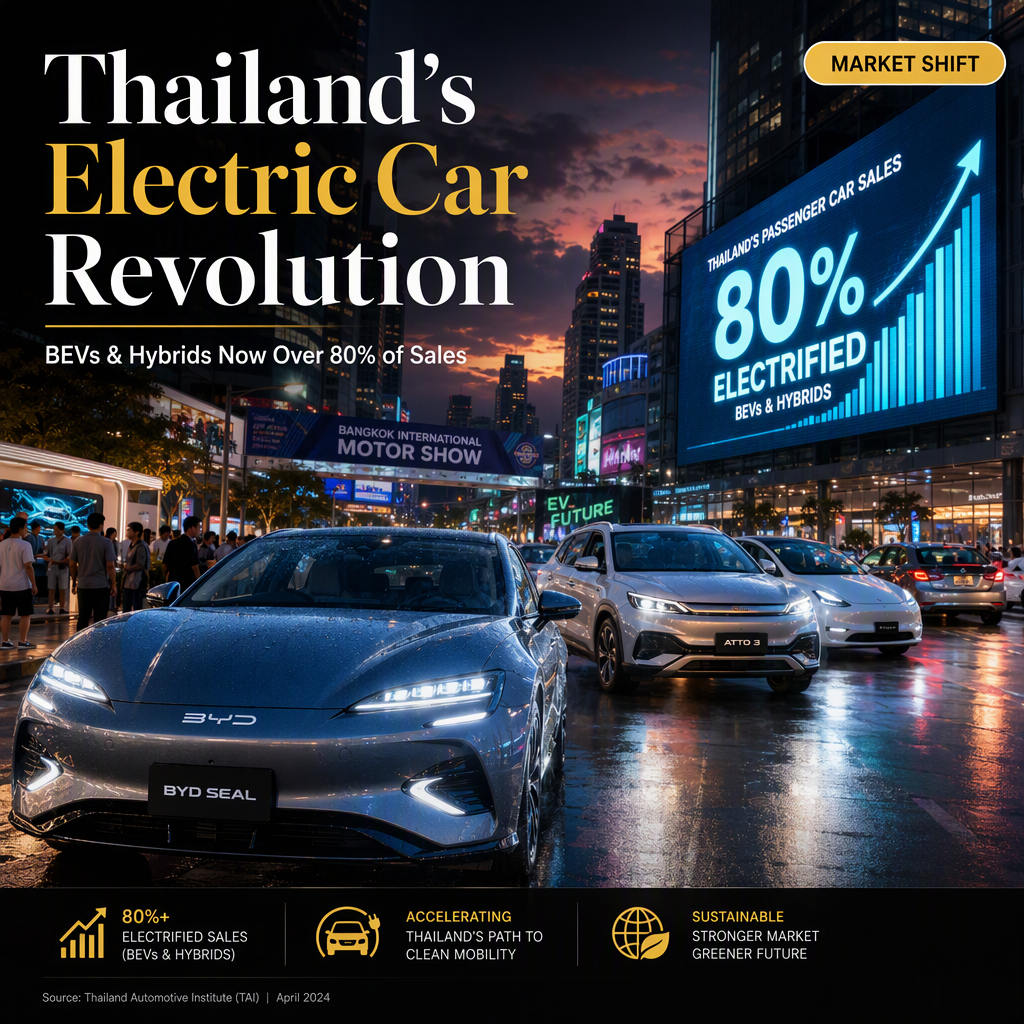
Thailand's passenger-car market experienced a significant shift toward electrification in August, with battery electric vehicle (BEV) sales more than doubling compared to previous months and hybrid models also posting strong gains [1]. As a result, electrified vehicles—including BEVs and hybrids—accounted for over 80% of Thailand's passenger car sales during the month, while gasoline-powered vehicles shrank to less than a fifth of the market [1]. This marks a dramatic change in consumer preference, with conventional internal-combustion-engine vehicles (ICEs) now representing less than 20% of total sales [1].
The surge in BEV sales has been attributed to an influx of affordable models from Chinese manufacturers such as BYD, whose visibility at events like the Bangkok International Motor Show has increased consumer awareness and interest [1]. Industry analysts highlighted the significance of this transformation, with one observer stating, "Thailand's auto market is undergoing a fundamental transformation, with electrified vehicles now becoming mainstream" [1].
Technical analysis indicates that electrified vehicles have established a strong resistance threshold above the 80% market share, while ICEs have found a new support level below 20% [1]. Automakers are responding to these market dynamics by expanding their electrified offerings and investing in local production facilities, with Chinese brands leveraging competitive pricing and advanced technology to capture additional market share [1].
Market sentiment remains bullish on electrified vehicles, with industry experts forecasting continued growth in BEV and hybrid sales. The decline in gasoline-powered cars is expected to persist, further consolidating the shift toward a greener, more electrified automotive future for Thailand [1].
CONCLUSION
Thailand's auto market is rapidly transitioning toward electrification, with BEVs and hybrids now dominating sales. The trend is expected to continue, driven by consumer demand and increased investment from automakers, particularly Chinese brands. The decline of gasoline-powered vehicles signals a lasting transformation in the country's automotive landscape.