
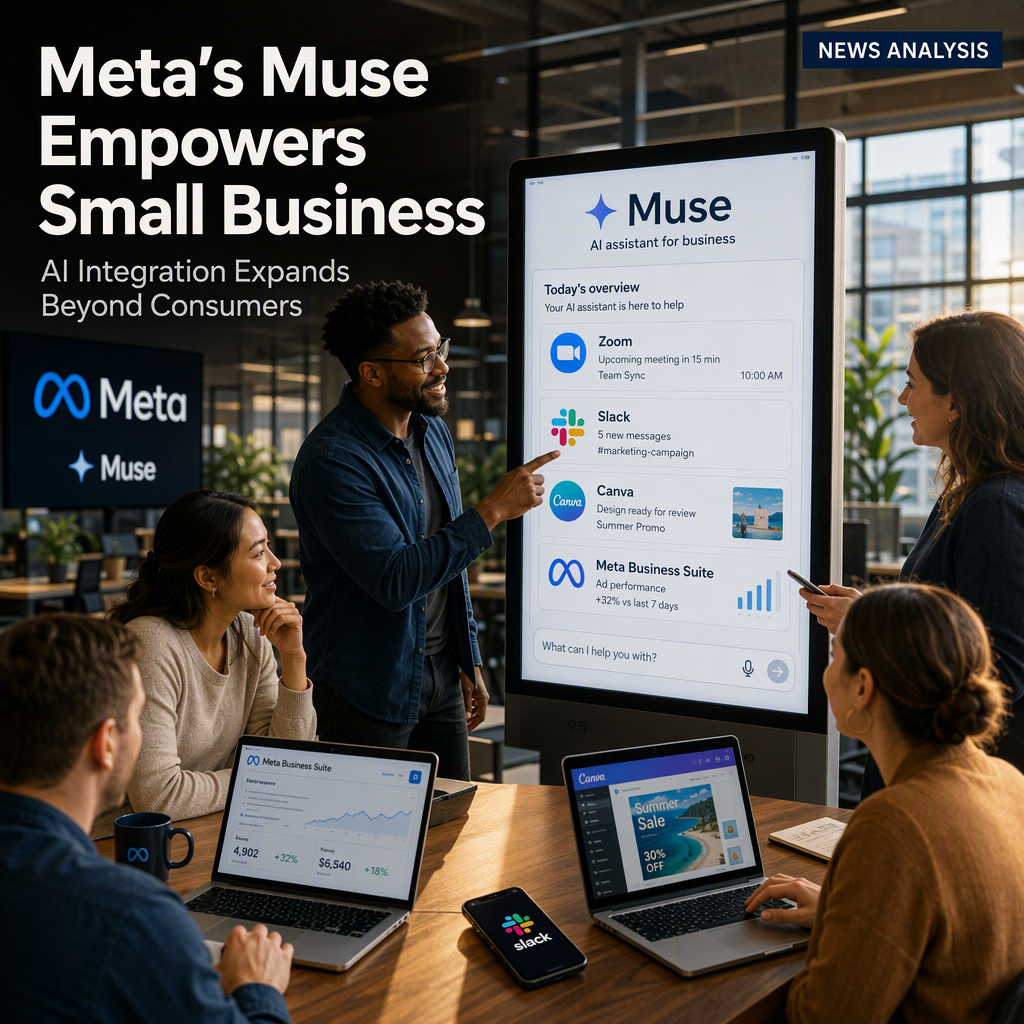
Meta has announced the launch of Muse for Small Business, a new version of its AI agent tailored for workplace use, marking a significant expansion beyond its traditional consumer-focused AI offerings [1]. The new service integrates with widely used business software such as Asana, Zoom, Intuit, Box, Canva, and Salesforce's Slack, and can also connect to Meta ad accounts as well as professional Instagram and Facebook profiles [1]. While pricing details were not disclosed, Meta referenced the existing Muse app, which is free with usage limits and offers a subscription for expanded access [1].
This move follows Meta's recent announcement of a forthcoming enterprise platform, which will include the Muse agent, a business agent, and a coding tool, and will be led by newly hired MongoDB CEO CJ Desai [1]. The company has seen strong stock performance, with shares rising 25% in September, driven by the successful September 8 launch of Muse, which quickly topped Apple's App Store rankings, surpassing ChatGPT [1]. However, there was some sell-off in the past two trading days [1]. Analyst Mark Mahaney of Evercore told CNBC he expects Muse to reach 100 million users within six to twelve months [1].
Meta CEO Mark Zuckerberg has emphasized the strategic importance of AI for the company's future, especially after significant investments in AI talent, including the hiring of Scale AI founder Alexandr Wang, who now leads Meta's AI efforts [1]. Wang's team began releasing new AI models under the Muse Spark family in April [1]. At the recent Meta Connect event, Zuckerberg described Muse as the 'centerpiece' of Meta's AI strategy [1].
The launch of Muse for Small Business coincides with OpenAI's developer day, signaling Meta's intent to compete directly with OpenAI and Anthropic in the enterprise AI space [1]. Meta highlighted its strong position among small businesses, noting that 200 million small businesses are already present on Facebook [1]. The company stated, 'Small businesses have been growing on our apps for nearly two decades. They told us they're short on hours, not ideas. So we built Muse for Small Business to help get work done with the tools they already use' [1].
CONCLUSION
Meta's launch of Muse for Small Business marks a major step in its AI strategy, targeting enterprise clients and leveraging its vast small business user base. The strong stock performance and analyst optimism reflect positive market sentiment, as Meta positions itself to compete with leading AI firms in the business sector.