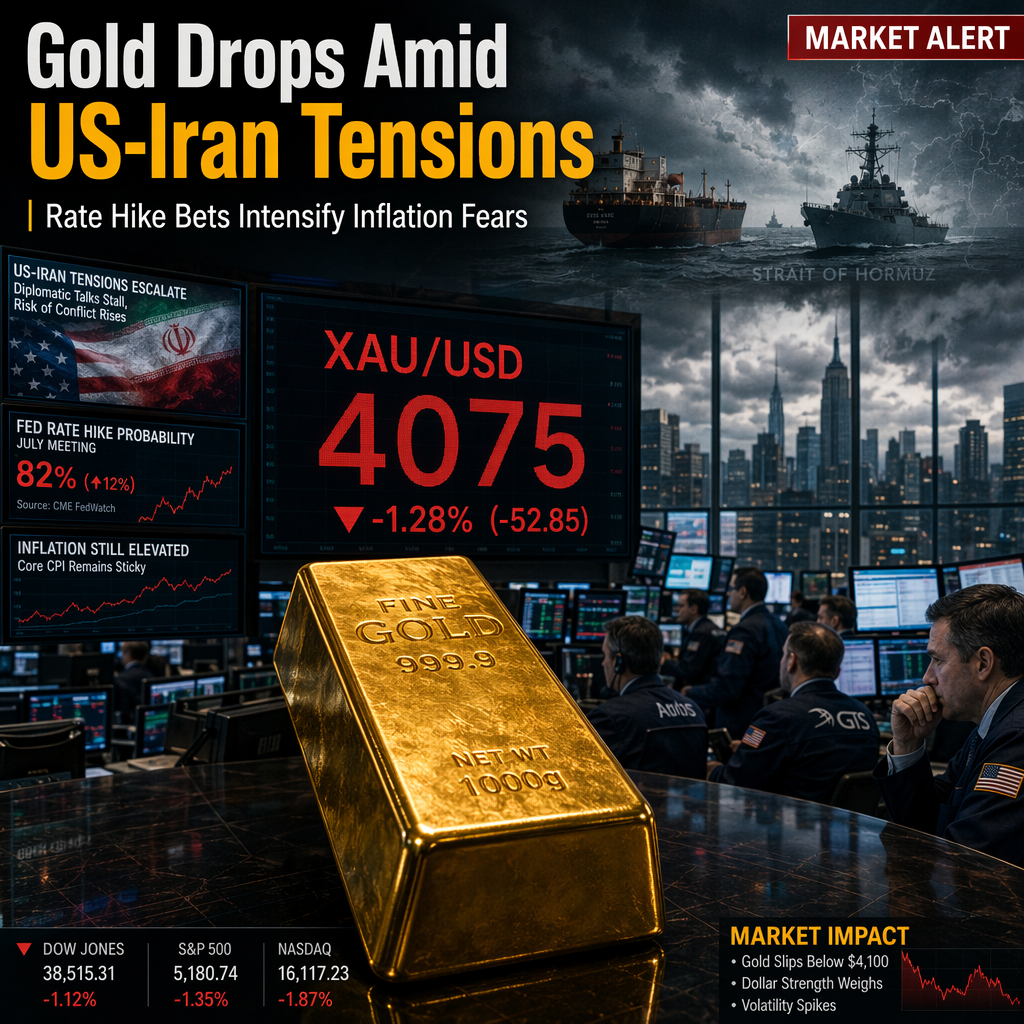
Gold prices (XAU/USD) declined to approximately $4,075 during the early Asian session on Thursday, extending losses as geopolitical tensions between the US and Iran escalated following US President Donald Trump's announcement that the ceasefire with Iran has ended [1]. Trump further threatened to bomb Iran for a second day and reimpose a US naval blockade in response to attacks on tankers transiting the Strait of Hormuz, according to Reuters [1].
David Meger, director of metals trading at High Ridge Futures, attributed the day's move to increased escalation in US-Iran tensions, noting that risk assets across the board traded lower, including gold [1]. The renewed conflict has revived energy-driven inflation fears and reinforced expectations that the US Federal Reserve may keep interest rates higher for longer to combat persistent inflation, which typically weighs on gold as it does not pay interest [1].
Swap traders are now pricing the likelihood of a rate hike at the next Fed meeting at more than 30%, up from less than 20% last Thursday, according to the CME FedWatch tool [1]. The minutes from the Fed’s June 16-17 meeting, released Wednesday, showed that a few policymakers saw a case for hiking rates, though they ultimately supported holding rates steady. The minutes reflected growing concern among Fed officials over inflation, even as worries about the labor market slightly receded [1].
Central banks remain significant buyers of gold, with emerging economies such as China, India, and Turkey rapidly increasing their reserves. In 2022, central banks added 1,136 tonnes of gold worth around $70 billion to their reserves, marking the highest yearly purchase since records began, according to the World Gold Council [1].
CONCLUSION
Gold's decline below $4,100 is driven by renewed US-Iran tensions and rising expectations of a Fed rate hike, as inflation fears intensify. The market reaction is pronounced, with risk assets trading lower and swap traders increasing bets on tighter monetary policy. The outlook for gold remains pressured by geopolitical uncertainty and the prospect of higher US interest rates.