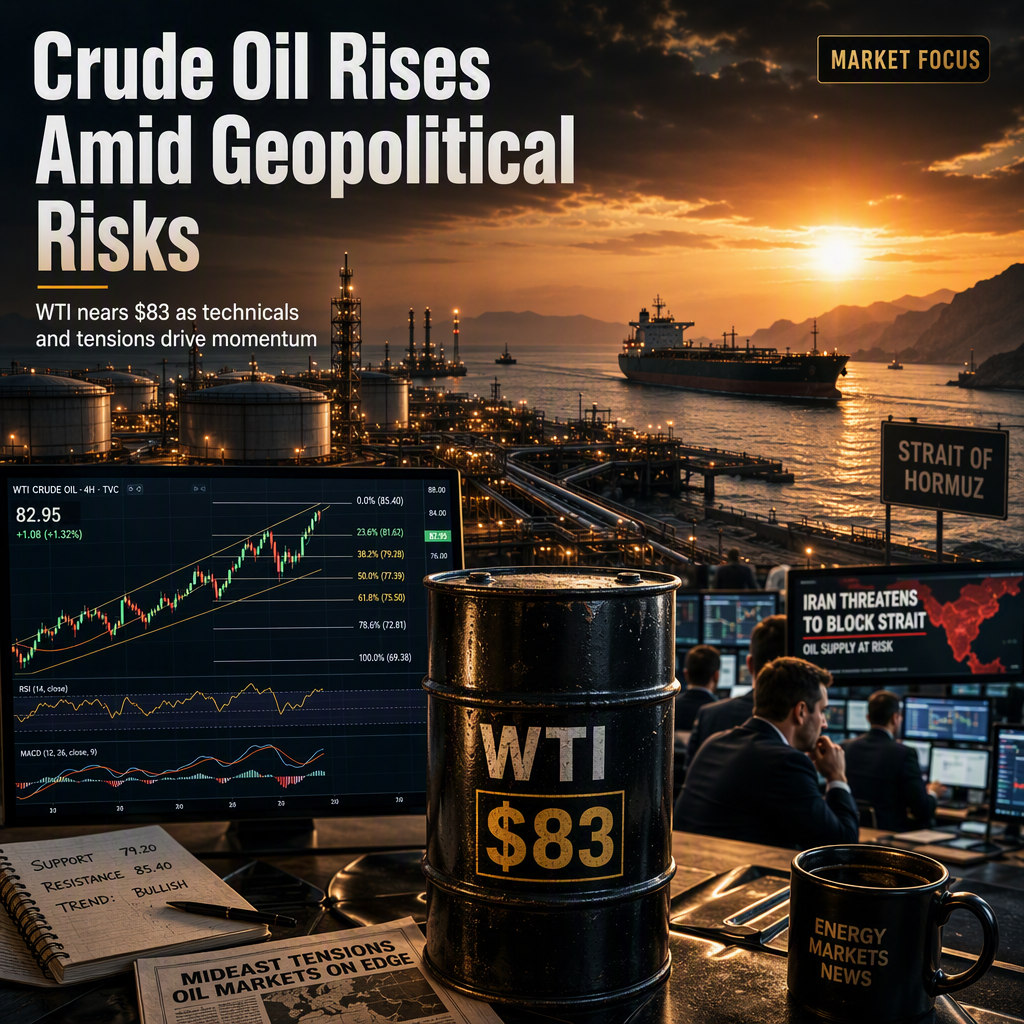
West Texas Intermediate (WTI), the benchmark US crude oil price, attracted buyers for the third consecutive day and traded just below the $83.00 mark during the Asian session on Wednesday, approaching a nearly two-week high set the previous day [1]. The recent upward momentum in WTI is supported by escalating geopolitical tensions, notably an advisor to Iran’s Supreme Leader, Mojtaba Khamenei, stating that the Strait of Hormuz will remain closed until the US meets Tehran's demands. Additionally, fresh strikes by Yemen’s Iran-backed Houthis on shipping in the Red Sea have heightened concerns over potential supply disruptions in West Asia, providing further support to oil prices [1].
From a technical perspective, WTI remains above the 38.2% Fibonacci retracement level of the July-August decline, maintaining a near-term bullish bias. The Relative Strength Index (RSI) stands at 64.63, indicating positive momentum without reaching overbought territory, while the Moving Average Convergence Divergence (MACD) indicator also signals constructive momentum [1]. Key resistance levels are identified at the 50% retracement ($82.93), 61.8% retracement ($85.13), 78.6% retracement ($88.27), and the prior cycle high at $92.26. On the downside, support is seen at the 38.2% retracement ($80.73), 23.6% retracement ($78.00), and the $73.60 swing low [1].
The combination of geopolitical risks and technical strength underpins the case for a further near-term appreciating move in WTI. However, the article does not provide specific market reactions or analyst forecasts beyond the technical outlook [1].
CONCLUSION
WTI crude oil prices are buoyed by ongoing geopolitical tensions and constructive technical indicators, suggesting potential for further gains. Key resistance and support levels are clearly defined, but no explicit analyst forecasts or broader market reactions are provided. The market remains attentive to developments in the Middle East and technical price action.