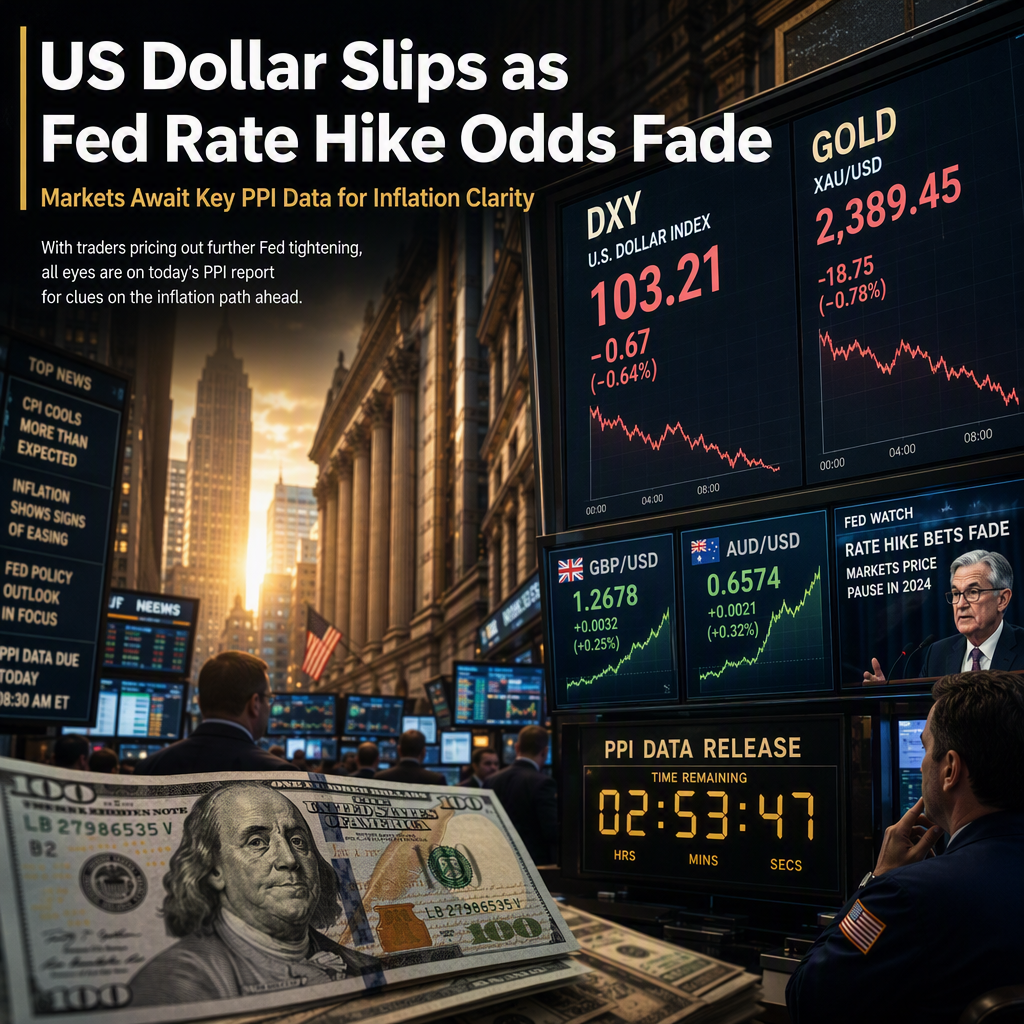
The US Dollar experienced broad-based pressure on Thursday as market participants reassessed the likelihood of further Federal Reserve (Fed) interest rate hikes in light of recent US economic data and ahead of the upcoming Producer Price Index (PPI) release at 12:30 GMT [1][2][3]. Gold (XAU/USD) retreated from a two-month high of $4,449 to trade around $4,386, down 0.52% on the day, as traders engaged in profit-taking and awaited fresh inflation signals from the PPI report [1]. The pullback in gold followed a rally driven by softer US data, including an in-line Consumer Price Index (CPI) and weaker-than-expected July Nonfarm Payrolls, which have collectively reduced the perceived risk of an imminent Fed rate hike [1]. According to the CME FedWatch Tool, the probability of a September rate hike has dropped to 36% from 54% a week ago [1].
Similarly, the British Pound (GBP) recovered early losses against the US Dollar, stabilizing around 1.3495, as traders prioritized easing Fed rate hike fears over ongoing Middle East tensions [3]. The US Dollar Index (DXY) was reported 0.1% lower near 99.90 [3]. The odds of the Fed holding rates steady in September have increased to almost 60%, up from 30.4% a month ago, reflecting a significant shift in market expectations [3]. Analysts from Commerzbank and Danske Bank noted that July US CPI came in broadly in line with expectations, with headline inflation at 3.4% year-on-year and core inflation at 2.5%, supporting the view that the Fed has room to remain on hold [3].
In the Australian Dollar (AUD) market, AUD/USD traded around 0.7055, consolidating after recent gains. The Reserve Bank of Australia (RBA) maintained its key rate at 4.35% with a hawkish bias, but markets assign a 79% chance that the RBA will leave rates unchanged at its September 29 meeting [2]. The US CPI data, showing annual inflation slowing to 3.4% in July from 3.5% previously, has limited the US Dollar's upside and provided some support to AUD/USD [2]. However, persistent geopolitical tensions between the US and Iran, particularly regarding control over the Strait of Hormuz, have sustained demand for safe-haven assets like the US Dollar and capped the Australian Dollar’s recovery [2].
Across all markets, attention is focused on the imminent US PPI release, which is expected to provide further clarity on inflation trends and the Fed's policy path [1][2][3]. Analysts caution that while recent data supports a pause in Fed tightening, ongoing risks such as elevated energy prices and Middle East tensions could still influence inflation and monetary policy going forward [1][2]. Technical analysis for gold and major currency pairs suggests a period of consolidation, with directional moves likely hinging on upcoming economic releases [1][2][3].
CONCLUSION
Markets are in a holding pattern as traders await the US PPI data for further direction on inflation and Fed policy. Recent US economic data has reduced expectations for a near-term Fed rate hike, pressuring the US Dollar and supporting assets like gold and the British Pound. However, geopolitical risks and upcoming data releases continue to inject uncertainty into the outlook.