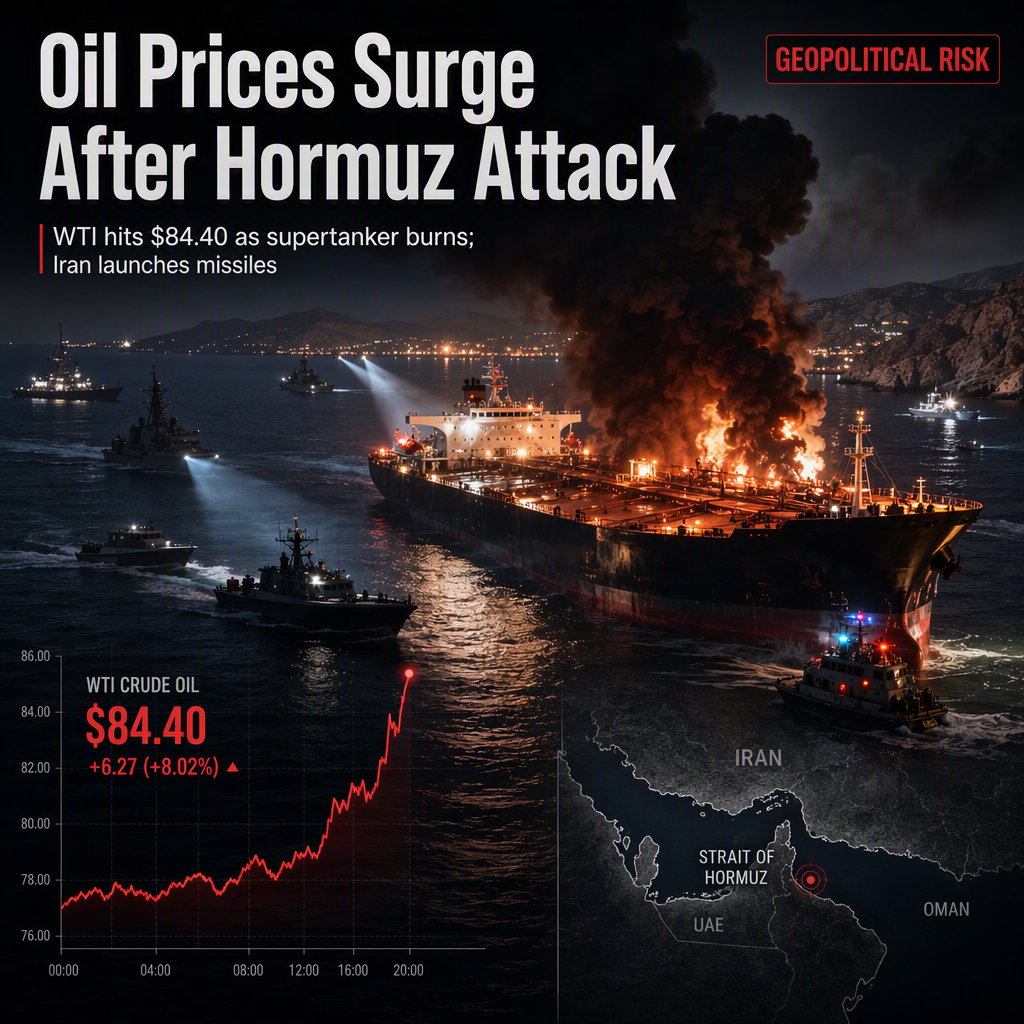
West Texas Intermediate (WTI) crude oil prices rebounded sharply, trading around $84.40 per barrel during Asian hours on Monday, following reports from Iran's Islamic Revolutionary Guard Corps (IRGC) that a rogue supertanker caught fire in the Strait of Hormuz after striking two naval mines along the southern passage of the waterway [1]. IRGC officials asserted that the vessel was attempting to pass through the strait illegally and issued a stern warning that all maritime traffic must strictly comply with Iranian rules for passage [1].
The situation escalated as Iran launched a coordinated barrage of ballistic and anti-ship cruise missiles from multiple locations, including Tehran, Lorestan, Karaj, Khorramabad, and Shiraz, targeting positions in the Strait of Hormuz. This action was described as a direct response to an earlier United States strike on Iranian launcher facilities at Larak Island, which the IRGC had vowed to avenge [1]. The US military action, which targeted Iranian rocket sites prepared to lay naval mines, marked the first direct strike on Iranian military positions in over a month and represented a shift from Washington's recent reliance on economic sanctions rather than direct force [1].
Despite the recent strength in crude prices, Brown Brothers Harriman cautioned that upside pressure on Brent appears limited. Citing Goldman Sachs estimates, the firm noted that oil exports from the Persian Gulf have recovered to around two-thirds of pre-war levels as more vessels transit the Strait of Hormuz, suggesting that improving regional supply dynamics may temper further gains [1].
From a technical perspective, WTI US Oil maintains a bullish bias, trading above both the short-term nine-period Exponential Moving Average (EMA) at $83.19 and the medium-term 50-period EMA at $81.82. The 14-day Relative Strength Index (RSI) stands at 55.13, indicating steady upward momentum without overbought conditions. As long as WTI holds above these support levels, pullbacks are likely to be viewed as corrective pauses within the broader uptrend [1].
CONCLUSION
WTI crude prices surged on heightened geopolitical tensions in the Strait of Hormuz, following Iranian claims of a supertanker incident and subsequent missile launches. While technical indicators support a bullish outlook, analysts suggest that recovering Persian Gulf exports may limit further price gains.