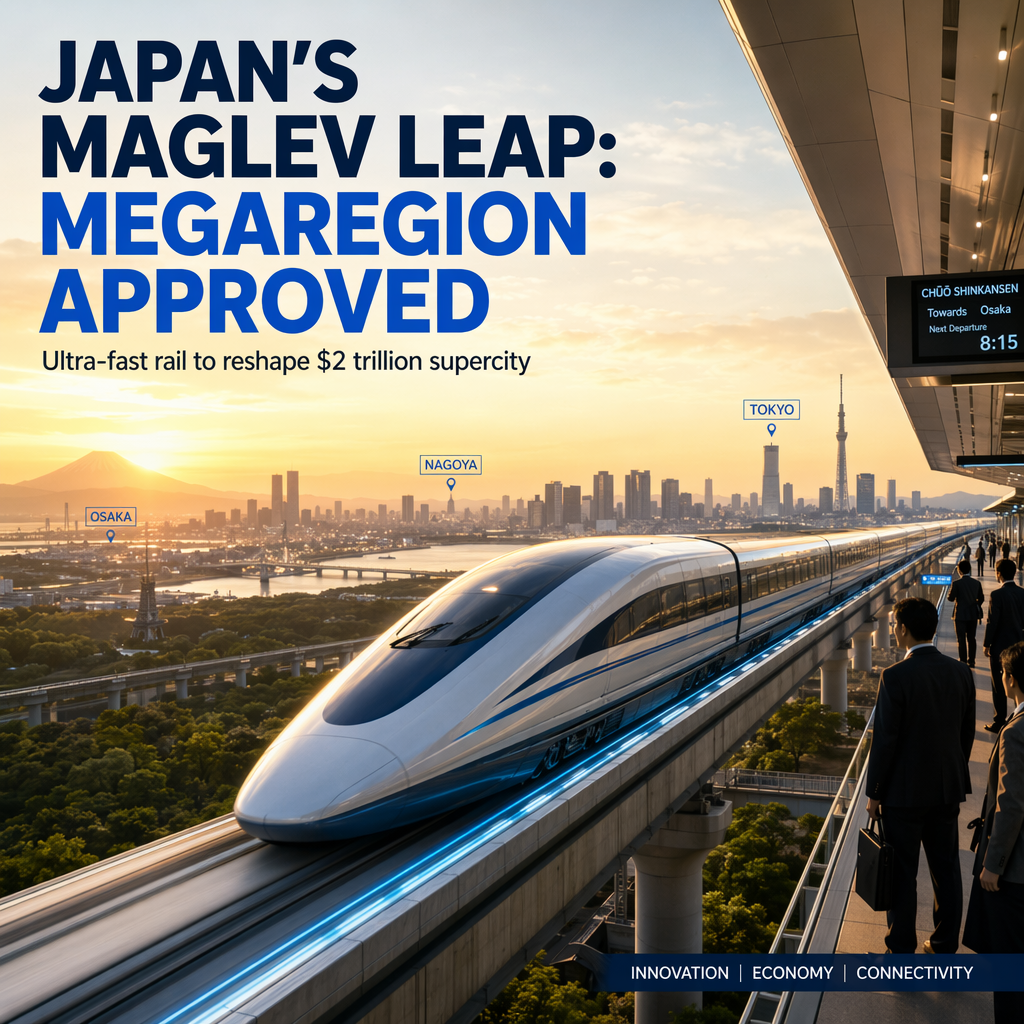
Japan's ambitious plan to construct an ultra-fast maglev train line connecting Tokyo, Nagoya, and Osaka has taken a significant step forward following the approval from a local governor, marking a major milestone after years of negotiations and planning [1]. The Linear Chuo Shinkansen project, led by Central Japan Railway (JR Central), aims to cut travel times between these major cities to less than half of the current fastest options, fundamentally reshaping a region that is home to 66 million people and referred to as a '$2 trillion megaregion' [1].
The maglev line is expected to have a substantial economic impact by enabling quicker business and commuter travel across some of Japan's most economically productive areas, thereby boosting regional integration and economic output [1]. The project has faced several challenges, including environmental concerns and a previous $26 billion cost overrun, but the recent approval has renewed optimism among public and private stakeholders [1].
Market observers highlight that the public-private partnership model and the anticipated returns from increased economic activity are key drivers of continued support for the project [1]. Additionally, JR Central sees the maglev line as a potential showcase for Japanese technology, with aspirations to export the technology overseas in the future [1]. The project is expected to further solidify Japan's reputation as a leader in high-speed rail innovation [1].
CONCLUSION
The approval of Japan's maglev project marks a pivotal advancement for the $2 trillion megaregion initiative, with expectations of significant economic and technological benefits. Despite past challenges, the project is poised to enhance regional connectivity and position Japan at the forefront of high-speed rail innovation.