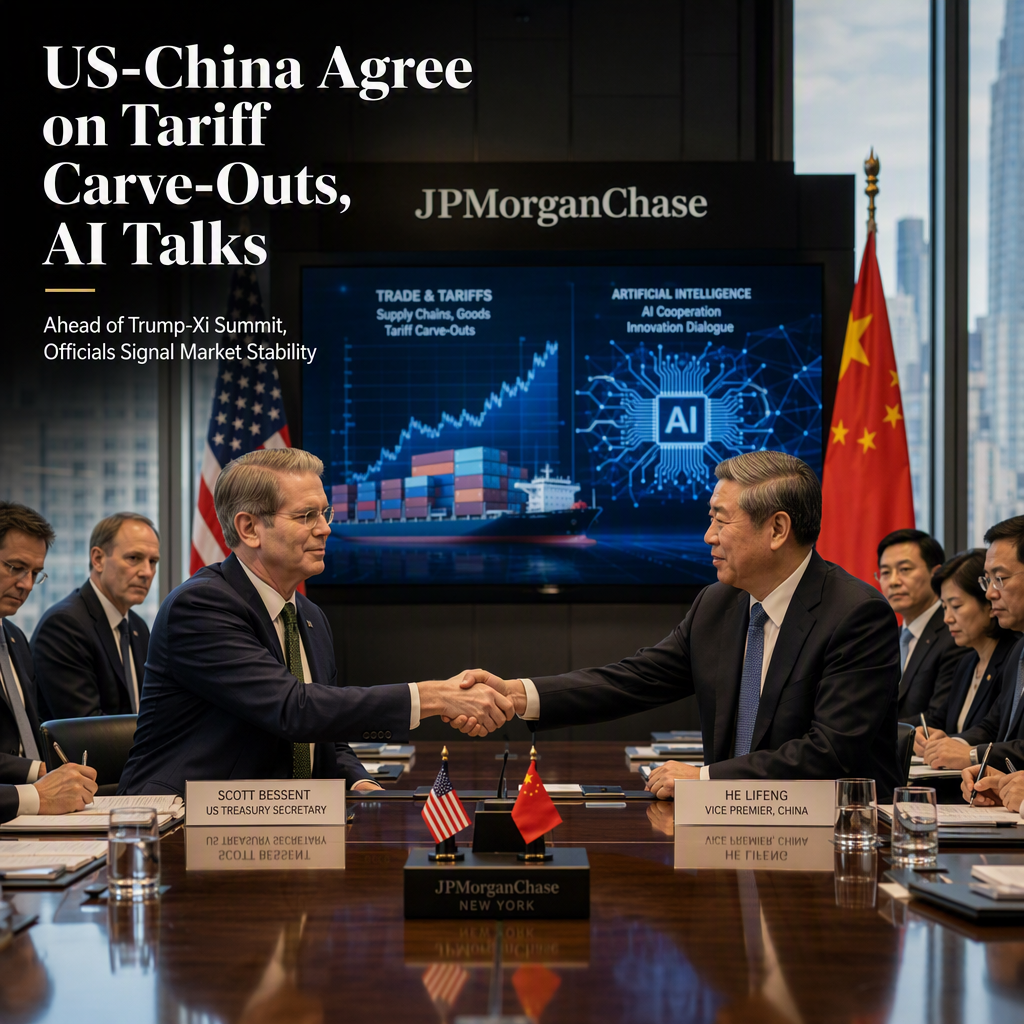
The United States and China have reached an agreement to carve out 'nonsensitive' goods from future tariff actions and to establish a formal channel for dialogue on artificial intelligence, according to statements from top American officials on September 20, 2026 [1]. U.S. Treasury Secretary Scott Bessent described his meeting with China's Vice Premier He Lifeng at JPMorgan Chase's headquarters in New York as 'very successful,' emphasizing that the talks were an important step in preparing for the upcoming Trump-Xi summit, which will focus on trade, artificial intelligence, and broader economic cooperation [1].
Officials from both countries indicated that the new agreement aims to shield key sectors from sudden tariff escalations, potentially reducing volatility for businesses engaged in cross-border trade. While the specific goods to be excluded from future tariffs were not named, sources noted that the list will be determined in future negotiations, with a focus on maintaining supply chain stability [1].
In addition to the tariff carve-out, both sides agreed to set up a formal channel for dialogue on artificial intelligence, addressing concerns over AI's impact on national security and economic competitiveness. The dialogue is expected to cover AI safety, ethics, and the development of guardrails to prevent misuse [1].
Although no immediate changes to existing tariffs were announced, analysts cited in the article believe that the agreement to exclude certain goods from future tariff actions could reduce uncertainty for importers and exporters, potentially supporting market stability in the near term. Market participants are closely monitoring the situation for further details that could influence trade flows and technology policy [1].
CONCLUSION
The agreement between the US and China to carve out nonsensitive goods from future tariffs and to establish an AI dialogue channel is viewed as a constructive step ahead of the Trump-Xi summit. While immediate tariff changes were not announced, the move is expected to reduce uncertainty and support market stability in the short term.