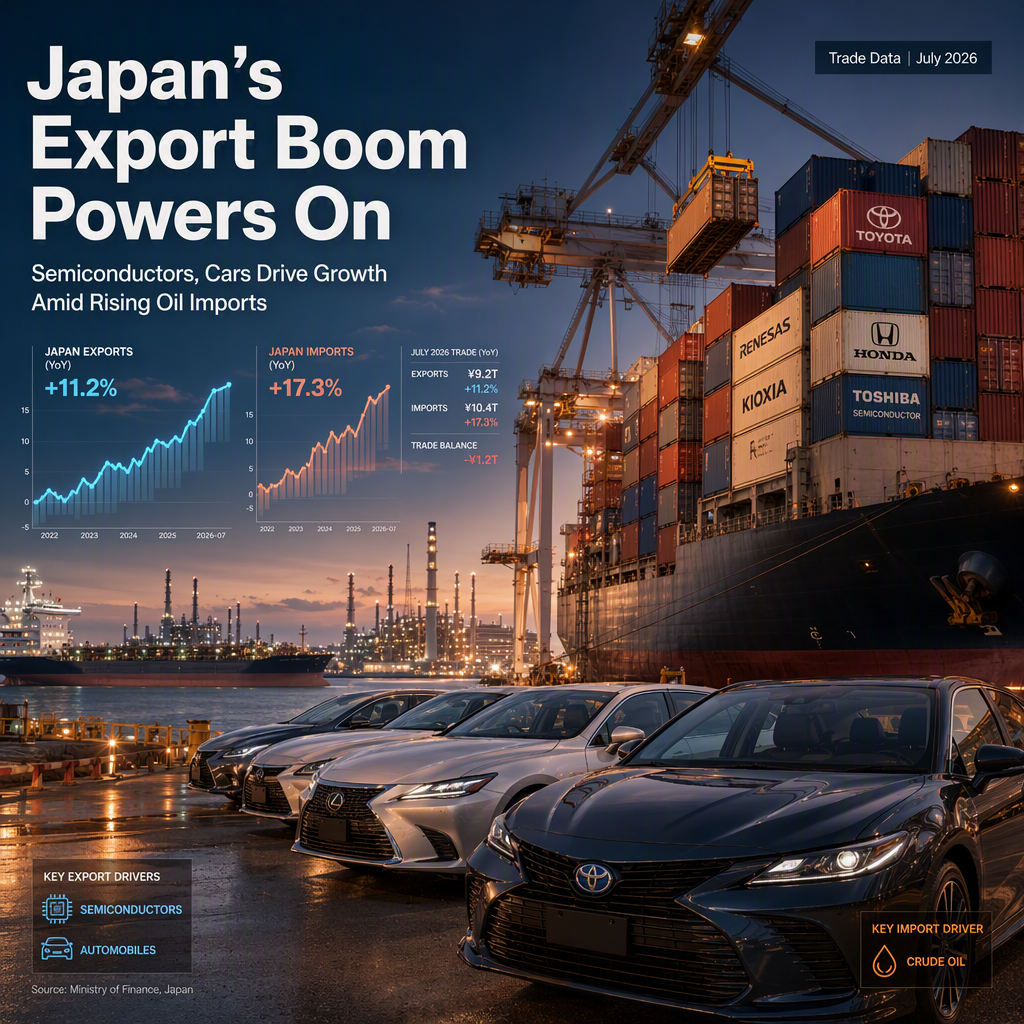
Japan's exports continued their upward trajectory in July, marking the 11th consecutive month of growth, according to official data released on August 20, 2026 [1]. The value of exports accelerated at the fastest pace since October 2022, rising by 23.2% and surpassing economists' expectations of 19.9% growth [2]. This robust performance was primarily driven by strong shipments of cars and semiconductors, with semiconductor equipment exports alone soaring by 49.1% in value, fueled by ongoing demand related to the artificial intelligence sector [1][2].
Exports to China, Japan's largest trading partner, increased by 25.8%, while shipments to the U.S. rose 22% in July [2]. The Japanese government has also been actively supporting its domestic semiconductor industry, unlocking billions of dollars in subsidies to revitalize the sector [2]. Market analysts highlighted that automobile and semiconductor exports remain the core drivers of this export growth, underscoring the resilience of Japan's manufacturing sector amid global supply chain challenges [1].
On the import side, Japan saw a significant surge, with imports rising 28% according to Nikkei Asia [1] and 27.8% according to CNBC World [2]. This marks the highest import level since November 2022 and contributed to Japan posting its third consecutive monthly trade deficit [1][2]. The spike in imports was largely attributed to an 87.8% jump in petroleum imports by value, driven by higher oil prices amid the Iran war [2]. Japan relies on imports for over 87% of its energy needs, amplifying the impact of global energy market fluctuations [2].
Despite the trade deficit, strong export performance has played a crucial role in supporting Japan's GDP. The economy grew 0.7% year-on-year in the second quarter, up from 0.5% in the previous quarter, with exports being the largest contributor to this growth [2]. However, GDP figures missed expectations on a quarter-on-quarter and annualized basis, indicating that while exports are a bright spot, other areas of the economy may be lagging [2].
CONCLUSION
Japan's export sector demonstrated notable strength in July, led by surging semiconductor and automobile shipments, and exceeded market expectations. However, soaring imports, particularly of petroleum, resulted in a continued trade deficit. While exports are providing critical support to Japan's GDP, persistent import pressures and energy dependency remain key challenges for the economy.