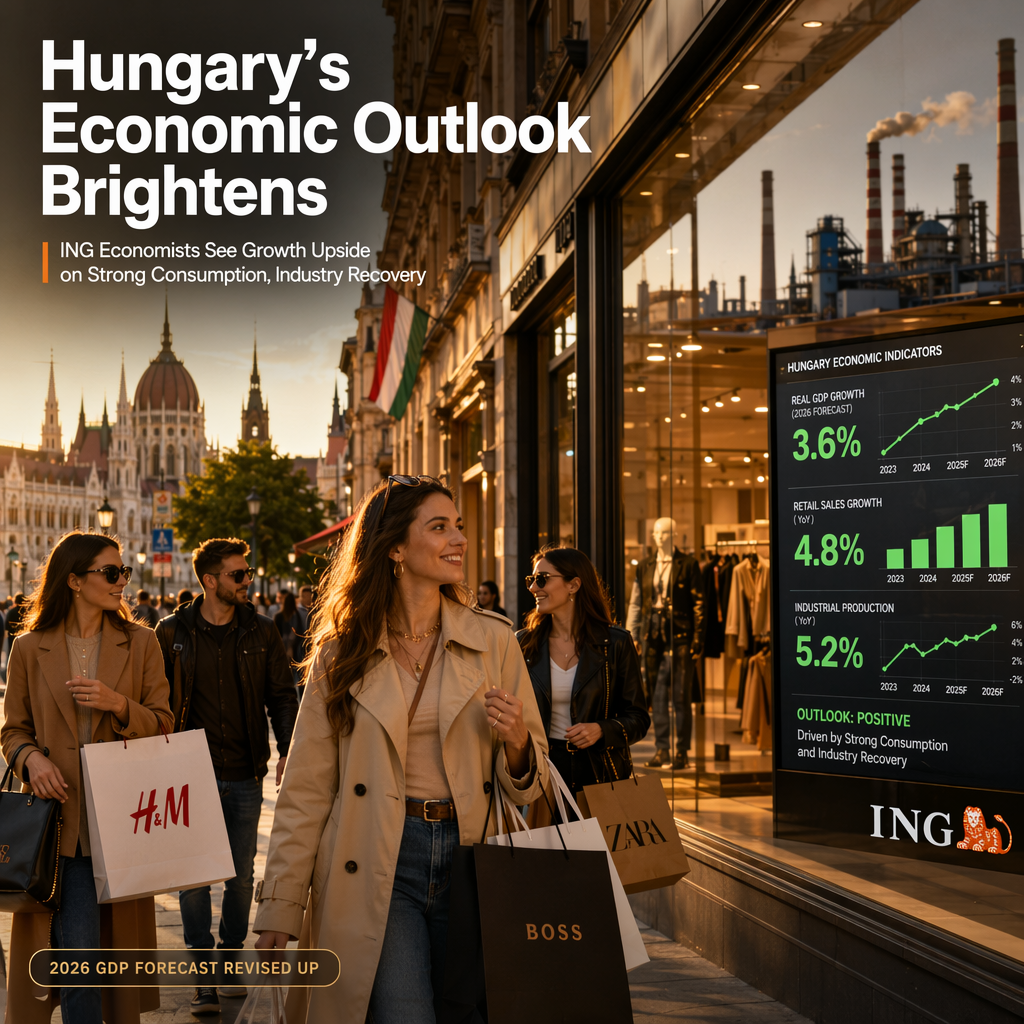
ING economists Peter Virovacz and Frantisek Taborsky have revised their outlook on Hungary's economic growth, citing positive surprises in high-frequency economic activity data and stronger consumption trends as reasons for increased optimism. Their latest GDP forecast projects a 1.5% increase in 2026, but they now see clear upside risks to this estimate due to recent data improvements. The Finance Ministry's expectations are slightly higher, forecasting GDP growth in the range of 1.6–2.0% for the same period [1].
The recovery in Hungary's industry and retail sectors is underway, although the economists note that net exports and demographic factors may still constrain overall expansion. Industrial output is expected to achieve an average growth rate of around 4% in 2026, potentially marking the end of a three-year industrial recession and contributing positively to the country's economic performance [1].
Consumer confidence is nearing historical highs, supported by persistently low inflation and robust wage growth. This favorable environment is expected to sustain growth in the retail sector, with retail sales anticipated to rise by approximately 5-6%. As a result, household consumption is projected to remain the main driver of Hungary's economy in 2026 [1].
Labor market conditions are likely to remain tight, as companies continue to hoard labor in the absence of significant demographic changes. The issue of wage negotiations is becoming more prominent as the three-year minimum wage agreement approaches its final year in 2027, signaling a need for revision. On the external front, ING expects the current account to turn negative in 2026, following improvements driven by increased export capacity in previous years [1].
CONCLUSION
Hungary's economic outlook is improving, with ING economists highlighting stronger consumption and a recovering industrial sector as key drivers. While upside risks to growth are emerging, challenges remain in net exports, demographics, and the labor market. The market takeaway is cautiously optimistic, with sustained consumption and industry recovery supporting medium-term growth prospects.