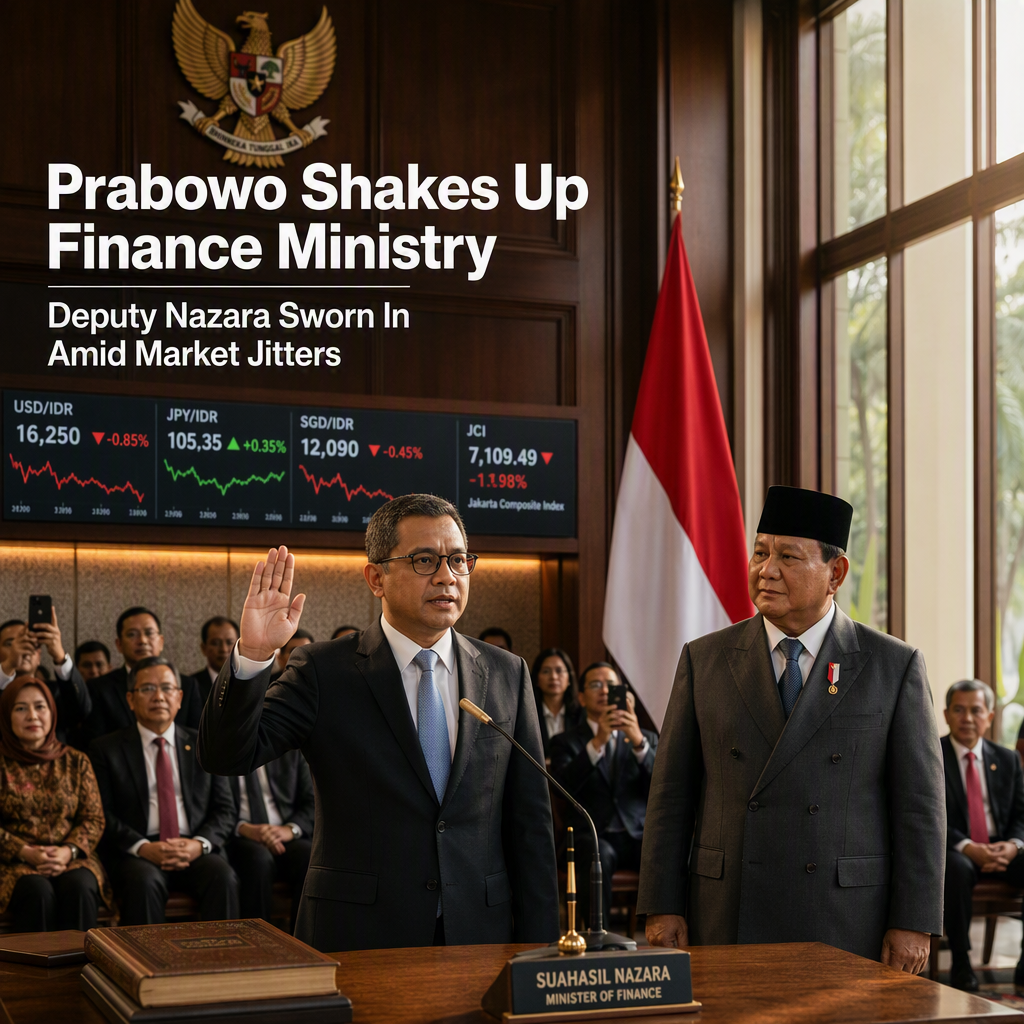
Indonesian President Prabowo Subianto made a surprise decision to fire Finance Minister Purbaya Yudhi Sadewa on Monday, appointing his deputy, Suahasil Nazara, as the new finance minister in a move that marks a significant shift in the country's economic leadership [1]. Nazara, an economist who has served as vice finance minister since 2019, was officially sworn in during a ceremony attended by senior government officials and finance ministry members [1].
Nazara has played a central role in Indonesia's fiscal policy response to global economic volatility, including efforts to stabilize the rupiah and manage inflation pressures [1]. Financial analysts interpret the leadership change as President Prabowo’s intent to accelerate economic reform and ensure more cohesive policy implementation, with one Jakarta-based market economist stating, "The move signals a desire for more aggressive fiscal management and policy coordination" [1].
Following the announcement, Indonesia’s bond and currency markets experienced moderate volatility, with the rupiah showing intraday fluctuations against the US dollar but stabilizing near support levels at 15,200 [1]. Technical analysts observed that the Jakarta Composite Index (JCI) remains above key support at 7,100, with resistance at 7,300, and noted that the next few sessions will be critical for gauging market sentiment after the cabinet reshuffle [1].
Nazara has previously advocated for prudent fiscal management and is committed to maintaining Indonesia’s debt-to-GDP ratio below 40%, a threshold considered safe by many analysts [1]. He is expected to continue efforts to broaden the tax base and improve public expenditure efficiency, emphasizing macroeconomic stability, sustainable growth, digital transformation in fiscal administration, and protecting Indonesia’s economic resilience amid global headwinds [1]. Traders and investors are closely monitoring upcoming policy statements for potential shifts in subsidy allocation, tax incentives, and regulatory changes that could impact stock and bond markets, with some observers anticipating renewed efforts to boost infrastructure spending [1].
CONCLUSION
President Prabowo's unexpected replacement of the finance minister with Suahasil Nazara has introduced moderate volatility to Indonesian financial markets, with investors closely watching for policy signals. Nazara's track record and stated priorities suggest a continued focus on fiscal prudence and economic stability, but the coming sessions will be crucial in determining market sentiment and the direction of fiscal reforms.