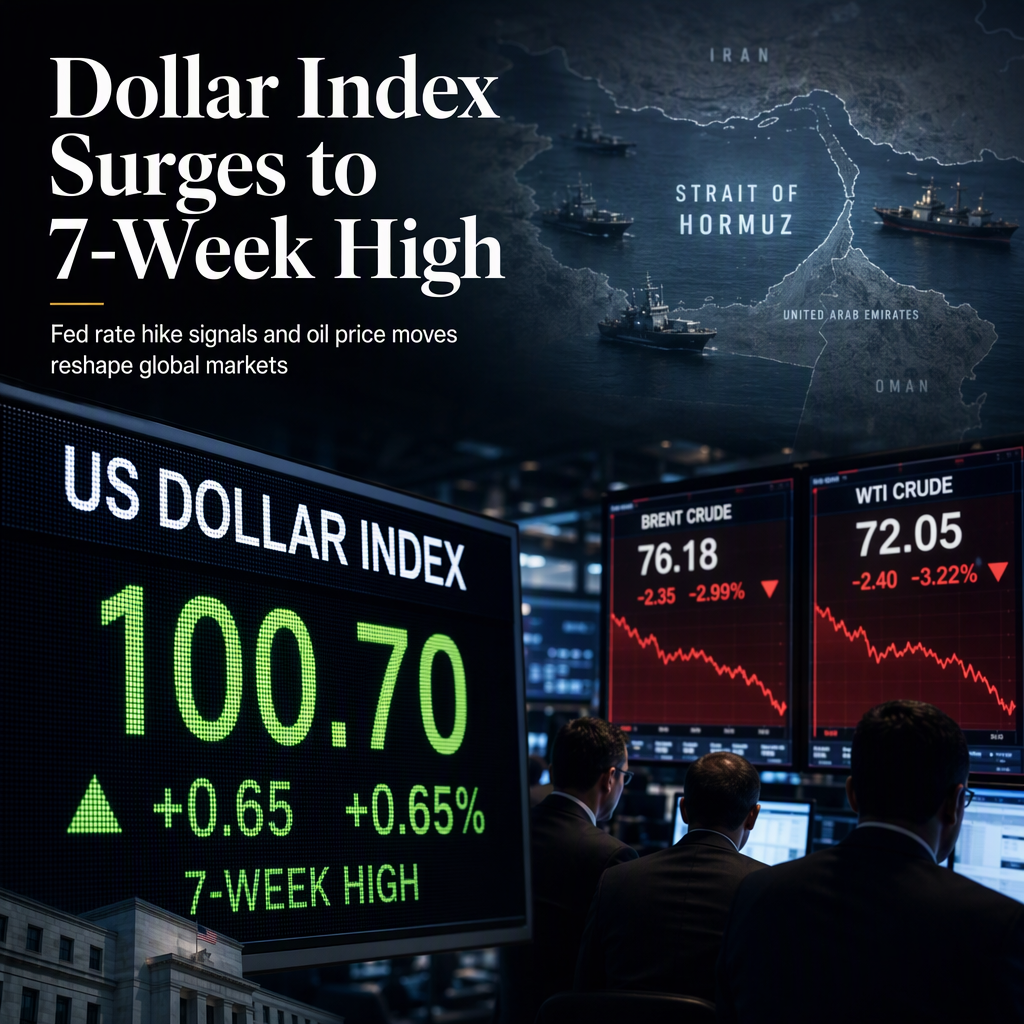
The US Dollar Index traded near 100.70, marking its highest level since late July, as the Federal Reserve's recent actions and statements fueled expectations for another interest rate increase this year [1]. The Dollar Index has climbed through five consecutive sessions of declining Crude Oil prices, a reversal from earlier trends this year where the war had typically driven the index [1]. The Federal Reserve raised rates on September 16 and signaled at least one more increase in 2023, with officials reiterating this stance in subsequent days [1].
A report from Japanese news agency Kyodo, citing a senior Iranian official, indicated that Iran might allow ships to pass through the Strait of Hormuz within a week, contingent on the United States ending its blockade of Iran's ports and ceasing military operations around the strait. This report, which has not been independently confirmed, led to a drop in Crude Oil prices, with Brent crude hitting its lowest price since September 8 [1]. Lower oil prices are generally expected to reduce inflationary pressures, potentially lessening the need for further Fed rate hikes. However, the offer from Iran was communicated to Washington via mediators on September 16 and only impacted oil prices after it was reported [1].
Before the conflict, about 20% of the world's crude oil and liquefied natural gas passed through the Strait of Hormuz. Saudi Arabia is also testing a restart of its East-West pipeline, which could further increase oil supply and put downward pressure on prices, thereby reducing the likelihood of another Fed rate increase [1]. Futures market data showed a 55.36% probability of a rate hike at the Fed's October 28 meeting, compared to 44.64% for no change. These odds, along with the Dollar Index, slipped following the Hormuz report [1].
Boston Fed President Collins supported the September 16 rate increase and warned that inflation could remain above the Fed's 2% target, with the Fed's own projections indicating inflation may stay elevated until after 2028 [1]. Minneapolis Fed President Kashkari, along with Chicago Fed President Goolsbee and St. Louis Fed President Musalem, emphasized that inflation remains high across the broader economy, not just in energy prices, which is why the Hormuz report had a more pronounced effect on oil than on the Dollar Index [1]. The ADP four-week average of private-sector hiring came in at 20K, up from 16.75K previously, providing a modest boost to the case for further tightening [1].
CONCLUSION
The US Dollar Index reached a seven-week high as expectations for another Fed rate hike remained strong, despite falling oil prices and geopolitical developments around the Strait of Hormuz. While lower oil prices could ease inflation and reduce the need for further tightening, Fed officials continue to signal concern about persistent inflation across the economy. Market odds for an October rate hike remain slightly above even, reflecting ongoing uncertainty.