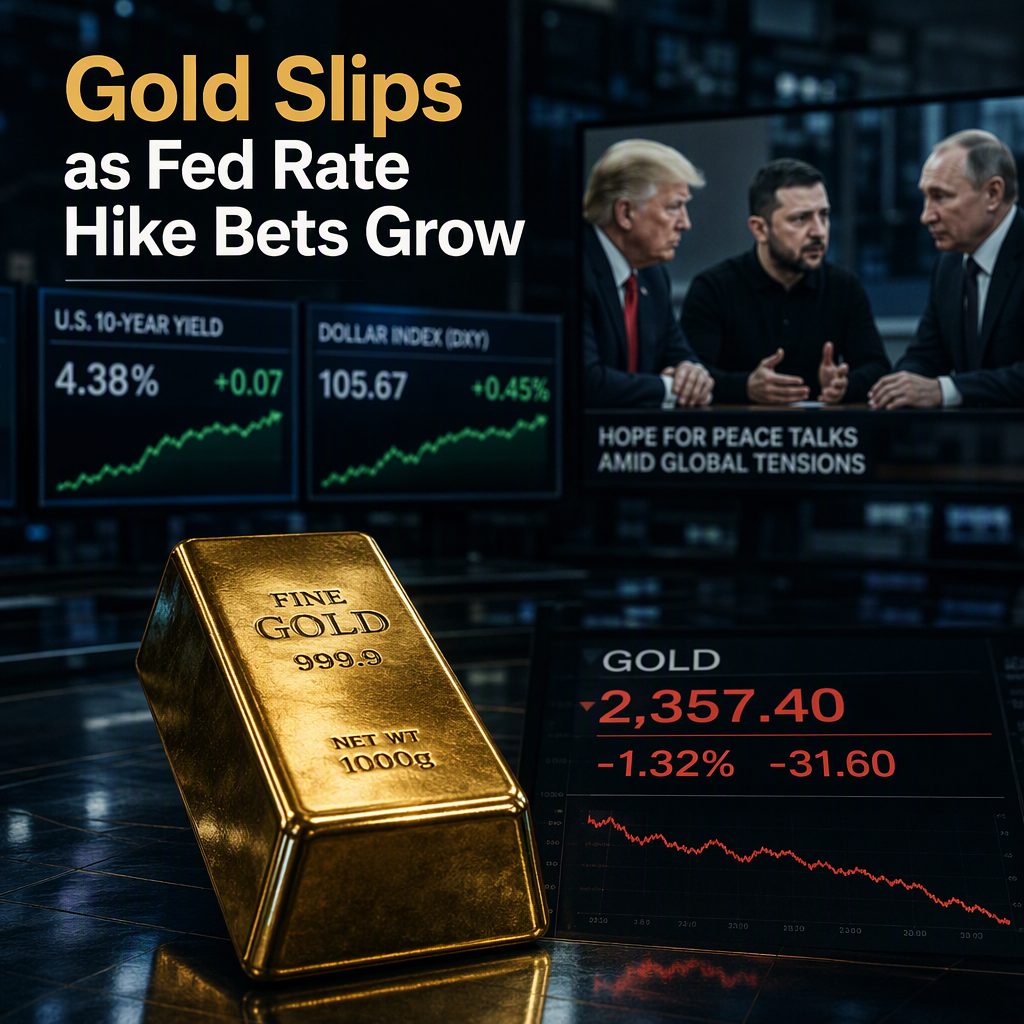
Gold (XAU/USD) retreated from daily highs of $4,376 on Tuesday, trading at $4,337 and marking a 0.14% decline, as US Treasury yields rose and the US Dollar strengthened, reducing demand for safe-haven assets like gold [1]. The shift in sentiment was influenced by US President Donald Trump's announcement of a 'very productive' meeting between US and Iranian delegations, as well as ongoing efforts with Ukrainian President Volodymyr Zelenskyy and Russian President Vladimir Putin to end the Russia-Ukraine conflict [1].
The Federal Reserve's recent rate hike and subsequent hawkish comments from policymakers, including Richmond Fed President Thomas Barkin and Boston Fed President Susan Collins, reinforced expectations of further tightening. Barkin noted that inflationary pressures would take time to ease and suggested additional rate hikes may be necessary, while Collins warned of elevated inflation risks and supported further hikes [1]. Money markets are currently pricing in a 53% chance of a 25-basis-point rate hike at the Fed's October 28 meeting, with the probability rising to 90% for the December meeting, according to Prime Terminal [1].
The US 10-year Treasury yield increased by more than 1.6 basis points to 4.97%, reflecting investor expectations for continued Fed action on inflation. The US Dollar Index (DXY) also rose 0.17% to 100.59 [1]. Despite gold's traditional role as an inflation hedge, it has struggled to gain traction in the current high-interest-rate environment [1].
On the technical side, gold remains subdued within a 'bullish wedge' pattern, with potential resistance at the 200-day Simple Moving Average (SMA) at $4,541 and immediate resistance near $4,382. Key psychological levels to watch include $4,400, $4,450, and $4,500, while the first support lies at the 100-day SMA at $4,316 [1]. Upcoming US economic data releases, such as S&P Global Flash PMIs, jobless claims, and the University of Michigan Consumer Sentiment, as well as further Fed commentary, may influence gold's direction later in the week [1].
CONCLUSION
Gold prices are under pressure as rising US yields, a stronger dollar, and expectations of further Fed rate hikes outweigh safe-haven demand driven by geopolitical developments. Market participants are closely watching upcoming US economic data and Fed communications for further direction.