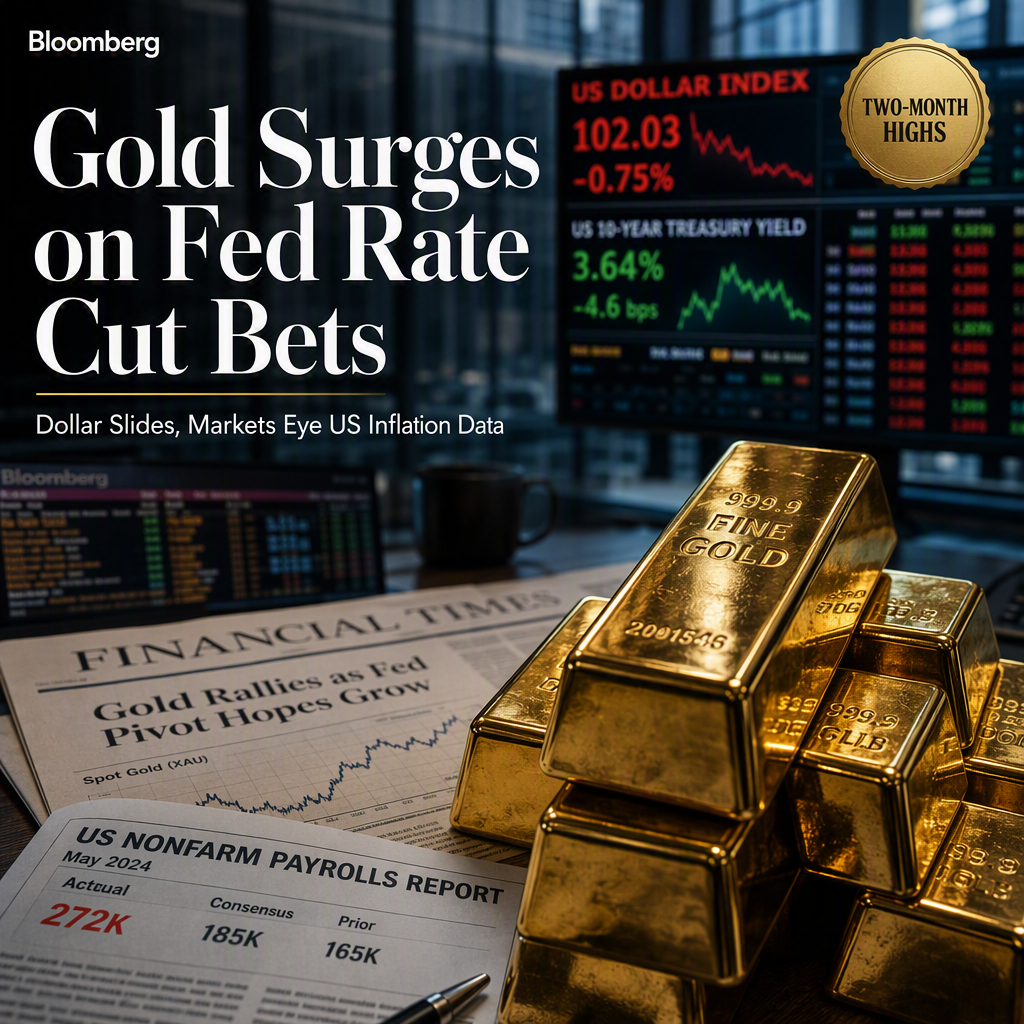
Gold (XAU/USD) consolidated gains near $4,343 on Monday after a sharp rally of more than 7% last week, reaching its highest level since June 17, 2024 [2][4]. The rally was triggered by a dovish shift in Federal Reserve (Fed) rate expectations following the release of the US Nonfarm Payrolls (NFP) report on Friday, which showed a 23,000 decline in net employment for July, significantly missing expectations of an 80,000 increase and accompanied by sharp downward revisions to previous months' data [1][4]. This labor market weakness led futures markets to reduce the probability of a September Fed rate hike to 42-44%, down from 67% a week earlier [1][2][4].
The US Dollar Index (DXY) attempted to stabilize near a two-month low, trading around 99.71, while the benchmark 10-year US Treasury yield held near 4.65%, below its recent peak of 4.74% [2]. Lower yields and a weaker dollar provided further support for gold prices [2][4]. Technical analysis indicates that XAU/USD maintains a bullish bias, trading above the 50-day Simple Moving Average (SMA) near $4,150, with resistance seen at $4,380 and further upside targets at $4,595 [2][4]. Despite overbought RSI levels, downside attempts have been limited, and momentum remains constructive [4].
Geopolitical developments in the Middle East also influenced market sentiment. Reports indicated that Iran and Oman are nearing an agreement to reopen the Strait of Hormuz, though Iran has tied the reopening to US concessions, including sanctions relief and security guarantees [1][2]. US President Donald Trump stated that Washington is 'semi-negotiating' with Tehran, but Iran denied direct talks [2]. Persistent uncertainty in the region has kept oil prices elevated, which in turn sustains some inflation concerns [1][2].
Strategists at Brown Brothers Harriman and ING highlighted that the risks around upcoming US inflation data are skewed against the US Dollar, with a soft Consumer Price Index (CPI) print likely to reinforce dovish Fed expectations and further weaken the dollar, while a hot print could trigger a short-term bounce [2][3]. However, BBH cautioned that with Fed policy already restrictive, the scope for a material hawkish repricing is limited, representing a continued headwind for the dollar [2].
Overall, the combination of weaker US labor data, dovish Fed repricing, and ongoing geopolitical risks has driven gold to multi-month highs and pressured the US Dollar, with markets now focused on upcoming US inflation data for further direction [1][2][3][4].
CONCLUSION
Gold's rally to two-month highs reflects a dovish shift in Fed rate expectations after disappointing US jobs data and ongoing geopolitical risks. The US Dollar remains under pressure, while traders await key US inflation data for further cues. Market sentiment is bullish for gold, with technicals and fundamentals both supporting further upside.