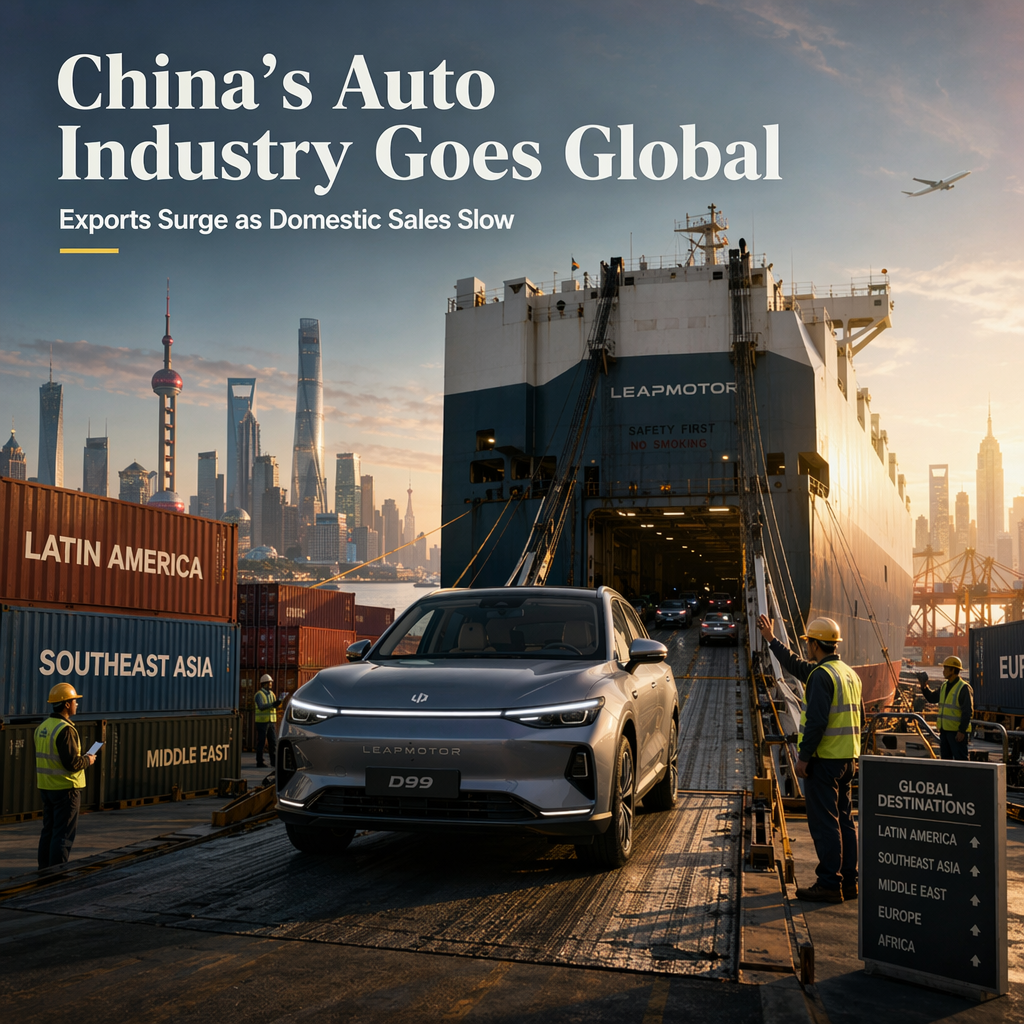
Chinese automakers are increasingly turning to exports as domestic demand for vehicles weakens, with the gap between strong factory output and softening local consumption becoming more pronounced in the industry [1]. Companies such as Leapmotor showcased their vehicles, including the D99 multipurpose vehicle, at international events like the Hong Kong auto show in June, highlighting their focus on overseas markets [1].
Financial data indicate a surge in vehicle exports, which is helping to offset the impact of declining sales within China [1]. Automakers are targeting new and underpenetrated regions, particularly in Latin America and Southeast Asia, where demand for electric vehicles (EVs) is growing and competition is less intense compared to saturated markets such as Europe and North America [1].
Industry experts caution that the external environment for exports is 'complex and volatile,' citing risks from trade policies, tariffs, and geopolitical tensions [1]. Despite these challenges, Chinese automakers are leveraging competitive pricing and technological advancements in EVs to accelerate their push into overseas markets [1].
Analysts emphasize that international expansion has become essential, rather than optional, for Chinese automakers to maintain growth momentum in the face of domestic headwinds [1]. However, they also warn that increased reliance on exports exposes companies to greater risks from global market fluctuations and regulatory changes [1]. The ongoing shift in strategy highlights both the strengths and vulnerabilities of China’s automotive sector in the current economic climate [1].
CONCLUSION
Chinese automakers are strategically increasing exports to counteract weakening domestic demand, focusing on growth in Latin America and Southeast Asia. While this pivot supports industry momentum, it also introduces new risks tied to global market volatility and regulatory uncertainty.