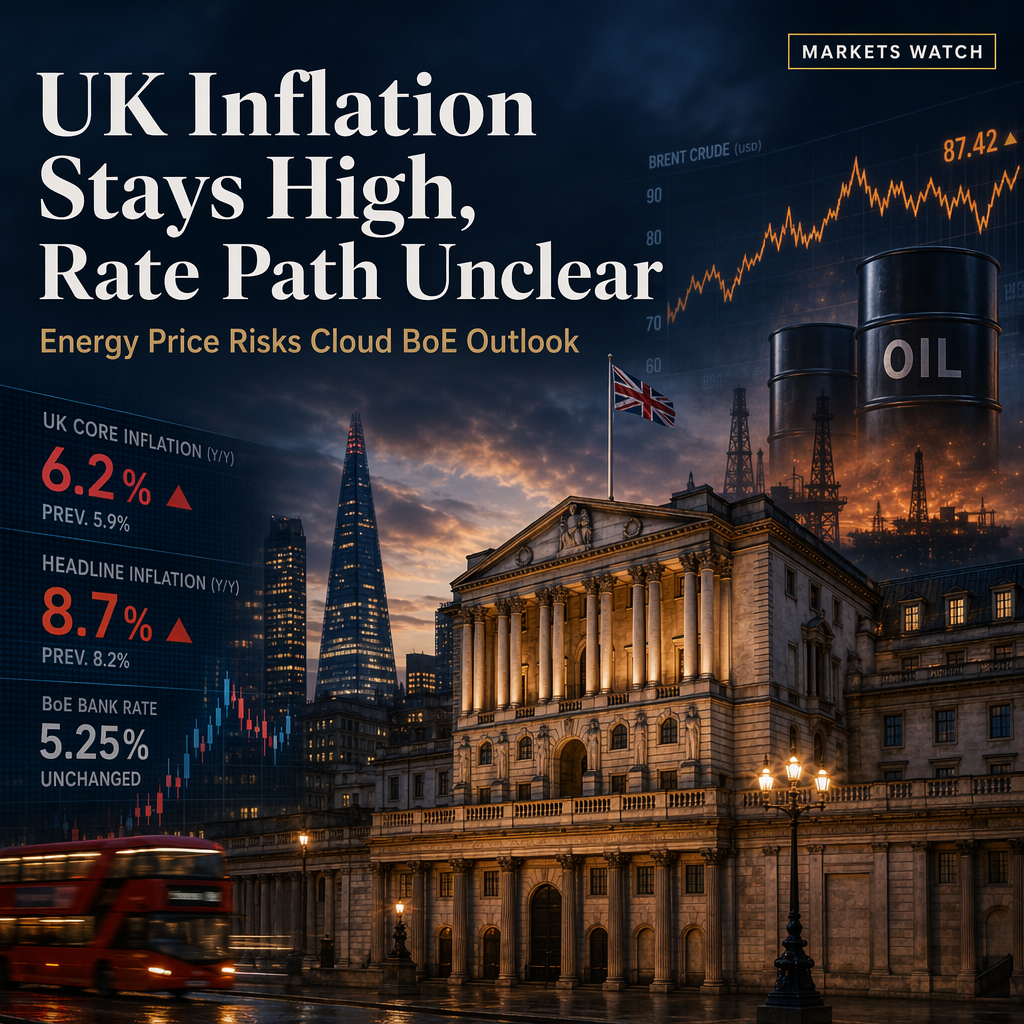
The latest United Kingdom (UK) June inflation data revealed that headline Consumer Price Index (CPI) fell by 0.2 percentage points to 2.6%, aligning with Bank of England (BoE) expectations and coming in below consensus forecasts [1][2]. However, both sources highlight that core inflation remained unchanged at 2.6% in June, and services inflation only declined marginally by 0.1 percentage points to 3.6%, missing consensus expectations for a larger drop [1][2]. Nomura strategists attribute the resilience in core and services inflation to falling food prices being offset by strength in information processing equipment and hotel/catering, as well as a sharp rise in upstream services prices, particularly in transport and storage [1].
Societe Generale economist Sam Cartwright notes that the headline CPI figure was below BoE projections, with fuel-driven disinflation and limited indirect energy effects observed so far [2]. Cartwright expects only modest increases in core inflation going forward, citing firms' limited pricing power as a constraint on passing higher input costs to consumers [2].
Looking ahead, Cartwright forecasts that the BoE will maintain the Bank Rate at 3.75% through 2026, with potential cumulative rate cuts of 75 basis points in 2027, bringing the rate to an estimated neutral level of 3% [2]. However, he flags that recent rises in Brent crude, refined oil products, and European wholesale gas prices could push headline inflation to peak closer to 3.5% year-on-year at the end of 2026, compared to a previous forecast of 3.0% [2]. The government's recently announced VAT cut on consumer electricity prices is expected to reduce headline CPI by around 0.1 percentage points [2].
Both sources emphasize that the persistence of core and services inflation complicates the BoE's policy path. While Nomura sees the inflation figures as less favorable than expected, Societe Generale highlights that energy price volatility—driven by geopolitical risks—could force the BoE to consider rate hikes if prices escalate, or bolster confidence in rate cuts if energy prices moderate [1][2].
CONCLUSION
UK inflation data for June showed headline CPI falling as expected but core and services inflation remaining stubbornly high, complicating the Bank of England's policy outlook. While the BoE is expected to hold rates steady through 2026, energy price risks could alter this trajectory. The persistence of underlying inflation pressures suggests a cautious approach from policymakers in the near term.