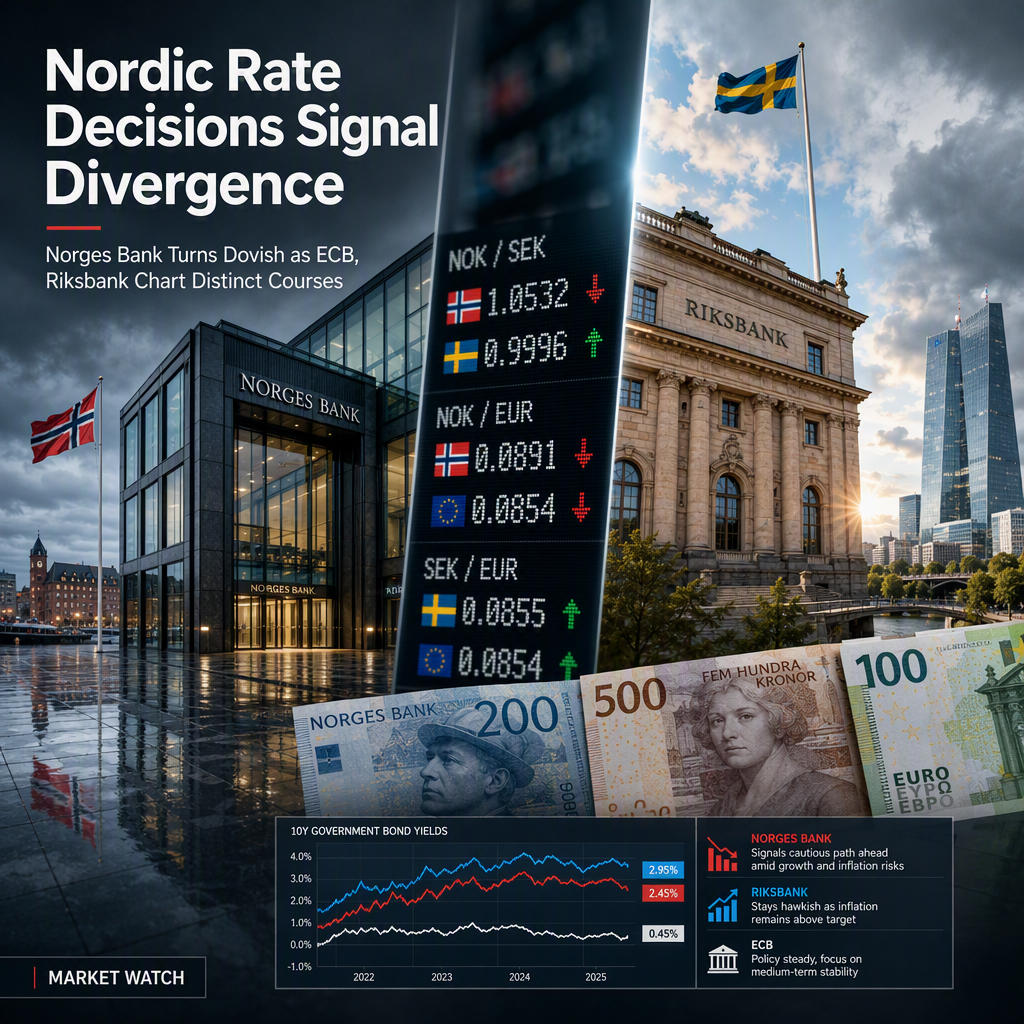
Norway’s central bank, Norges Bank, maintained its policy rate at 4.25% but adopted a more dovish tone, according to Societe Generale. While the bank still anticipates one further rate increase, it removed explicit guidance for a near-term hike, stating instead that 'it may thus still become necessary to raise the policy rate.' This shift comes as inflation has slowed and been lower than projected over the summer, though it remains elevated. New forecasts are expected in September, and Societe Generale warns that a dovish turn could reduce the Norwegian Krone’s (NOK) appeal for investors. Notably, the NOK is the only currency where the 2-year UST/NGB spread has widened (+4.4bp), which has diminished tactical support for the currency [1].
In contrast, Nordea strategists view the Swedish Krona (SEK) as undervalued, supported by robust domestic fundamentals and improving macroeconomic data. However, they note that momentum for SEK appreciation has faded into 2025–2026, and they are less bullish than before. The possibility of Riksbank rate hikes could support SEK by narrowing the policy rate differential with the ECB, but the upside is now seen as more limited. Nordea warns that if the Riksbank does not meet market expectations of 1-2 hikes by year-end, EUR/SEK could edge higher. Despite these constraints, Sweden’s healthy global risk appetite and favorable domestic conditions position it well to attract foreign capital [2].
Meanwhile, Nordea analysts Ole Håkon Eek-Nielsen and Jan von Gerich expect the European Central Bank (ECB) to deliver three additional 25bp rate hikes, taking the deposit rate to 3%. These hikes are projected to occur quarterly in September, December, and March 2027, rather than consecutively as previously expected. The outlook is shaped by gradually building inflation pressures, solid Euro-area growth, and low unemployment. However, the analysts highlight that risks to the rate path remain wide, particularly due to developments in the Middle East and potential energy-market disruptions. Even with a slower pace of ECB hikes, there is still room for longer bond yields to climb, supported by ample bond supply, Eurosystem reductions in bond holdings, and higher inflation-risk premia [3].
CONCLUSION
Norges Bank’s dovish shift may weaken the Norwegian Krone’s investment appeal, while the Swedish Krona’s upside is seen as constrained despite underlying strength. The ECB is expected to continue its tightening cycle, but at a slower pace, with risks tied to geopolitical and energy market developments. Overall, diverging central bank stances are shaping currency and bond market dynamics across the region.