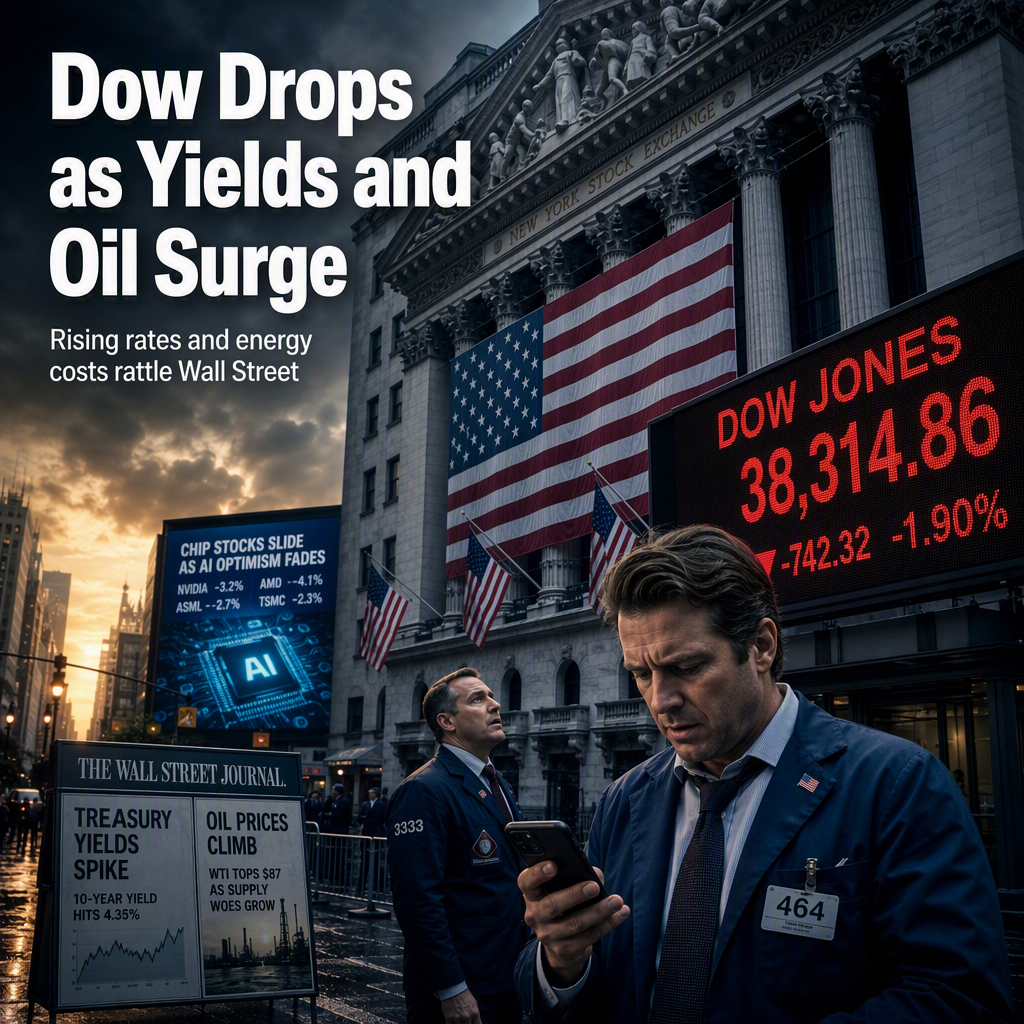
The Dow Jones Industrial Average fell by approximately 200 points, trading just under 52,400, as investors reacted to surging Treasury yields and rising crude oil prices [1]. The 10-year Treasury yield climbed above 5%, marking its highest level since 2023. This increase in yields has broad implications, as many consumer and corporate borrowing rates, such as the average 30-year mortgage (now at 6.76%, up from 6.15% at the start of the year), are tied to the 10-year yield [1]. The higher yield makes government bonds more attractive compared to stocks, with the Dow's dividend yield at about 1.4% versus the 5% offered by Treasuries [1].
The impact was particularly felt among Dow components exposed to the housing market, such as Home Depot (HD) and Sherwin-Williams (SHW), as higher mortgage rates dampen housing activity [1]. The Federal Reserve is set to vote in two days, but the bond market is already tightening financial conditions for housing-related stocks [1].
In the technology sector, a separate but related story unfolded as chip stocks sold off sharply. Nvidia (NVDA), the only chipmaker in the Dow, dropped around 3%, while other major chipmakers like Broadcom (AVGO), Advanced Micro Devices (AMD), Intel (INTC), and Marvell Technology (MRVL) fell between 4% and 7% [1]. This sell-off was triggered by public statements from AI leaders at Anthropic, OpenAI, and Elon Musk, who advocated for slowing the development of advanced AI models. The market interpreted this as a signal that fewer chips and data centers would be purchased, impacting tech stocks that have benefited from the AI boom over the past three years [1]. Microsoft (MSFT) and Amazon (AMZN), which are buyers rather than sellers of chips, held up better [1].
Additionally, crude oil prices surged, with West Texas Intermediate (WTI) rising over 3% to above $103 per barrel and Brent crude exceeding $108, following Saudi Arabia's closure of its East-West pipeline after drone strikes [1]. This pipeline, which carries up to 7 million barrels a day, is a critical export route for the kingdom. Higher oil prices represent increased costs for 29 of the 30 Dow components, with Chevron (CVX) being the exception as it benefits from higher crude prices. Consumer-facing companies like Walmart (WMT) and McDonald's (MCD) may face headwinds as higher fuel costs impact consumer spending [1].
CONCLUSION
The Dow Jones faced significant pressure from rising Treasury yields and surging oil prices, both of which increase costs and reduce the relative attractiveness of equities. The sell-off in chip stocks, driven by AI industry leaders' calls for slower model development, added to the negative sentiment. Overall, the market reaction was broadly negative, with few Dow components insulated from these headwinds.