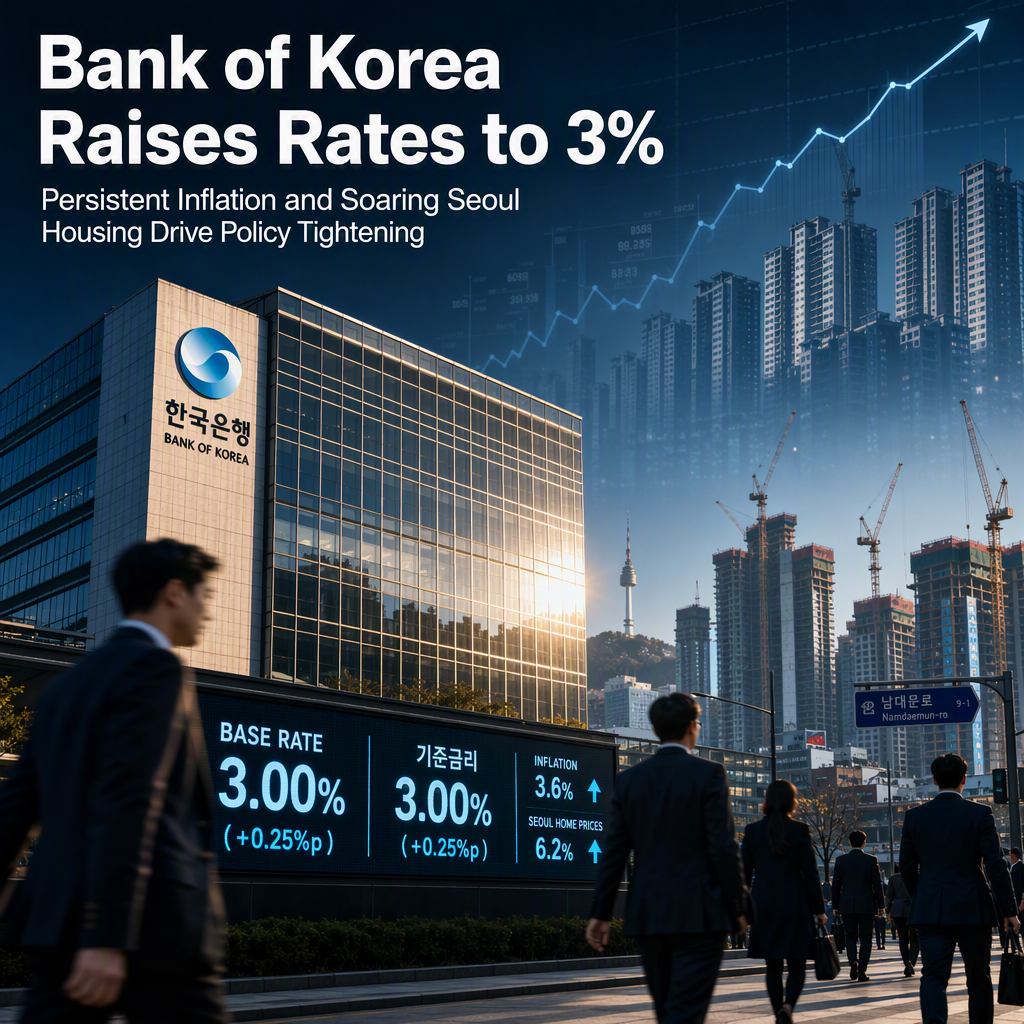
The Bank of Korea (BOK) raised its policy rate by 25 basis points to 3% on Thursday, marking the second consecutive rate hike as the central bank intensifies efforts to curb rising inflation pressures in South Korea [1]. This move brings the policy rate to its highest level since January 2025 and aligns with market expectations [1].
The decision follows a notable increase in core inflation, which reached 2.6% in July—the highest since December 2023 [1]. Although the headline inflation rate cooled slightly to 2.8% in July, it has been on an upward trajectory every month since February, coinciding with the onset of the Iran war, until June [1]. The BOK highlighted that persistent cost pressures and accelerating housing prices, particularly in Seoul, necessitate a continued policy stance that could include further rate hikes [1]. Housing prices in Seoul surged by 2.5% month on month in June, marking the steepest rise in five years, according to Asia Business Daily [1].
The central bank also pointed to robust growth in both export and domestic demand, driven by positive spillover effects from South Korea's semiconductor sector [1]. Despite these growth drivers, the BOK expects inflation to remain above its 2% target for a considerable period [1].
No specific forward-looking statements from analysts were cited, but the BOK's own guidance suggests a continued tightening bias as inflationary pressures persist [1].
CONCLUSION
The Bank of Korea's rate hike to 3% underscores its commitment to tackling persistent inflation and surging housing prices. With inflation expected to stay above target and strong economic growth projected, further policy tightening remains a possibility. Market participants are likely to interpret the move as a signal of ongoing vigilance against inflationary risks.