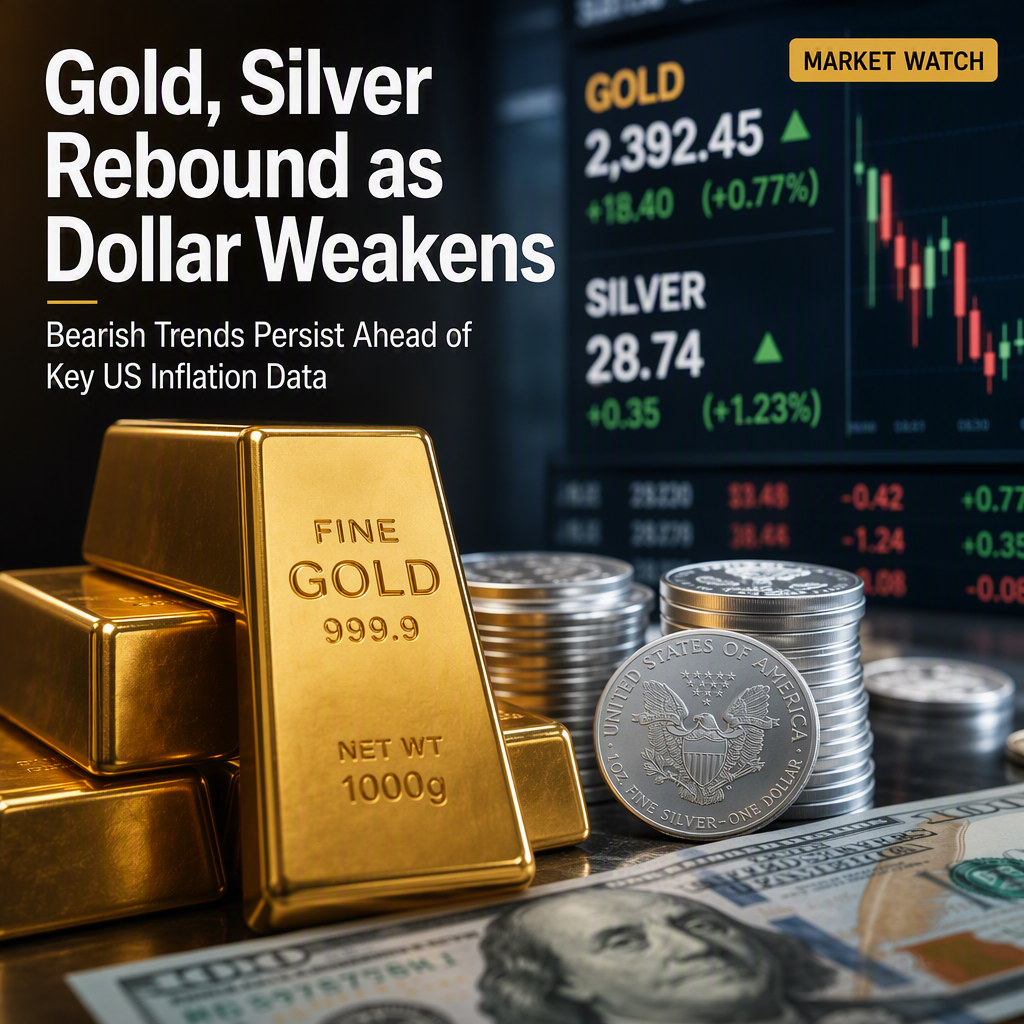
Gold (XAU/USD) trimmed recent losses on Wednesday, rebounding to the $4,400 level during the European morning session after hitting lows of $4,345 on Tuesday [1]. This recovery is attributed to broad-based weakness in the US Dollar, though the overall trend for gold remains bearish, with the metal having lost more than $100 over the previous three trading days [1]. Technical analysis indicates that gold remains capped below the 200-day Simple Moving Average, and momentum indicators such as the RSI and MACD suggest a neutral-to-bearish outlook, with rebounds considered vulnerable [1]. Key support levels are identified at $4,311 and $4,282, with a potential downside target at $4,223 if these are breached, while resistance is seen at $4,443 and $4,500 [1].
Silver (XAG/USD) also saw gains on Wednesday, rising to $66.58 per troy ounce, up 1.23% from $65.76 on Tuesday [2]. Despite this uptick, silver prices have declined by 6.34% since the start of the year [2]. The Gold/Silver ratio decreased slightly to 66.08 from 66.23 the previous day, indicating a marginally stronger performance for silver relative to gold [2].
Market participants are closely watching upcoming US Consumer Inflation data, which could influence expectations for a Federal Reserve interest rate hike next week [1]. According to strategists at Brown Brothers Harriman, a higher-than-expected CPI reading would likely solidify the case for a September rate hike and support a firmer US Dollar, while a cooler reading could lead to a more dovish outlook and further USD weakness [1]. However, they caution that even if a rate hike is confirmed, the USD may not reach new cyclical highs due to tightening by other major central banks, such as the ECB, which is expected to deliver a 25bps hike [1].
Both gold and silver are benefiting from their safe-haven status amid currency fluctuations, but technical and fundamental indicators suggest that the broader bearish trends remain intact, especially for gold [1][2].
CONCLUSION
Gold and silver prices rebounded on Wednesday, supported by a weaker US Dollar, though both metals remain in broader bearish trends. Upcoming US inflation data and central bank decisions are expected to be key drivers for future price action. Market sentiment is cautious, with technical indicators signaling vulnerability to further downside, particularly for gold.