
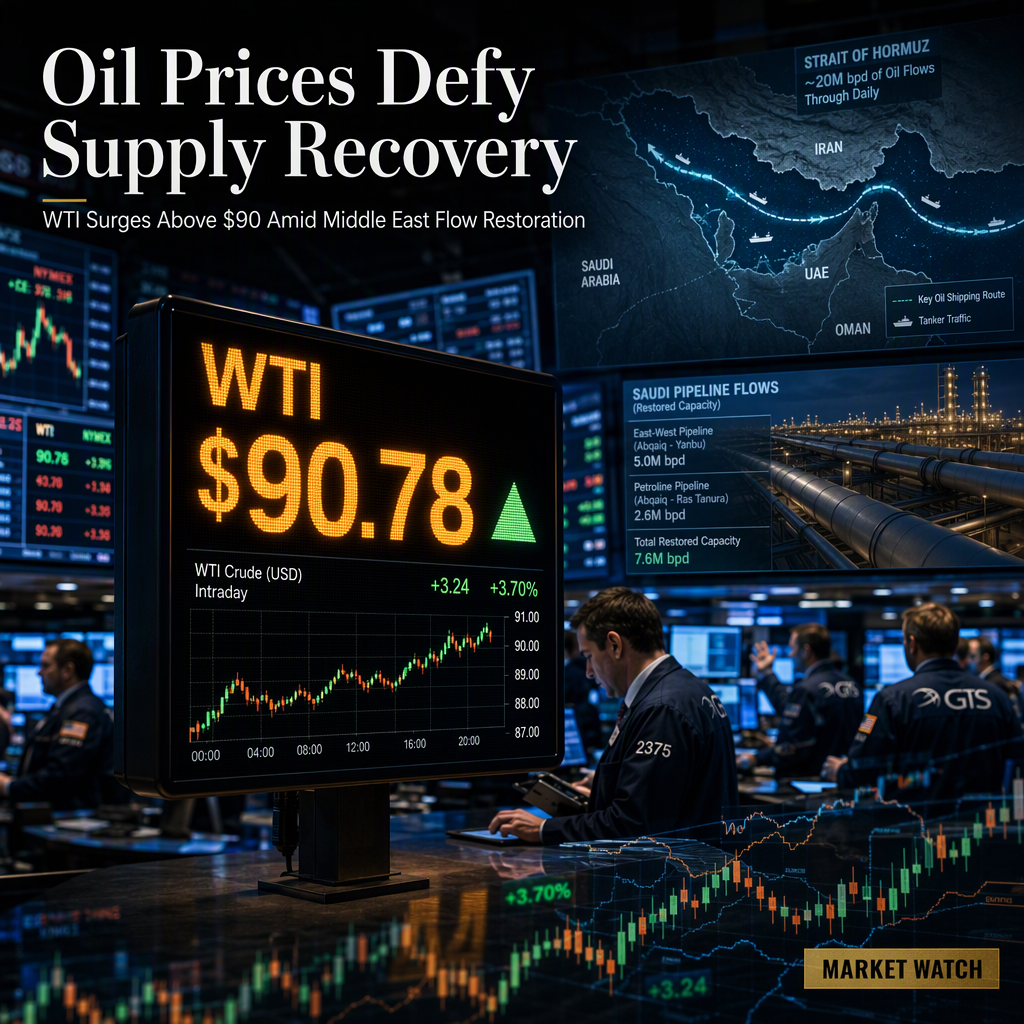
West Texas Intermediate (WTI) crude oil futures on NYMEX rebounded sharply, erasing early losses and climbing 1.7% to trade near $91.00 during European hours, after attracting significant bids just below $88.00 [1]. This recovery occurred even as energy flows through the Middle East have returned to, and in some cases exceeded, pre-war levels. The restoration of half of the flows through Saudi Arabia’s East-West pipeline and continued safe passage for shipments through the Strait of Hormuz, supported by United States military escorts, have contributed to improved overall supply [1].
According to Kpler data cited by CNBC, crude oil shipments from the Middle East, including the Persian Gulf and Red Sea, reached a seven-day average of 19.5 million barrels per day as of Monday, surpassing the prewar baseline of approximately 17 million barrels per day [1]. Kpler also noted that Iran is losing its dominance over the Strait of Hormuz, with strong volumes passing through the passage despite Tehran's previous claims of control and threats to close the strait [1].
From a technical perspective, WTI US Oil is trading at $90.78, just below the 20-day Exponential Moving Average (EMA) at $91.41, indicating a mildly bearish near-term bias and a loss of immediate upside traction despite the broader uptrend [1]. The Relative Strength Index (14) stands at 50.12, suggesting a consolidative momentum backdrop with limited directional conviction following the recent retreat from the $100 area [1]. Key resistance is at the 20-day EMA ($91.41), while support lies at the former breakout area and uptrend support line around $86.53 [1].
CONCLUSION
WTI oil prices have rebounded above $90 despite a recovery in Middle East supply to pre-war levels, reflecting ongoing market volatility and technical consolidation. While supply concerns have eased, technical indicators suggest limited immediate upside, with key resistance and support levels in focus for future price action.