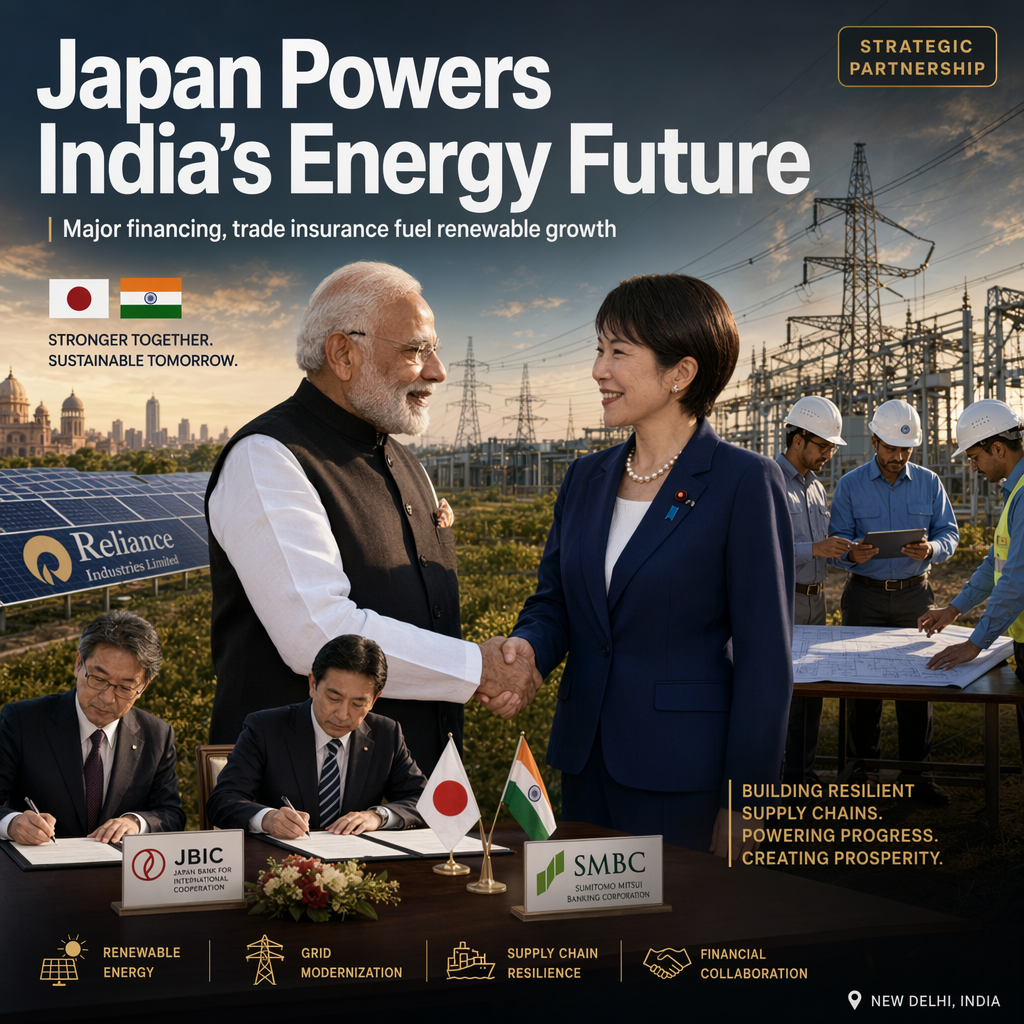
Japan is significantly expanding its financial and strategic involvement in India's energy sector through a series of major initiatives. State-backed Japan Bank for International Cooperation (JBIC), Sumitomo Mitsui Banking Corp. (SMBC), and other lenders will provide up to 80 billion yen ($492 million) in financing to develop India's power grid. This project, to be announced alongside a meeting between Indian Prime Minister Narendra Modi and Japanese Prime Minister Sanae Takaichi in New Delhi, aims to upgrade and expand India's electricity transmission infrastructure, thereby strengthening the country's energy security and supporting economic growth. The funds are earmarked for the construction and upgrade of transmission lines, substations, and related infrastructure to meet India's rising electricity demand [1].
In a parallel move, Japan will offer trade insurance on a 100 billion yen ($616 million) syndicated loan to Reliance Industries, an Indian conglomerate, to support its solar and battery production expansion. This initiative is designed to mitigate financial risks for Japanese lenders and encourage greater participation by Japanese companies in India's renewable energy sector. The effort aligns with India's goal to boost domestic production of solar power equipment and reflects a broader policy objective to deepen supply chain cooperation and economic ties between the two countries [3].
The involvement of JBIC and major Japanese banks in these projects underscores Japan's commitment to supporting India's energy transition and infrastructure modernization. These deals are part of a wider trend of strategic cooperation, as both governments seek to enhance bilateral economic and energy relations. The trade insurance arrangement for Reliance Industries is specifically intended to create new opportunities for Japanese manufacturers in the Indian market and to strengthen supply chain resilience [1][3].
While JBIC's recent activities have also included a notable increase in U.S. financing, reflecting a shift toward economic security and supply chain fortification, its continued engagement in India demonstrates a dual focus on both emerging markets and established partners. JBIC is expected to maintain and expand its overseas investments in line with Japan's national security and economic objectives [2].
CONCLUSION
Japan is making a substantial commitment to India's energy and manufacturing sectors through large-scale financing and trade insurance initiatives, reinforcing strategic cooperation between the two nations. These moves are expected to accelerate India's energy infrastructure upgrades and renewable energy production, while also opening new avenues for Japanese companies. The market impact is high, reflecting the scale and strategic importance of these agreements.