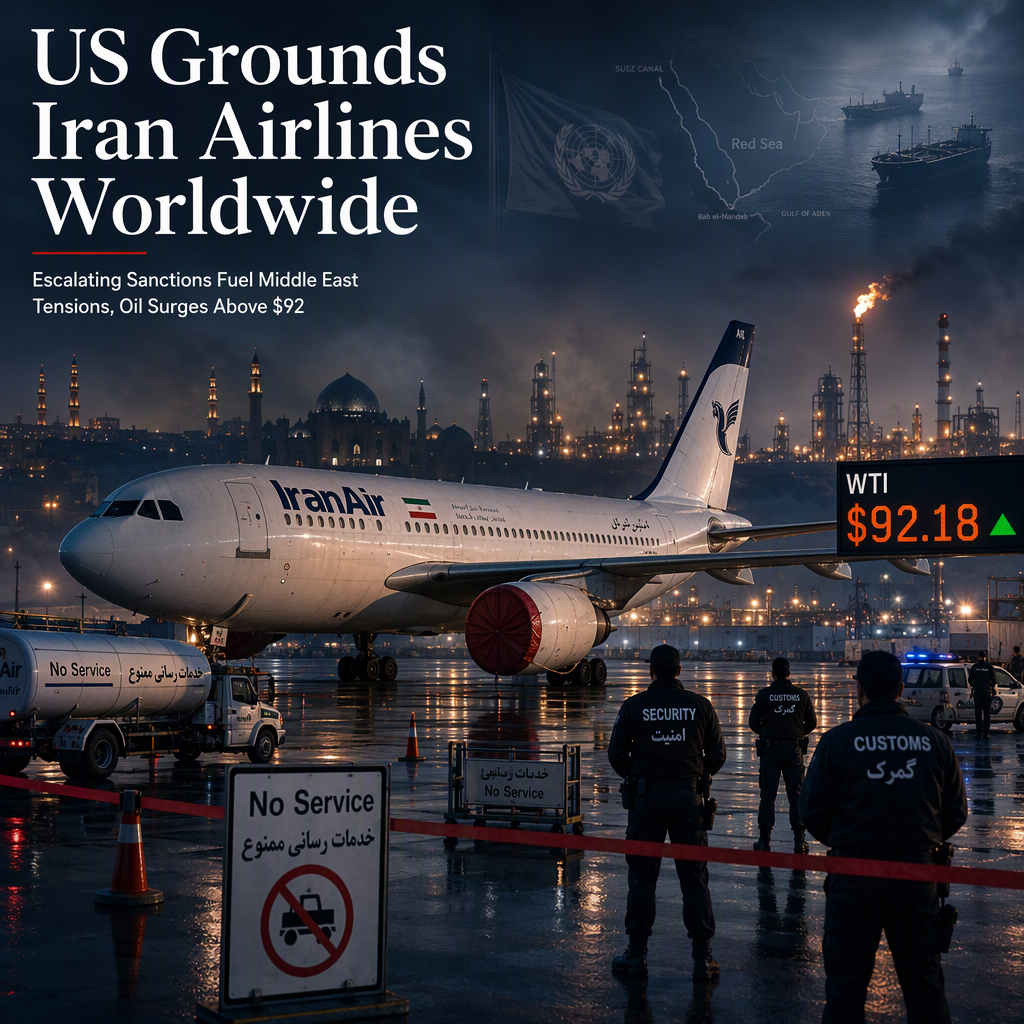
The United States Treasury Secretary Scott Bessent announced that all Iranian airlines will be effectively shut out of international travel starting September 23, 2026, as the US threatens foreign companies with secondary sanctions if they continue servicing Iran's carriers [2][3]. Bessent stated, "If they land, you cannot provide them with fuel, you cannot provide them with landing services, you cannot sell them tickets, or you will be knocked out of the dollar system" [2][3]. This move is part of the Trump administration's escalating economic campaign against Tehran, which has continued alongside the ongoing US-Iran war [2]. Washington is also pressuring Iran by sanctioning banks and preventing financial transactions, including new sanctions on Russia's state-controlled VTB Bank to economically isolate Iran by targeting its business partners and financial enablers [3].
Meanwhile, West Texas Intermediate (WTI) oil prices halted a four-day losing streak, trading around $92.30 per barrel during Asian hours on Tuesday, up 0.41% on the day at $92.18 [1][2]. The price increase comes despite easing supply concerns in the Middle East and growing diplomatic efforts to end the US-Iran conflict, including President Trump's scheduled address at the UN General Assembly and potential meetings with Iranian President Masoud Pezeshkian, Gulf nations, and Chinese President Xi Jinping [1]. Saudi Arabia moved crude through the Strait of Hormuz at 2.9 million barrels per day over the past six days, and satellite images showed supertankers with a combined capacity of 14 million barrels at Saudi Arabia’s Gulf export terminals, marking the highest tanker count since at least June [1].
Tensions remain high as Yemen's Iran-backed Houthis launched attacks against Riyadh and a Saudi Aramco facility in Yanbu, and intensified maneuvers to block Saudi-backed forces from accessing the Red Sea coast [1][3]. The UK has pledged support to Saudi Arabia against the Houthi rebels, with the Royal Air Force providing air-to-air refueling for Saudi planes, while European nations may also offer assistance [3]. Houthi rebels have seized Yemen's Perim Island on the Red Sea, tightening their grip on the Bab el-Mandeb Strait, which, along with the Strait of Hormuz, are critical oil choke points [3].
According to TD Securities, speculative positioning in the crude complex has increased in recent weeks, but CTAs are now liquidating a portion of their recently acquired WTI and Brent crude oil length, indicating a more cautious stance among systematic traders despite the build-up in overall speculative exposure [1].
Forward-looking statements from UK Prime Minister Andy Burnham suggest that the arrangement to support Saudi Arabia will be kept under review, and NATO Secretary Mark Rutte indicated that European nations may coordinate further support for Saudi Arabia [3].
CONCLUSION
The US-imposed shutdown of Iranian airlines and heightened sanctions mark a significant escalation in economic pressure on Tehran, coinciding with persistent Middle East tensions and attacks on Saudi infrastructure. Despite diplomatic efforts and increased oil flows from Saudi Arabia, WTI prices have rebounded, reflecting ongoing market concerns about supply disruptions. The situation remains fluid, with international support for Saudi Arabia and cautious speculative trading signaling continued volatility in the oil market.