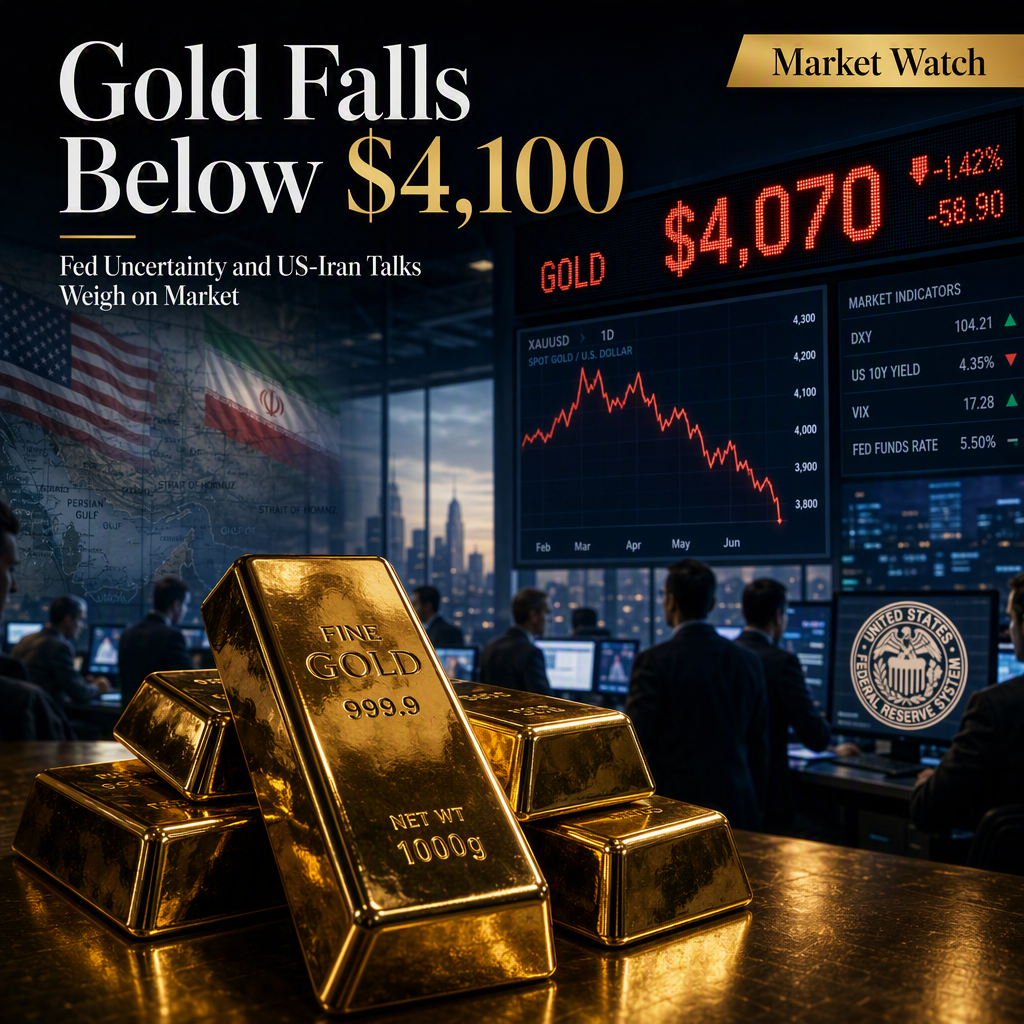
Gold (XAU/USD) declined to near $4,070 during the early Asian session on Wednesday, as traders assessed the Federal Reserve’s interest-rate outlook amid ongoing uncertainty in the Middle East [1]. The Guardian reported that US Secretary of State Marco Rubio noted progress in discussions with Iran and Oman regarding the passage of ships through the Strait of Hormuz, though no final agreement has been reached. US Treasury Secretary Scott Bessent indicated that Washington could reach a deal with Tehran by tomorrow to reopen the critical waterway [1].
The potential easing of US-Iran tensions could alleviate energy-driven inflation fears and lead traders to reduce bets on further Fed interest-rate hikes, which may support gold prices. Currently, markets have priced in nearly a 60% chance that the US central bank will hike rates at the September meeting, according to the CME FedWatch tool [1]. However, uncertainty remains high as there are no direct talks between the US and Iran, with Qatar’s Foreign Ministry stating that efforts are in 'very progressive stages' and drafts of a potential agreement are being circulated [1].
Market participants are expected to remain cautious ahead of the upcoming US employment data due on Friday, which could provide further insight into the Fed’s monetary policy path. Bart Melek, global head of commodity strategy at TD Securities, commented that any signs of economic weakness would likely benefit gold, as it would reduce the need for the central bank to act on interest rates [1].
ING strategist Ewa Manthey observed that gold’s recent recovery is constrained by conflicting drivers, with the metal likely to remain caught between improving geopolitical sentiment and ongoing uncertainty over US interest rates. While easing Middle East tensions and softer inflation pressures have supported gold’s latest bounce, expectations of US rates staying higher for longer continue to limit further gains [1].
From a technical perspective, XAU/USD maintains a bearish near-term tone below the 100-day Moving Average, with the Relative Strength Index (14) at 47.71 indicating neutral, consolidative momentum. Resistance is seen at the Bollinger upper band near $4,140 and the 100-day MA around $4,405, while initial support aligns with the Bollinger middle band [1].
CONCLUSION
Gold prices are under pressure as traders weigh the impact of US-Iran negotiations and the Federal Reserve’s interest-rate outlook. While easing geopolitical tensions could support gold, persistent uncertainty over US monetary policy continues to cap gains. Market participants are expected to remain cautious ahead of key US employment data later this week.