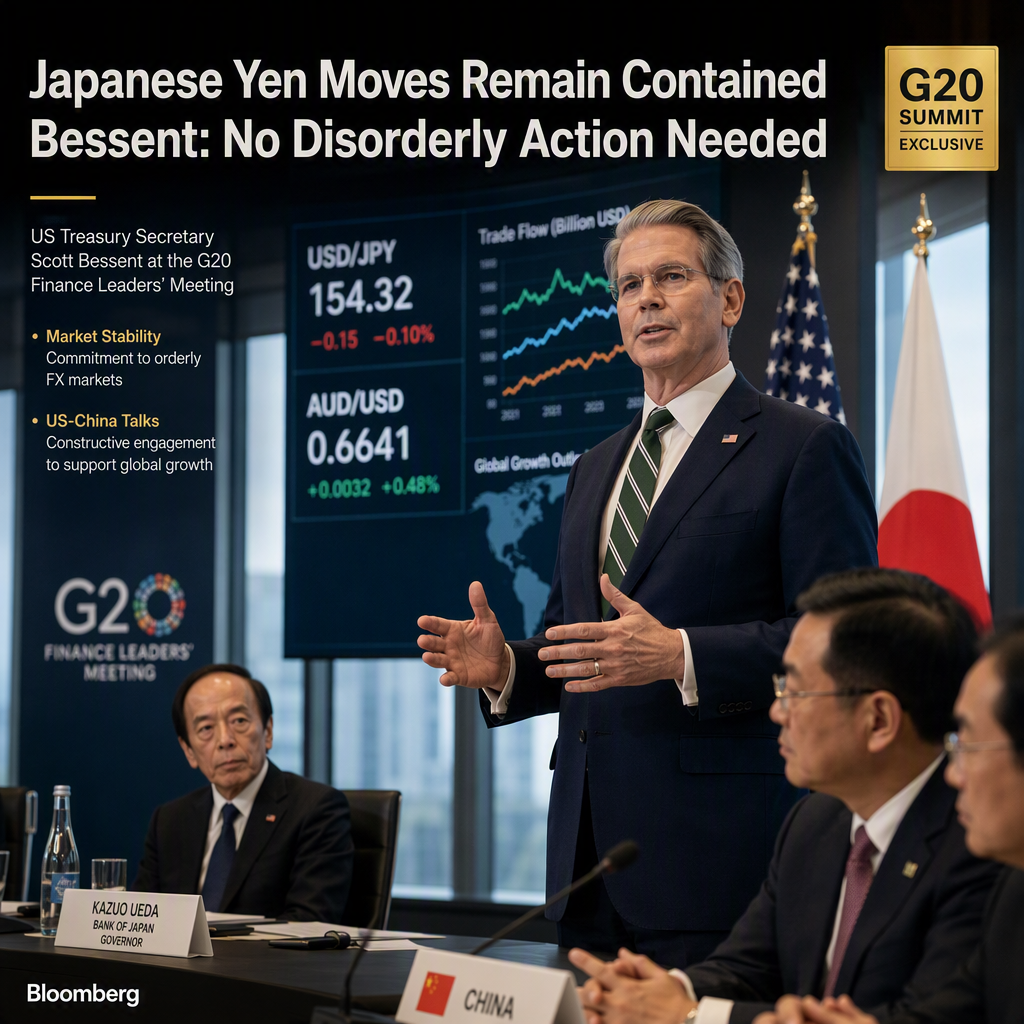
US Treasury Secretary Scott Bessent commented on Sunday that recent movements in the Japanese Yen (JPY) are 'pretty well contained,' indicating that the currency's renewed weakness does not constitute disorderly moves that would prompt intervention similar to the rare joint Japan-US action seen last month [1]. Bessent noted that Japan has likely reached the end of its Abenomics reflation program and praised Bank of Japan (BoJ) Governor Ueda as an underrated, market-savvy economist, stating that with Prime Minister Takaichi's support, Ueda will act appropriately on monetary policy [1]. Bessent also mentioned that he would meet BoJ's Ueda on the sidelines of the G20 finance leaders' summit [1].
Regarding market reactions, the USD/JPY pair was up 0.02% on the day at 160.15, while the AUD/USD pair was down 0.06% to 0.7160 at the time of reporting [1]. Bessent refrained from advising whether the BoJ should consider back-to-back rate increases, emphasizing that the Japanese government should 'sit back and enjoy' the success of Abenomics and let it run [1].
On the China front, Bessent stated that Washington will hold 'very robust' talks with China, focusing on preventing powerful models from getting into non-state actors' hands [1]. He also highlighted the US's improving direct trade position with China and plans to pursue tariff cuts on $30 billion in non-strategic goods for each side [1]. Bessent urged G20 nations to reassess trade terms with China to lower global imbalances, suggesting that tougher trade barriers on Chinese goods would encourage Beijing to shift its economy from exports to domestic demand [1]. He noted that the world cannot accept China maintaining a $1.2 trillion trade surplus [1].
It remains unclear whether Bessent will meet Chinese vice premier He Lifeng in person before the Trump-Xi summit scheduled for late September [1].
CONCLUSION
US Treasury Secretary Bessent's remarks suggest that recent Japanese Yen movements are not disorderly and do not warrant intervention, with the USD/JPY pair showing minimal change. The focus remains on robust US-China trade talks and reassessment of global trade terms. Market sentiment is cautiously positive, with medium impact expected as policymakers emphasize stability and ongoing dialogue.