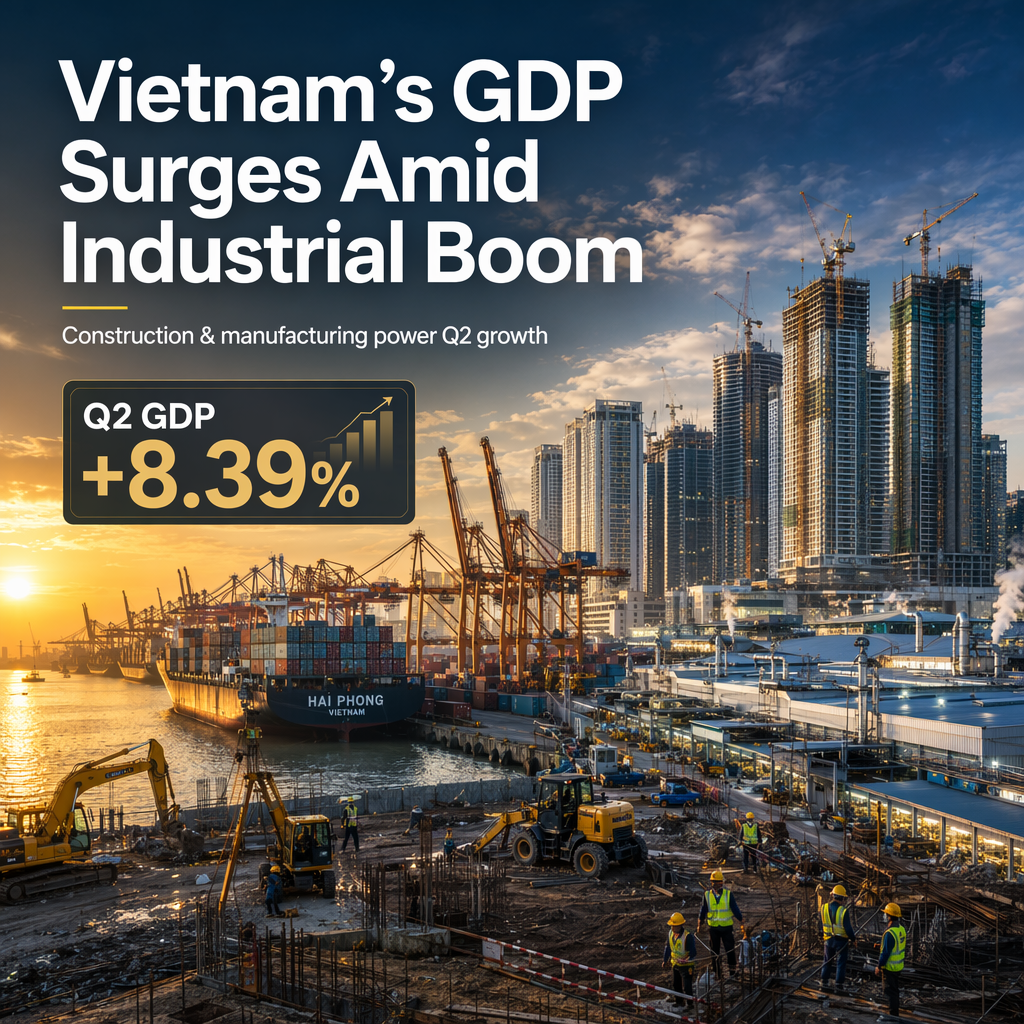
Vietnam's economy expanded by 8.39% in the April-June quarter, up from 7.83% in the first quarter of the year, according to the country's statistics office. This robust growth was primarily driven by strong performances in the construction and manufacturing sectors, which continue to serve as the main engines of economic expansion [1]. For the first half of the year, Vietnam's GDP rose by 8.18%, placing pressure on the government to achieve its ambitious annual growth target of 10% [1].
The port of Haiphong remains a critical gateway for Vietnam's export-driven economy, underscoring the importance of sustained export activity and industrial output to maintain the current growth trajectory [1]. Analysts note that while the acceleration in GDP signals resilience in Vietnam’s economic fundamentals, the country faces challenges such as rising fuel costs and inflation, which has reached its highest level since 2020 [1]. These factors have contributed to a widening trade deficit due to increased fuel expenditures [1].
Market observers maintain a positive outlook, citing continued investment and infrastructure development as supportive factors for growth. However, some analysts caution that global uncertainties and commodity price fluctuations could pose risks to Vietnam's growth projections in the second half of the year [1]. The government is expected to closely monitor inflationary pressures and trade dynamics to ensure economic stability [1].
CONCLUSION
Vietnam's Q2 GDP growth demonstrates strong economic momentum, largely fueled by construction and manufacturing. While market sentiment remains positive, the government faces the dual challenge of sustaining this pace to meet its 10% annual target and managing inflationary pressures and trade deficits. Ongoing vigilance regarding global risks and commodity prices will be crucial for maintaining growth.