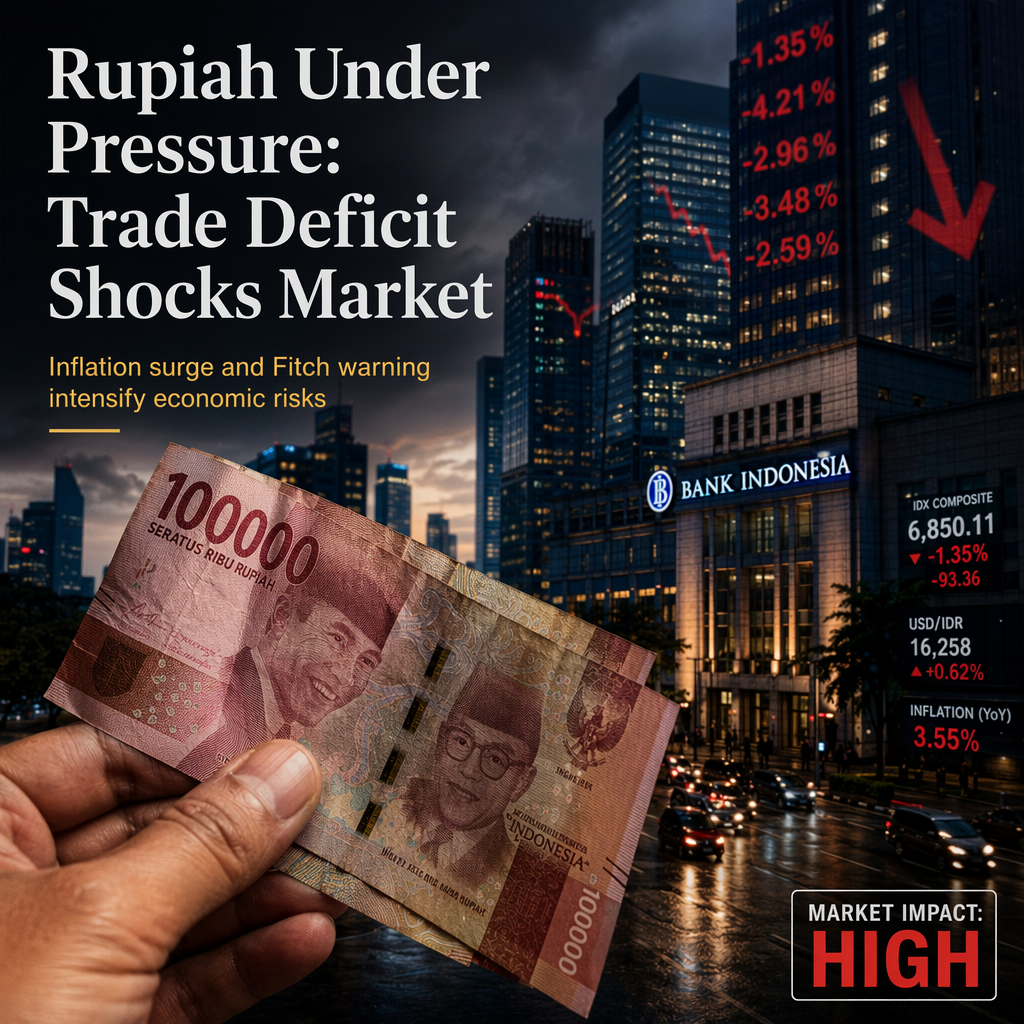
The Indonesian Rupiah (IDR) declined against the US Dollar (USD), with the USD/IDR pair trading around 18,000 during Asian hours on Friday, following minor losses the previous day [1]. This depreciation comes amid Indonesia's surprise $1.61 billion trade deficit in May, its first since 2020, and a three-month inflation high of 3.34% in June [1]. The trade deficit was driven by falling exports and surging imports, raising concerns about the country's economic outlook [1]. Fitch Ratings has warned that declining foreign exchange reserves could threaten Indonesia's credit rating if the trend continues [1].
On the US side, the Dollar held its position despite disappointing domestic labor data released on Thursday. The June Nonfarm Payrolls (NFP) report showed the US economy added just 57,000 jobs, missing the market consensus of 110,000 [1]. However, the headline unemployment rate unexpectedly ticked downward to 4.2% from May's 4.3% [1]. The severe hiring slowdown signals a cooling broader economy, prompting traders to scale back their hawkish bets. According to the CME FedWatch tool, financial markets are now pricing in a 52% chance of a September interest rate hike, down sharply from 66% before the NFP release [1].
Federal Reserve Chair Kevin Warsh, speaking at the ECB's Sintra conference, reaffirmed the central bank’s commitment to a 2% price stability target and acknowledged that inflation risks and expectations have begun to moderate over the past month [1].
The combination of Indonesia's trade deficit, rising inflation, and warnings from Fitch Ratings has heightened risk-off sentiment, leading investors to favor safer assets and currencies such as the US Dollar [1].
CONCLUSION
Indonesia's unexpected trade deficit and rising inflation have pressured the Rupiah, raising concerns about the country's economic stability and credit rating. Meanwhile, US labor market weakness has tempered expectations for aggressive rate hikes, but the Dollar remains resilient amid global risk-off sentiment. The market impact is high, with investors closely watching Indonesia's economic developments and US monetary policy signals.