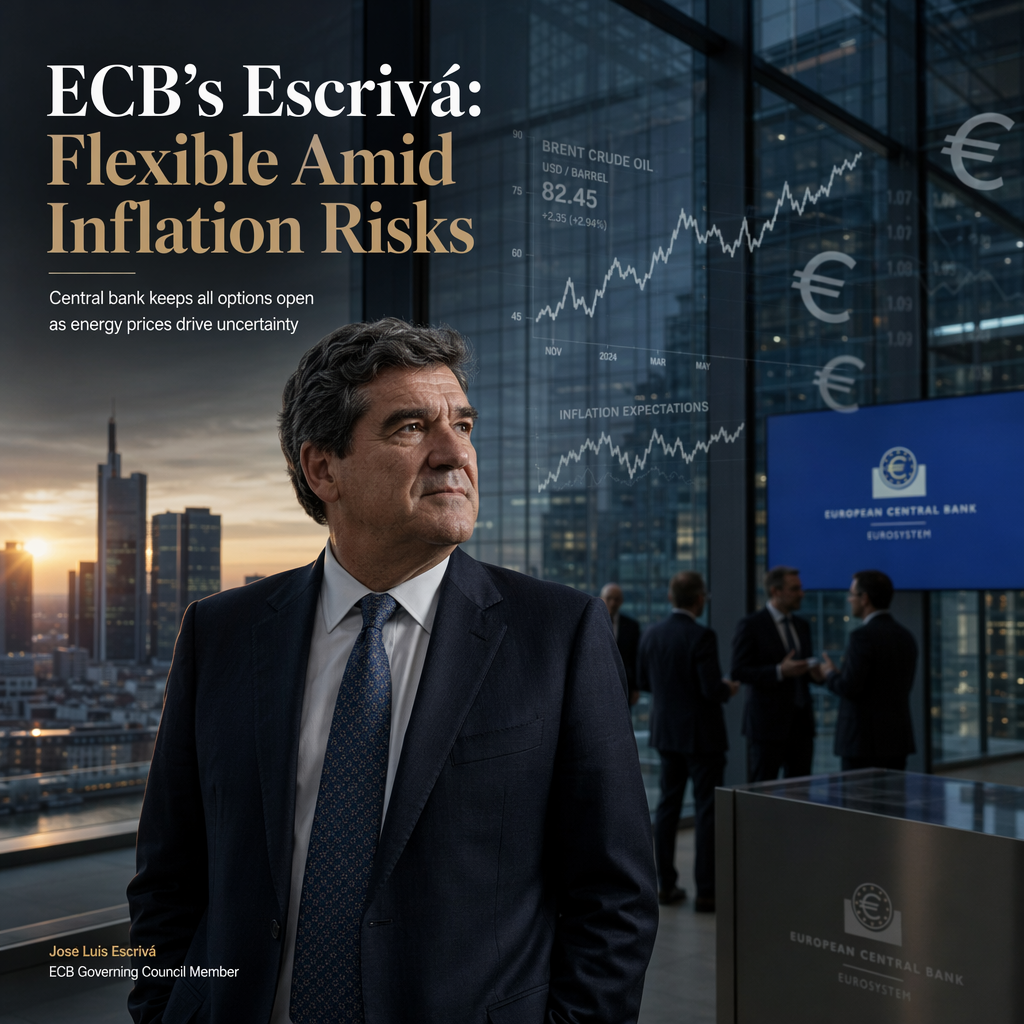
European Central Bank (ECB) policymaker and Governor of the Bank of Spain, José Luis Escrivá, stated that the central bank will "keep all options on the table and decide on a meeting-by-meeting basis" in response to ongoing economic developments [1]. Escrivá highlighted that the recent rise in oil prices has begun to affect other prices in the economy, including services inflation, transport costs, and food prices, prompting the ECB to raise interest rates [1]. He noted that while monetary policy typically looks through one-off energy price shocks, the indirect effects observed in recent months have warranted a policy response [1].
Escrivá also indicated that if the recent decline in oil prices persists, the factors concerning policymakers would gradually ease, suggesting that energy-driven inflation risks could diminish over time [1]. Despite this, he emphasized the need for the ECB to remain agile and flexible given the prevailing uncertainty, reiterating that decisions will be made on a meeting-by-meeting basis [1].
Market reaction to Escrivá’s comments was muted, with EUR/USD trading modestly flat around 1.1400 at the time of reporting [1]. Escrivá’s remarks were assessed as mildly more hawkish than usual, as reflected by his 6.2/10 FXS Speechtracker score, which is above the historic 5.4/10 baseline [1]. However, his conditional statements regarding energy prices tempered the hawkish tone, leaving market participants focused on upcoming energy and inflation data for further direction [1].
CONCLUSION
ECB’s Escrivá underscored the central bank’s flexible and data-dependent approach amid ongoing energy-driven inflation risks. While recent policy actions have been in response to indirect effects from rising oil prices, the ECB remains poised to adjust its stance as new data emerges, keeping markets attentive to future developments.