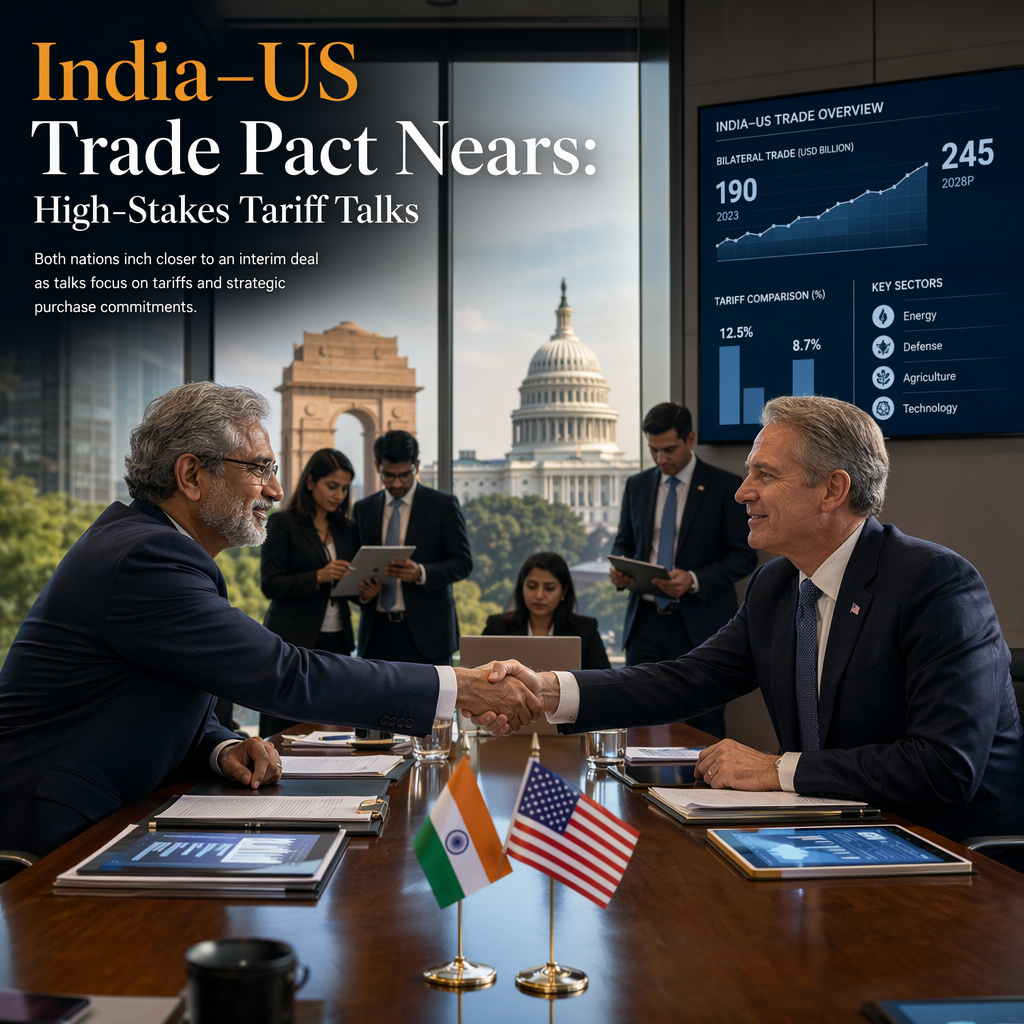
India and the United States are close to finalizing an interim trade agreement under a new framework that was first agreed upon in February, according to DBS economist Radhika Rao [1]. The Indian government has been pushing for tariff advantages compared to regional manufacturing peers and has sought assurances from the US administration that higher duties will not be imposed once the deal is concluded [1].
The tariff landscape has shifted notably after a court decision earlier in the year overruled the IEEPA tariffs, which were subsequently replaced by a 10% blanket rate effective until July 24. Additionally, Section 301 investigations indicate that tariffs of 10-12.5% may be applied to selected product groups [1].
US Trade Representative Jamieson Greer is expected to visit India on June 23-24 to finalize discussions. Indian authorities are likely to push for better terms than those agreed in February, aiming to secure a larger share in bilateral trade and investment commitments [1].
US officials have previously indicated that India committed to purchasing $500 billion worth of US products in the future, which would represent an approximate ninefold increase compared to the FY26 run rate. This target is described as a 'tall order' by the source [1].
CONCLUSION
India and the US are on the verge of formalizing an interim trade agreement, with both sides negotiating tariff structures and ambitious purchase commitments. While the deal could boost bilateral trade and investment, the scale of India's proposed purchases from the US appears challenging. Market participants will be watching the upcoming discussions for concrete outcomes.