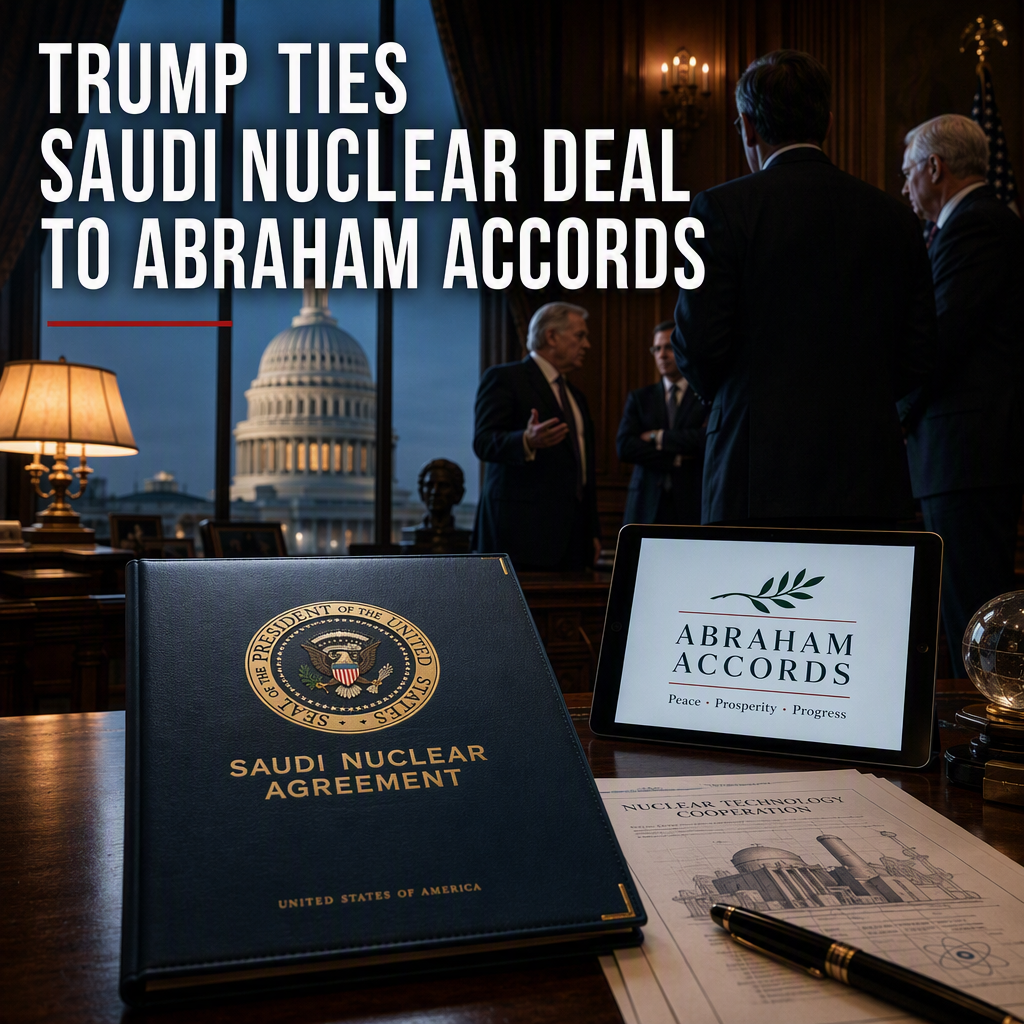
President Donald Trump has submitted a proposed civil nuclear energy agreement with Saudi Arabia to Congress, initiating a mandatory review period for a pact that would allow U.S. companies to export civilian nuclear technology to the kingdom [1]. The deal, reached in July, is a 30-year accord that calls for Saudi Arabia to build AP1000 reactors, a project valued at tens of billions of dollars and expected to benefit Westinghouse, which is jointly owned by Cameco and Brookfield Asset Management [1].
A U.S. official confirmed that the agreement, led by the Department of Energy, is consistent with the Atomic Energy Act and will only proceed if Saudi Arabia joins the Abraham Accords, as reiterated by President Trump [1]. Congress now has 90 days of continuous session to review the agreement, after which it would go into effect unless there is an objection [1].
Trump has stated that the terms of the agreement would prevent Saudi Arabia from enriching uranium, emphasizing in a social media post that "There will be no enrichment of material!" and that the deal is "totally subject to Saudi Arabia joining the very respected and successful Abraham Accords" [1]. However, some Democratic lawmakers and nonproliferation advocates have criticized the pact for not including a permanent prohibition on enrichment or reprocessing, and for weakening standard controls against converting the technology to military use [1]. The deal instead proposes a U.S.-built and operated enrichment facility subject to a two-year feasibility study [1].
Analyst Matthew Kroenig of the Atlantic Council expects the feasibility study to conclude that Saudi Arabia should rely solely on imported fuel-cycle services, as most countries with peaceful nuclear programs do, which he views as a preferable outcome to exporting bomb-making capability to another country in a volatile region [1]. Erin Dumbacher of the Council on Foreign Relations noted that the agreement takes a distinct approach from the stringent nonproliferation measures the U.S. has previously insisted upon when exporting nuclear energy [1].
CONCLUSION
Trump's submission of the Saudi nuclear deal to Congress marks a significant step in U.S.-Saudi relations, with major implications for companies like Cameco and Brookfield Asset Management. The deal's conditionality on Saudi Arabia joining the Abraham Accords and its approach to enrichment have sparked debate among lawmakers and experts, highlighting both commercial opportunities and proliferation concerns. The outcome of Congress's review and the feasibility study will be critical for the deal's future and its impact on the global nuclear order.