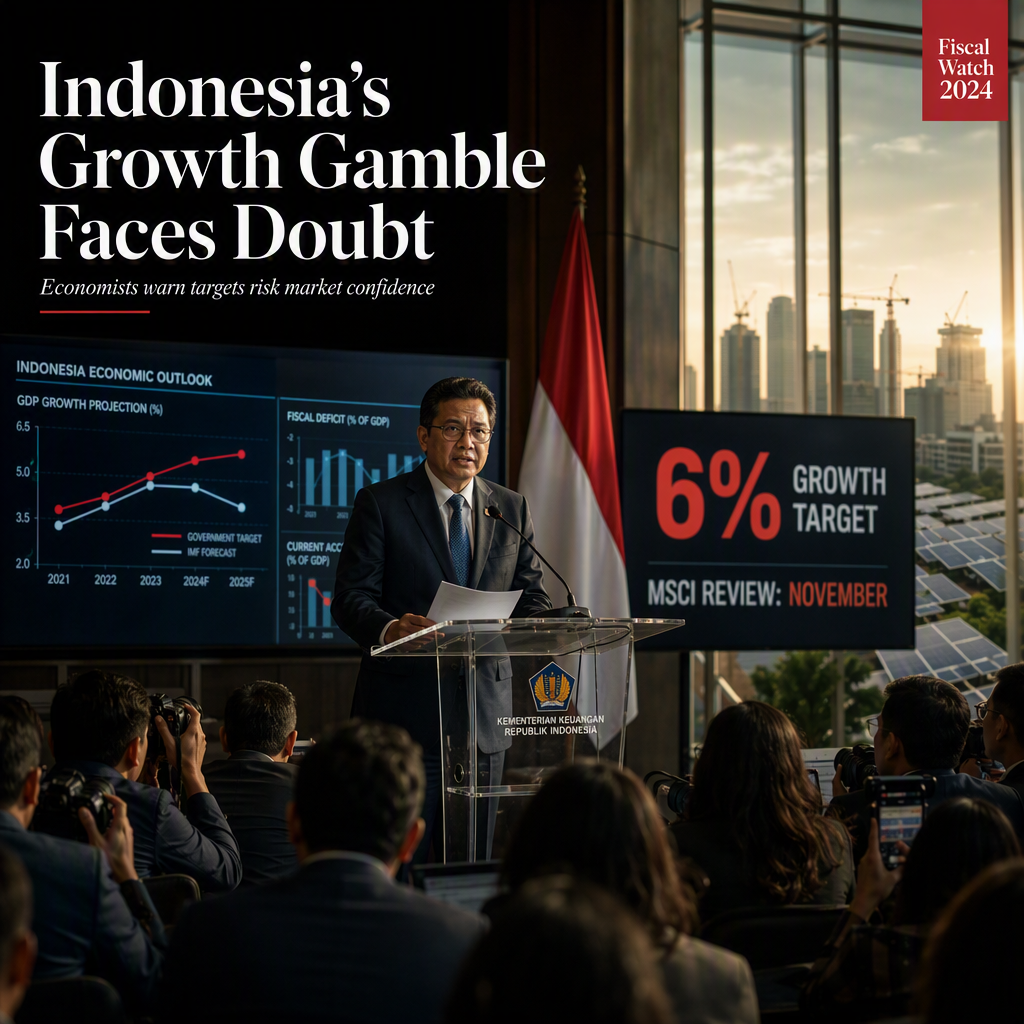
Indonesia has set an ambitious target to achieve 6% economic growth in 2027 while maintaining a fiscal deficit at 2.4% of GDP, below the statutory ceiling of 3% [1]. This plan, championed by President Prabowo Subianto, aims to accelerate from Indonesia's decade-long average growth rate of roughly 5% and includes eight budget priorities such as food and energy self-sufficiency [1]. However, economists have expressed skepticism about the feasibility of these goals, citing concerns over fiscal outlays and the risk of a downgrade by MSCI, which has extended its review of Indonesia's market status until November [1].
Ashok Bhundia, deputy chief economist at the Institute of International Finance, stated that achieving 6% growth would likely require "an unanticipated commodity boom" to boost exports, revenues, and investment, and described the targets as "overly ambitious on timelines" [1]. Gareth Leather, senior Asia economist at Capital Economics, noted that while fiscal stimulus could lift growth, the proposed budget shows little appetite for loosening, and monetary easing could provide a short-term boost but risks undermining Bank Indonesia's independence, which is crucial for the country's credibility [1].
Yanuar Rizky, senior economist at the Bright Institute, criticized the budget's assumptions as "completely unrealistic," highlighting the fragile state of purchasing power and a sharp spike in online lending, with outstanding financing in the sector growing 25.88% year-on-year in June according to Indonesia's Financial Services Authority [1]. Rizky also pointed out that relying on tax revenues would be difficult given depleted savings and high-interest debt, and that China's economic slowdown would negatively impact Indonesia's exports [1].
Despite these challenges, economists suggested that investment-led reforms, particularly in solar energy and infrastructure, could provide a pathway to faster growth. Bhundia described solar investment as "encouraging" with a potential multiplier effect on long-term growth, while Leather advocated for a focus on supply-side measures to attract foreign investment [1].
CONCLUSION
Indonesia's ambitious growth and deficit targets are viewed by economists as overly optimistic given current fiscal, monetary, and external challenges. The risk of an MSCI downgrade and concerns about central bank independence add to market uncertainty. Investment-led reforms and supply-side measures are seen as more realistic avenues for sustainable growth.