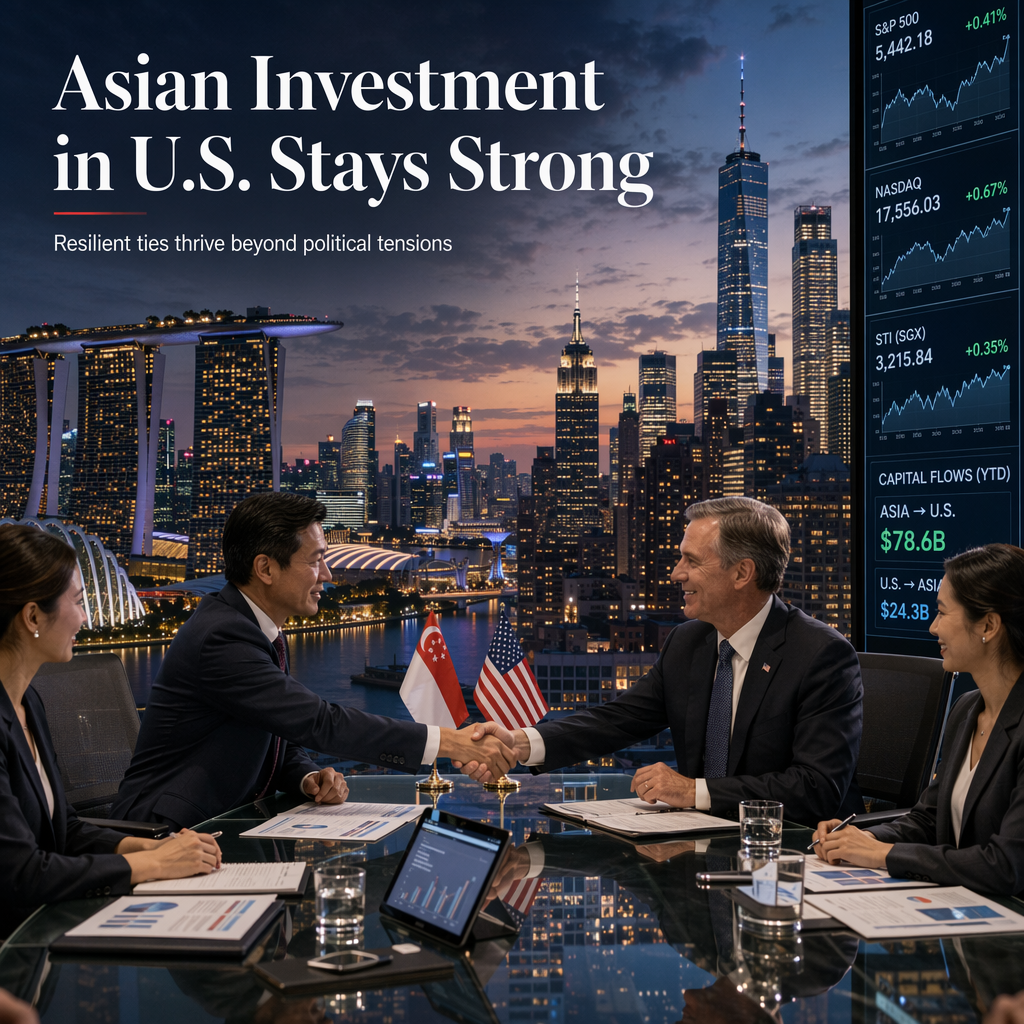
Despite the Trump administration's combative trade rhetoric and policies, Asian investors continue to favor exposure to the U.S. market, according to Eric Cantor, vice chairman of Moelis & Company [1]. Cantor stated that investors from Southeast Asia, North Asia, Japan, and Korea remain eager to invest in the United States, citing the country's adherence to the rule of law and the protection of investor rights as key attractions [1]. He noted that the opacity of the Chinese business environment makes the U.S. a more appealing destination for Asian capital [1].
In Singapore specifically, Cantor observed that investors are focused on maintaining open dialogue with the Trump administration and are largely able to look past political rhetoric from Washington [1]. Singapore, despite running a trade deficit with the U.S., was still subject to baseline tariffs under the Trump administration. Nevertheless, the city-state maintains a strong affinity for the U.S., which is reflected in the significant American investment presence: Deputy Prime Minister Gan Kim Yong stated in 2025 that the U.S. is Singapore's largest foreign investor, with around 6,000 American companies operating there and U.S. investment nearly doubling from 292 billion Singapore dollars in 2018 to 574 billion Singapore dollars in 2022 [1].
Cantor also addressed the broader U.S.-China trade relationship, highlighting that trade remains central from Washington's perspective, especially in light of U.S. export restrictions on advanced AI chips to China [1]. Treasury Secretary Scott Bessent emphasized the importance of national economic capacity, stating that economic security is rooted in a nation's ability to produce what it needs [1]. Cantor linked this sentiment to lessons learned during the Covid pandemic, which exposed vulnerabilities in U.S. supply chains and prompted a reassessment of reliance on China and other foreign suppliers for critical goods such as high-performance chips and rare earths [1].
CONCLUSION
Asian investors remain committed to U.S. markets despite ongoing trade tensions and protectionist rhetoric from the Trump administration. The U.S.' legal protections and transparent business environment continue to attract significant capital from the region, particularly from Singapore. Ongoing supply chain concerns and U.S.-China trade dynamics are prompting further scrutiny of cross-border investments and dependencies.