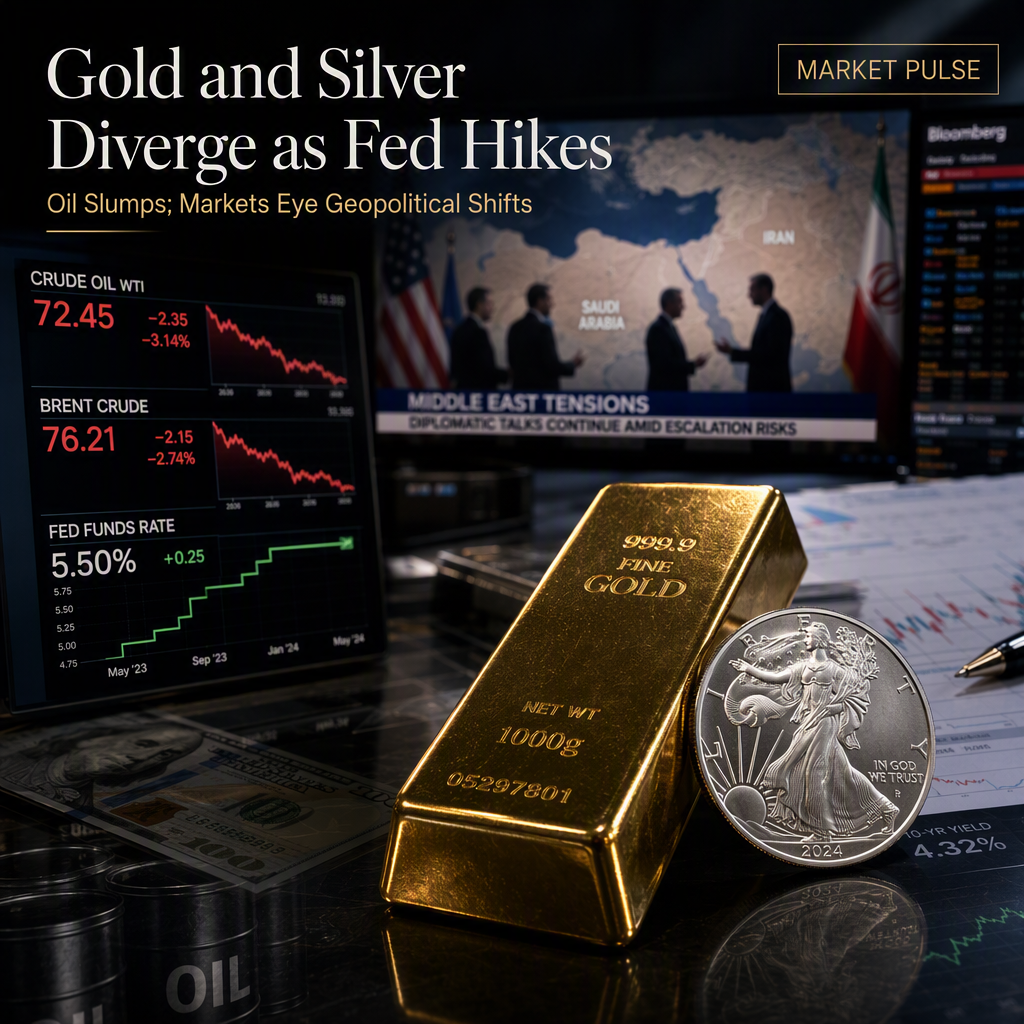
Gold (XAU/USD) and Silver (XAG/USD) began the week with divergent moves following the Federal Reserve's recent 25 basis point interest rate hike, the first since 2023, as well as ongoing geopolitical developments and a decline in Oil prices [1][2][3]. Silver gained 0.37% on Monday, trading around $66.50, supported by falling Oil prices and easing inflationary concerns, despite a stable US Dollar Index (DXY) at approximately 100.25 [1]. In contrast, Gold edged lower, trading near $4,350 and down nearly 0.60% on the day, as expectations of further Fed rate hikes and a firmer US Dollar weighed on the metal [3]. ING’s commodities team noted that higher rates remain a headwind for Gold, but ETF holdings at six-month highs and ongoing central bank buying should cushion downside risks [2].
Oil prices declined, with West Texas Intermediate (WTI) trading around $93.50, its lowest level in more than a week and on track for a fourth consecutive daily drop [3]. The decrease in Oil prices was attributed to diplomatic efforts in the Middle East, including US President Donald Trump's openness to meeting Iranian President Masoud Pezeshkian at the United Nations General Assembly, and improving energy flows from Saudi Arabia [1][3]. Iranian security official Mohsen Rezaei stated that Tehran has conveyed its conditions to the US through international mediators, but warned of a strong response to any further US attacks. Fighting between Iran-backed Houthis and Saudi forces continues to keep geopolitical risks elevated [1][3].
The Federal Reserve's policy outlook remains a central driver for precious metals. Fed official Goolsbee delivered a hawkish message, emphasizing optimism about returning to 2% inflation only if demand does not overheat, and asserting readiness to tighten policy if necessary [1]. The FXS Fed Sentiment Index slipped by 1.07 points to 149.54, indicating a modest pullback in perceived hawkishness, though the overall stance remains firmly above neutral [1]. Traders are pricing in a meaningful chance of another Fed rate hike in October, with the updated dot plot pointing to at least one more increase this year [3]. Higher borrowing costs typically weigh on non-yielding assets like Gold, making interest-bearing investments more attractive [3].
Looking ahead, investors will monitor preliminary S&P Global Purchasing Managers Index (PMI) data and the University of Michigan Consumer Sentiment survey for September, as well as a busy schedule of Fed speakers for further policy clues [1][3]. Technical analysis suggests Gold remains range-bound near the Bollinger middle band, with a neutral near-term bias [3]. ING expects Gold to remain range-bound due to Fed headwinds, but notes that strong ETF and central bank demand may limit downside [2].
CONCLUSION
Gold and Silver markets are reacting to the Federal Reserve's rate hike and ongoing geopolitical developments, with Silver showing modest gains and Gold facing headwinds from tighter monetary policy and a firmer US Dollar. Oil price declines have tempered losses for Gold, while strong ETF and central bank demand provide some support. The outlook remains data-dependent, with investors closely watching upcoming economic releases and Fed commentary for further direction.