
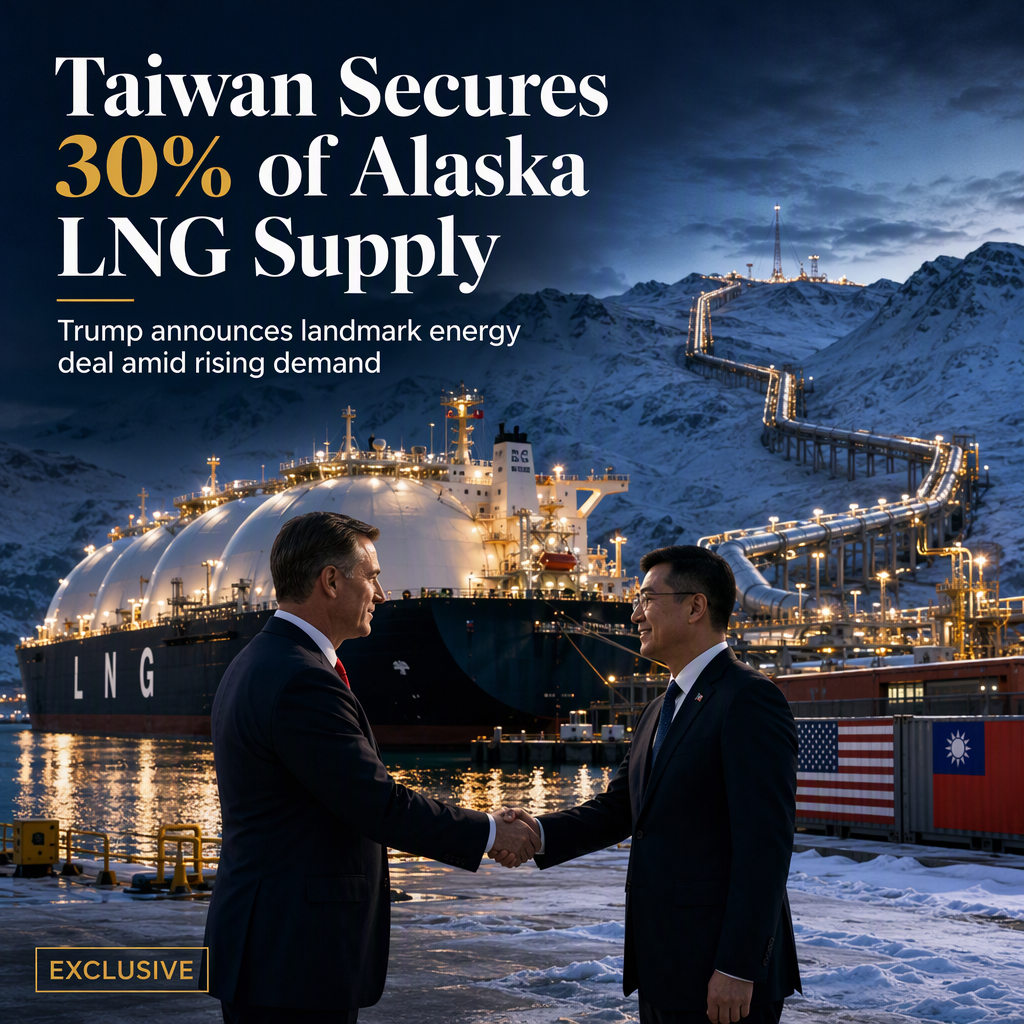
U.S. President Donald Trump announced that Taiwan has agreed to purchase 30% of the gas from the proposed Alaska liquefied natural gas (LNG) project for the next 20 years, describing the deal as a guarantee of the project's success [1]. Trump made this statement during a rally in Alaska, highlighting the significance of the agreement for both the U.S. energy sector and Taiwan's growing energy needs [1].
Trump also referenced ongoing negotiations with South Korea, claiming that the country had committed $50 billion to the Alaska LNG project, although Seoul has maintained that its participation has not been finalized [1]. Additionally, Trump stated that the U.S. would invest $4.4 billion into the project on top of the purported South Korean commitment [1].
The specific terms of the Taiwan deal remain unclear, and neither the White House, Taiwan's energy ministry, nor CPC Corp. responded to requests for comment at the time of reporting [1]. Last year, Taiwan's state-owned CPC Corp reportedly reached an agreement with Alaska Gasline Development Corp to purchase LNG and invest in the pipeline project [1]. The developer, Glenfarne, reported to the U.S. government that the Alaska LNG pipeline aims to deliver its first gas in 2029 [1].
Taiwan's energy demand is rising rapidly, driven by growth in the AI sector and the presence of major semiconductor companies like TSMC [1]. The island imports over 90% of its energy supply and projects an average electricity demand growth rate of about 2.5% per year through 2035, which would be the second-highest in its history and outpace Japan and South Korea [1].
CONCLUSION
Taiwan's agreement to purchase a significant portion of gas from the Alaska LNG project marks a major development for both U.S. energy exports and Taiwan's energy security. While the deal's precise terms remain undisclosed, the announcement signals strong demand growth in Taiwan and potential momentum for the Alaska LNG project.