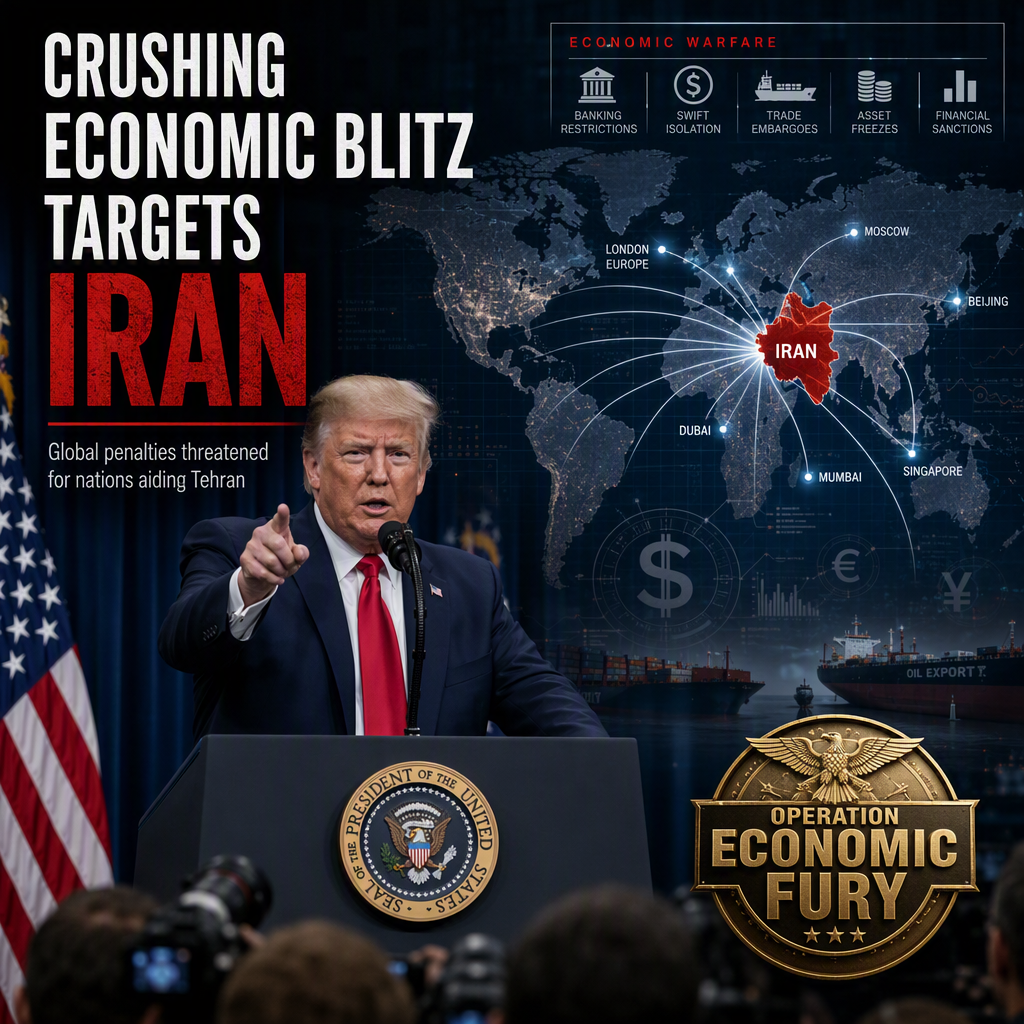
US President Donald Trump announced what he described as the 'most crushing economic operation ever taken against any country' targeting Iran, with the aim of imposing unprecedented economic conflict and isolation. Trump warned that any nation providing financial aid or support to Iran—including through financial institutions, businesses, airports, or government entities—will face 'tremendous economic consequences' [1][2][3]. Specific channels cited for immediate shutdown include oil smuggling, swap lines, cash transfers, exchange houses, ship registries, and front companies [1][2][3].
Trump likened the operation to an 'economic D-Day' and called for US allies to join in isolating Iran, stating these 'historic measures' would cripple Iran's ability to project terror worldwide [2]. He emphasized that Iran will never be permitted to acquire a nuclear weapon [3]. Trump also claimed that Iran's navy, air force, and military production facilities have been destroyed and its currency rendered worthless, asserting the regime is 'hanging by a thread' [3].
The announcement extends the Trump administration's pressure campaign, known as Operation Economic Fury, which began in April and aims to cut off Iran's global terror financing and revenue streams [3]. Iran's Foreign Minister Abbas Araghchi accused Washington of escalating sanctions after previous rounds failed to force Tehran into submission, calling the US approach a barrier to any negotiated exit from the conflict [3].
The escalation follows the United Arab Emirates' decision to suspend all trade and financial dealings with Tehran after two ballistic missiles reportedly targeted the UAE. Iran denied firing the missiles, labeling the claim a 'false flag' [1][3].
Market reaction was muted, with West Texas Intermediate (WTI) crude oil up 0.02% at $85.28 [1], and S&P 500 futures gaining less than 0.1% after the announcement [3].
CONCLUSION
President Trump's announcement marks a significant escalation in economic pressure on Iran, with threats of severe penalties for any nation aiding Tehran. While the immediate market reaction was limited, the move signals heightened geopolitical risk and continued uncertainty for global trade and energy markets.