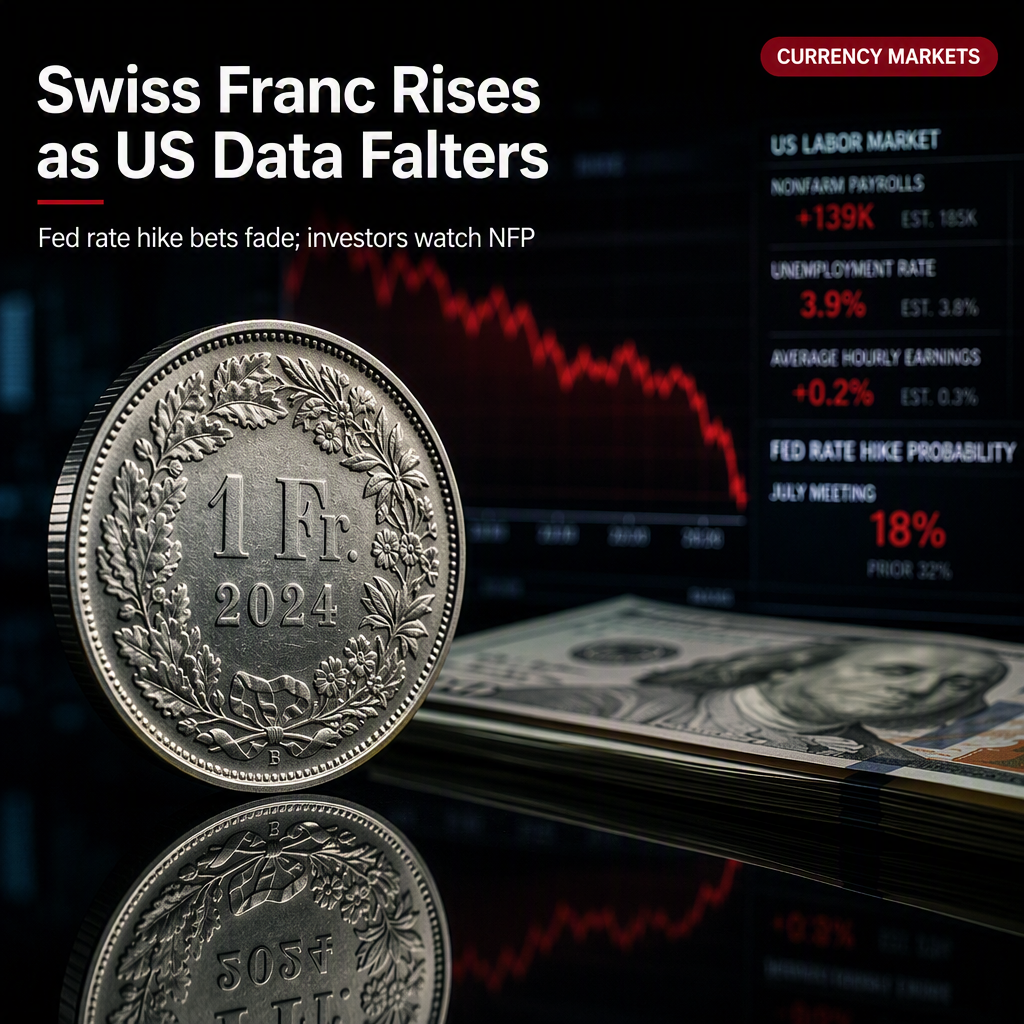
The Swiss Franc (CHF) appreciated against the US Dollar (USD) on Wednesday, driven by disappointing US economic data and a reduction in market expectations for further Federal Reserve (Fed) interest rate hikes this year. At the time of reporting, the USD/CHF pair traded around 0.8078, marking a decline of nearly 0.18% on the day [1].
Key US data releases included the ADP Employment Change, which rose by 44,000 in July—well below the expected 70,000 and a significant slowdown from June's 98,000. Additionally, the ISM Services Purchasing Managers Index (PMI) edged up slightly to 54.1 from 54, but still missed the market forecast of 54.5 [1]. These weaker-than-expected figures contributed to a softer US Dollar as traders reassessed the likelihood of further Fed tightening.
Market-based expectations for a September Fed rate hike have diminished, with the CME FedWatch Tool indicating a 56% probability, down from 67% just a day earlier. This shift reflects growing doubts about the strength of the US labor market and the Fed's willingness to raise rates further in the current environment. Investors are now looking ahead to Friday’s Nonfarm Payrolls (NFP) report for additional guidance on the Fed’s next moves [1].
On the Swiss side, inflation remains subdued, with the Consumer Price Index (CPI) rising 0.4% year-over-year in July, down from 0.5% previously. This keeps inflation near the lower end of the Swiss National Bank’s (SNB) 0%-2% price stability range and reinforces expectations that the SNB will maintain its policy rate at zero [1].
Geopolitical developments also played a role, as hopes for the reopening of the Strait of Hormuz pressured oil prices. Iran and Oman have reportedly reached an understanding on a proposed shipping route, but an informed source noted that a final agreement—and the fulfillment of US commitments—would still be required before the Strait could reopen, maintaining a degree of market uncertainty [1].
CONCLUSION
Weaker US economic data and easing Fed rate hike expectations have strengthened the Swiss Franc against the US Dollar. With Swiss inflation subdued and geopolitical uncertainties lingering, markets remain cautious and are closely watching upcoming US labor data for further direction.