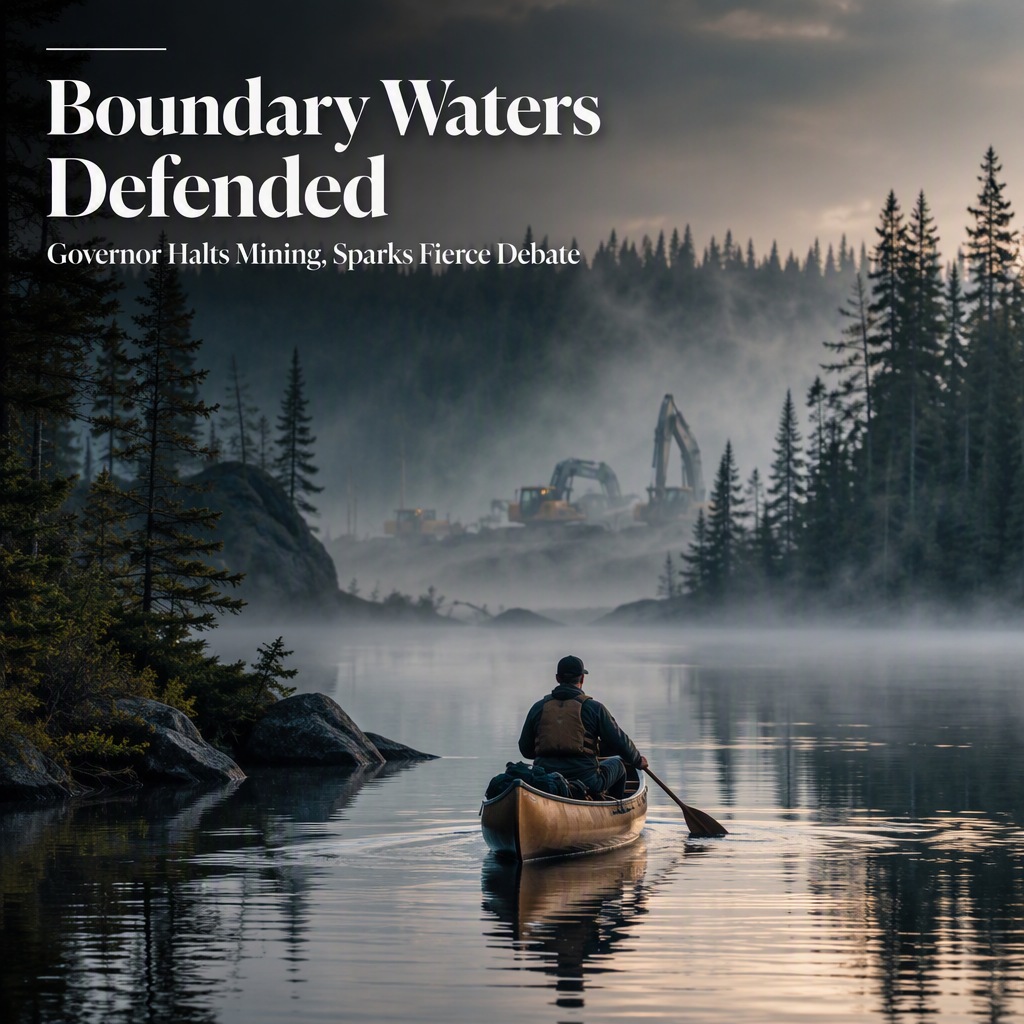
Minnesota Governor Tim Walz issued an executive order on Tuesday blocking mining permits and leases near the Boundary Waters Canoe Area Wilderness in northeast Minnesota, a region under significant federal jurisdiction. This action directly opposes President Donald Trump's recent signing of legislation in April that reversed a previous ban on new mining leases near the Boundary Waters, which had been implemented during the Biden administration for a period of 20 years [1].
The order specifically targets the mining of critical minerals such as copper and nickel, which are essential for manufacturing boat components, electric vehicle parts, military equipment, and commercial electronics. Northeastern Minnesota's Duluth Complex is noted as the largest known untapped source of nickel and copper in North America [1].
House Majority Whip Tom Emmer, R-Minn., criticized Walz's decision, labeling it as "stupid" and "dangerous." Emmer argued that the order would harm Minnesota's economy, particularly union jobs in northern Minnesota, and increase U.S. dependence on adversaries like China for critical minerals, thereby posing a risk to national defense [1]. The legislation to reverse the mining ban was led by Rep. Pete Stauber, R-Minn. [1].
Environmental groups, however, praised Walz's executive order. Ingrid Lyons, executive director of Save The Boundary Waters, stated that the federal government had previously "sold out our canoe country" by removing protections, and commended Walz for taking action to prevent toxic copper mining in the region. Lyons also called on the state legislature to enact permanent protections [1]. Emmer dismissed the environmental concerns as a "false argument," emphasizing that all parties care about environmental stewardship [1].
The market implications center on the restriction of access to significant domestic sources of copper and nickel, which could affect supply chains for industries reliant on these minerals. The debate highlights a divide between economic and environmental priorities, with potential long-term impacts on U.S. mineral independence and job creation in the region [1].
CONCLUSION
Governor Walz's executive order halts critical mineral mining near the Boundary Waters, reversing recent federal policy changes and sparking political and economic debate. The move is seen as a win by environmental groups but criticized by some lawmakers for potentially increasing U.S. reliance on foreign minerals and impacting local jobs. The decision introduces uncertainty for the mining sector and related industries in Minnesota.