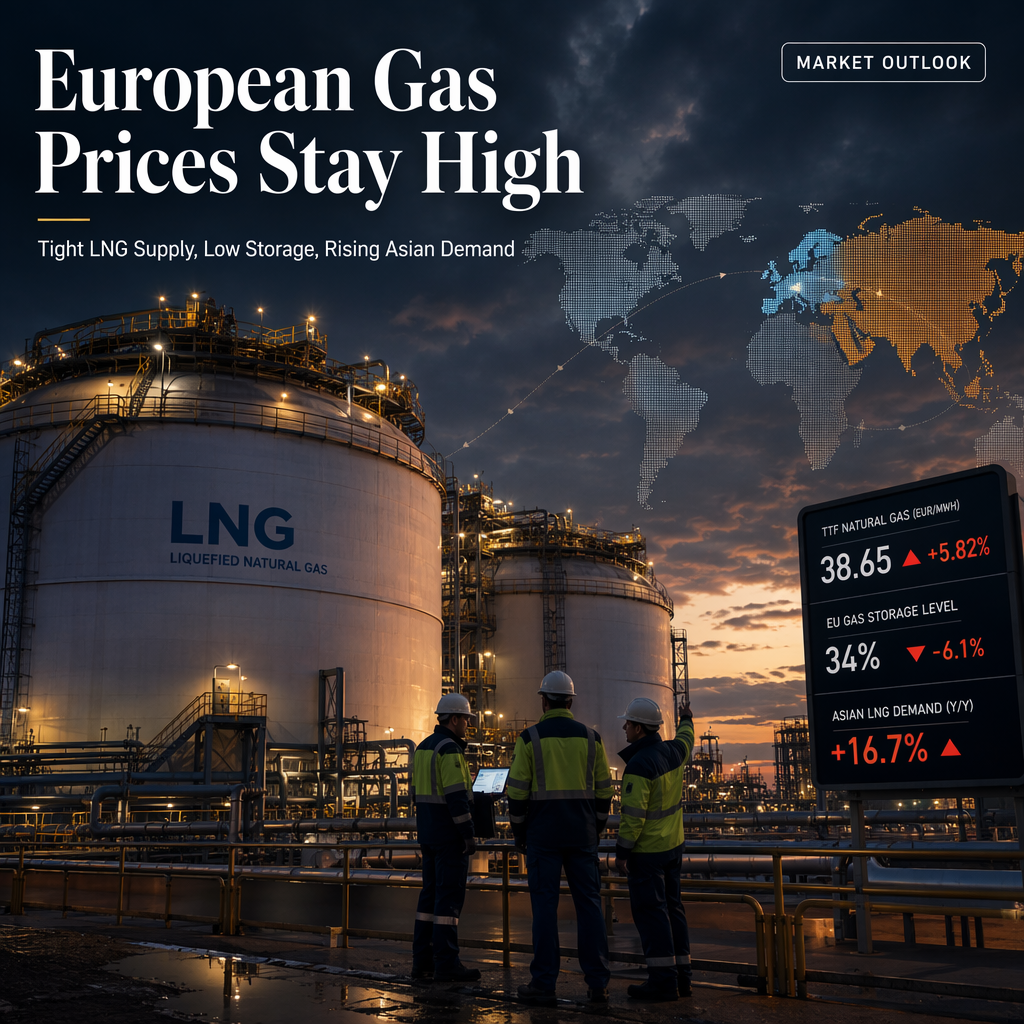
European gas prices are expected to stay high in the near term due to a combination of tight LNG supply, low storage levels, and increased Asian demand, according to Norman Liebke at Commerzbank [1]. Even if the Strait of Hormuz reopens and remains accessible, Commerzbank does not anticipate a return to pre-war price levels for European gas in the immediate future [1].
Several factors are contributing to the current tightness in the market. War damage to Qatar’s LNG infrastructure has reduced supply, while European gas storage levels are currently at approximately 52%, which is nearly 15 percentage points below the five-year average [1]. This low storage situation is expected to keep demand for gas high as Europe seeks to refill its reserves in the coming months [1].
If storage levels follow the typical daily changes observed over the past five years, they are projected to peak at only 75% by the end of October, which would be the lowest level since 2009 and slightly below the 77% reached at the end of October 2021 [1]. Additionally, the El Niño weather phenomenon is expected to trigger extreme weather events in Asia, leading to increased electricity demand and, consequently, higher demand for gas-fired power generation. This is likely to further support elevated gas prices in Europe as Asian LNG demand strengthens [1].
Commerzbank notes that relief in the European gas market is only expected in the longer term, as the United States and Qatar expand their export capacities [1].
CONCLUSION
European gas prices are likely to remain elevated in the near term due to tight LNG supply, low storage levels, and rising Asian demand. Market relief is not expected until new export capacities come online, suggesting continued price pressure for the foreseeable future.